
Why Do I Feel Off?
Perhaps you nurture an overall well-balanced lifestyle and consider yourself healthy—conscious about what you eat, how you exercise, and the types of relationships you maintain. Perhaps sometimes, though, you feel off without a clear reason.You might feel aches and pains that you cannot explain. Your joints feel stiffer than usual, you wake up with headaches that normally are not there, experience a little heartburn after eating certain foods, your muscles feel sore without physical activity, or your immune system seems off-guard.
Homeostasis–The Body’s Basic Requirement
Human metabolism has three major jobs:

One key requirement for the metabolic system to perform these jobs well is acid-base homeostasis—meaning that the pH level in all extracellular fluids (those outside of the cells) stays between 7.35 and 7.45. This pH balance is critical to overall health.
pH Balance Critical for Health
Our daily food consumption both produces and consumes acids (ions that can donate a proton). However, the food choices we make determine the quantity of acid production (dietary acid load), which in turn influences the body’s pH balance.- Digestive system
- Respiratory system
- Eliminatory system
- Muscular/skeletal system
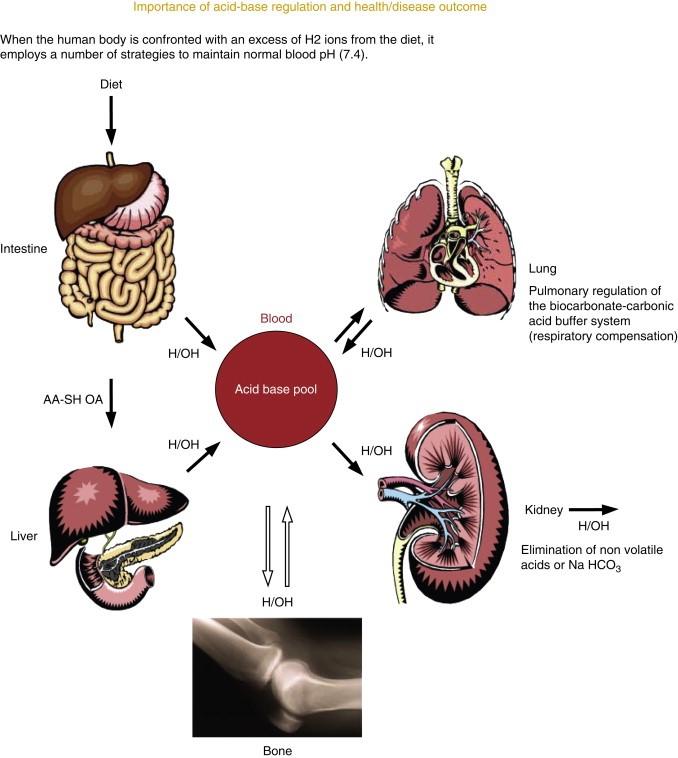
Ailments Caused by Acid Imbalance
Disturbances in the acid-base balance can cause many health issues. A 2024 review in Pflugers Archiv of the European Journal of Physiology relates a high dietary acid load among those who live in the West to the high intake of processed food and animal protein.The researchers recommend an adjustment of people’s diets to lower their dietary acid loads, therefore preventing “a chronic low-grade metabolic acidosis,” which “is associated with increased morbidity and mortality.”
Damage to Connective Tissue–A Disposal Site for Surplus Acids
Connective tissue has multiple jobs—one of which is to transport nutrients and waste. Blood and lymph, as well as cartilage and bone, are all considered specialized connective tissues.To save other organs from harm, connective tissue is the first responder to high dietary acid loads and works tirelessly to reduce toxins in our bodies.
Organ Damage
A large cross-sectional study published in the journal Risk Management and Healthcare Policy enrolled 18,855 participants from the National Health and Nutrition Examination Survey 1999–2018. Researchers concluded that there was a link between dietary acid loads and nonalcoholic fatty liver disease.Furthermore, high acid loads can lead to chronic metabolic acidosis, which in turn “has been documented to be closely involved in the development of a range of diseases, including CVD [cardiovascular disease], hypertension, diabetes, chronic kidney disease, bone-related disorders, and cancers,” the study stated.
The same academic journal featured a study published in 2019 in which researchers were able to show, for the first time, a connection between high dietary acid loads and asthma in overweight and obese children.
Cancer
A 2021 case-control study published in the journal Cancer Treatment and Research Communications observed the acid-base balance in relation to lung cancer development in men. In the study, 843 lung cancer patients were given a multitopic questionnaire, including questions about their food intake. The research revealed a direct association between dietary acid loads and heightened inflammation and an increased risk of lung cancer.Cardio-Metabolic Diseases
Cardio-metabolic diseases, such as hypertension, atherosclerosis, and Type-2 diabetes, are also present on the long list of negative health effects caused by high acidity in the body.Diabetes and Hypertension
A 2022 study published in the journal Current Aging Science examined the relationship between metabolic acidosis and the development of insulin resistance, hypertension, and other cardiometabolic disorders.The researchers analyzed the potential renal acid load (PRAL) and “net endogenous acid production” of 114 elderly participants over three days, including a breakdown of their 24-hour dietary records.
The research found that dietary choices significantly affected cardiometabolic diseases. Participants already suffering from hypertension and diabetes showed a much greater acid-forming potential, which in turn is a risk factor for these illnesses.
Insulin Resistance
A link between insulin resistance and dietary acid load was identified in a 2022 Latin American population-based study published in the journal Clinical Nutrition. Samples of 545 individuals between the ages of 25 to 64 were examined. The study determined that high levels of dietary acid were consistently associated with higher insulin resistance.Obesity
According to the American Heart Association, the incidence of cardiometabolic diseases rooted in poor lifestyle choices has been increasing over the past decades. Currently, they are among the leading causes of morbidity.Mental Health
A German study published in 2018 in the journal Nutrients explored, for possibly the first time, a potential correlation between high dietary acid loads and mental/emotional problems, including hyperactivity and peer problems in children.Acid-Associated Health or Illness
Another 2018 article in the Mexican journal Nefrologia confirmed in detail the connection between a high acid load, an imbalanced pH homeostasis, and chronic diseases. Researchers concluded that nutritional intervention and the reduction of dietary acid load may improve one’s health.In addition, the 2024 Pflugers Archiv review explains the dietary acid load and its extensive implications. It also provides a valuable graphic to visualize the topic’s far-reaching interrelations.
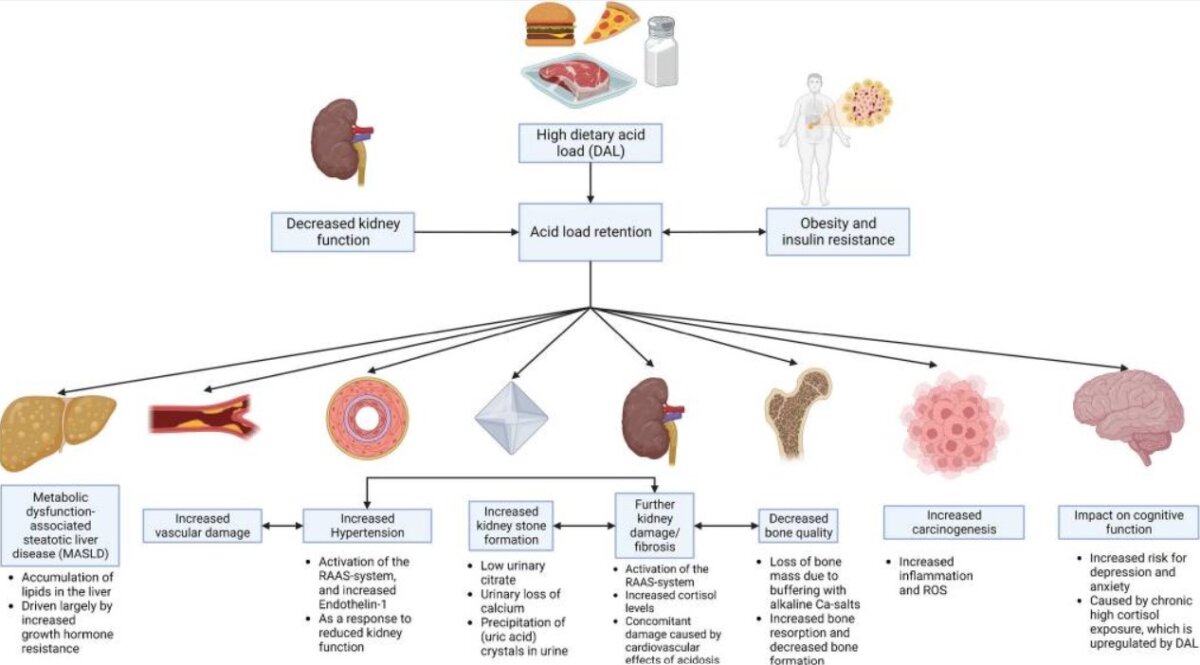
Summary of the consequences of a high dietary acid load (DAL). Pflugers Arch. 2024; 476(4): 427–443. CC by 4.0
According to the review, it’s hard to measure dietary acid load precisely. A complex evaluation of stool and urine samples, as well as the concurrent food consumption, is needed. However, the assessment of urinary pH and ammonium is another method that is being used to gauge the DAL.Where Do Acids Come From?
Acids come from dietary chlorides, phosphates, sulfates, sulfurous amino acids from dietary proteins, and biological acids (breathable and non-breathable).Often, they are vital to our bodies and play key roles. Chlorides, for example, channel water and other nutrients into and out of our cells and help balance bodily fluids, which regulate blood pressure and pH. They assist the muscles to contract and support nerve cells in carrying messages. The mineral also exchanges oxygen and carbon dioxide and aids in the digestion process.
Reducing Your Dietary Acid Load
The evidence shows that high acidity causes illness.If you are interested in discovering more about various dietary and lifestyle ways to treat hyperacidity and the toxification that comes with it, watch for an upcoming article on the topic, which will include how to home-test for acidity and other helpful dietary information.