People diagnosed with medical conditions face a higher risk of major depressive disorder, especially in the critical months after diagnosis.
“A diagnosis can disrupt everything—your sense of identity, your sense of safety, and even who you thought you’d be in the future. It can feel like grief, like mourning the version of you that existed before,” Dr. Sulagna Misra, an integrative medicine doctor, told The Epoch Times.
Disease Predicts Mental Health
A large-scale, population-based Danish study tracking more than 6.5 million people from 1995 to 2022 explored the connection between physical illness and depression. Researchers focused on different medical conditions, including heart disease, cancer, and musculoskeletal disorders, and monitored whether those affected later developed major depressive disorder.They found that those with a medical condition were more than twice as likely to experience depression compared with those without one. Musculoskeletal conditions showed the strongest link to depression, while endocrine issues, such as thyroid problems, showed the weakest.
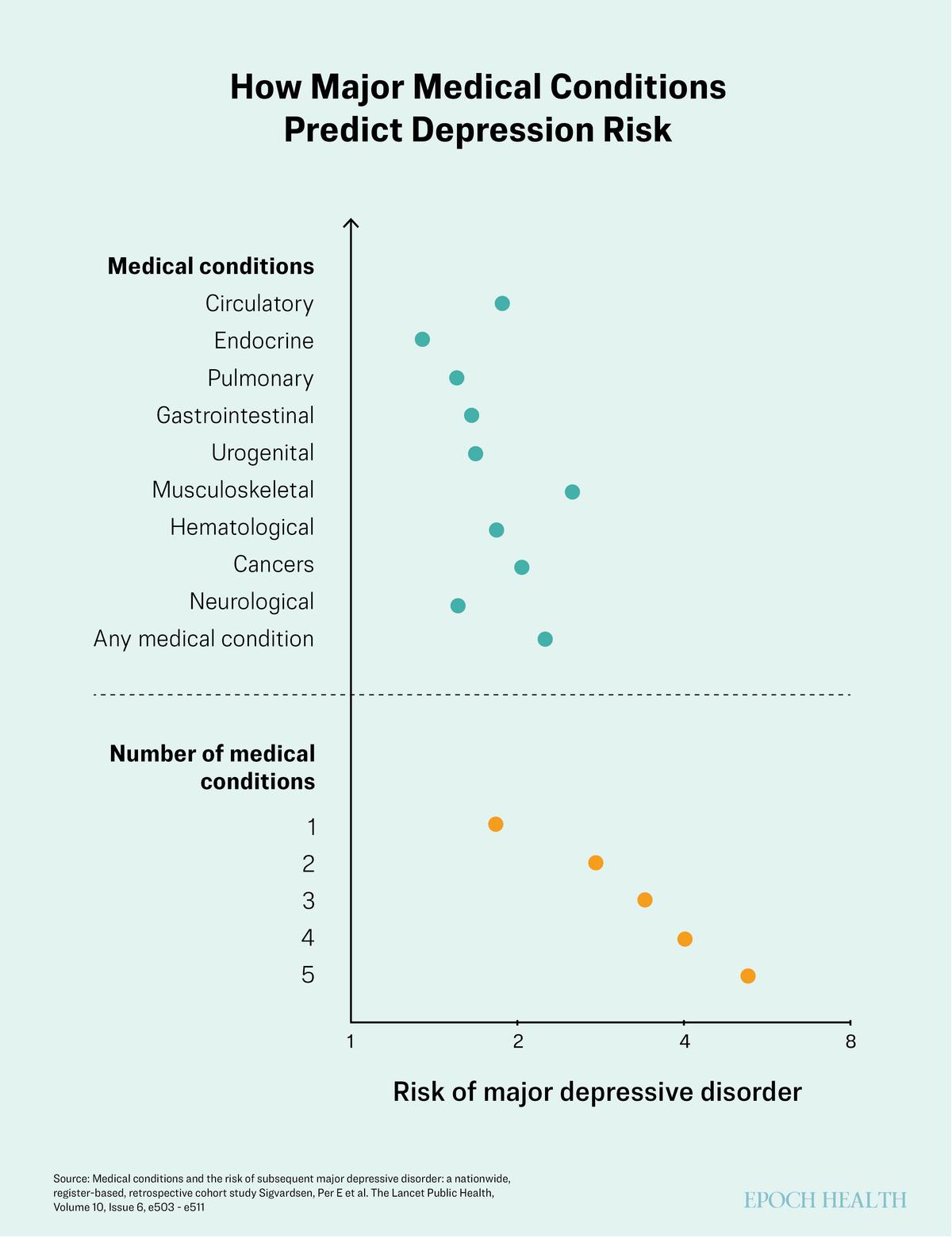
“In our clinic, patients with post-COVID-19 syndrome and ME/CFS [myalgic encephalomyelitis/chronic fatigue syndrome] are more than four times as likely to develop depression compared to the general population,” Dr. Caroline Gibson, a lifestyle medicine physician, told The Epoch Times.
ME/CFS often involves musculoskeletal symptoms such as muscle pain, joint pain, and stiffness.


Several factors may explain the connection between medical conditions and depression.
Biologically, many medical conditions—particularly those that affect the brain, hormonal balance, gut microbiome, or have an inflammatory component—may directly influence mood, increasing the risk of depression, Gibson said.
The psychological effect of receiving a diagnosis, especially one that is perceived as overwhelming or threatening to a person’s identity, can lead to feelings of helplessness, loss of control, or isolation. Uncertainty about the future and fear of treatment or worsening health can contribute to anxiety and depressive symptoms, she said.
‘It’s OK Not to Be OK’
Understanding the increased risk of depression following a medical diagnosis, health systems have a crucial opportunity to better support patients, especially during those vulnerable early months.“The key is communication, first and foremost,” Misra said.
She noted that follow-up care should go beyond lab tests to include emotional support, such as mental health services, routine check-ins, and easy access to therapy or support groups.
“It shouldn’t take a breakdown for a system to respond,” Misra said.
Gibson suggested using holistic care—bringing together doctors, nurses, psychologists, and therapists—to treat chronic conditions. This allows for a “joined-up” approach, which is impactful for patients.
She said she also prioritizes creating a safe space where patients feel heard and understood. Reassure them that their emotions, such as fear, anger, or sadness, are normal, she said.
Gibson said that many patients feel guilty for struggling and believe that they should be able to cope on their own.
“It is important that people know that it is OK not to be OK,” she said.
In addition, paraphrasing the patient’s feelings can be very powerful. It helps them feel validated.
Misra emphasized the importance of regularly checking in with patients, especially those struggling to get out of bed.
Lifestyle Changes
Small lifestyle shifts can give patients a sense of agency and relief.One of the most overlooked yet impactful tools is sleep. Disrupted sleep is both a symptom and a driver of depression.
“Even a simple bedtime routine can help quiet a chaotic mind,” Misra said.
And rest isn’t just sleep. Creative play, sensory breaks, time in nature, or rituals such as morning tea or evening journaling can all offer a meaningful pause, Misra said.
Building or maintaining a strong support system, whether through family, friends, or peer groups, can serve patients well. Social isolation is a major risk factor for depression, but connection can shift everything, Gibson said.
Misra said she also encourages patients to notice who makes them feel safe and grounded.
“Some people show up differently when you’re sick. Lean into those who bring peace,” she said.
Diet can be another therapeutic tool. Whole-food diets rich in omega-3 fatty acids, antioxidants, and whole grains can help manage inflammation and oxidative stress, both linked to depression. Mediterranean-style eating patterns, in particular, have been associated with lower rates of depressive symptoms, Gibson said.
Mindfulness-based practices such as meditation, breathwork, or body scans can also help patients manage uncertainty and emotional distress.
“Mindfulness encourages us to meet a new reality with more acceptance,” Gibson said.
That mindset, paired with lifestyle medicine principles, can offer a framework for supporting both body and mind after a diagnosis, she said.
“And remember, doctors feel this, too. Giving a hard diagnosis isn’t clinical—it’s personal. We celebrate when you heal, and we ache when you’re hurting,” Misra said.
She said that doctors also carry the emotional weight—sometimes privately and sometimes after the patient has left—but it’s important to remember that this challenging moment will not last forever.
“Healing isn’t linear, and neither is grief. Take it one breath, one hour, one day at a time,” Misra said.