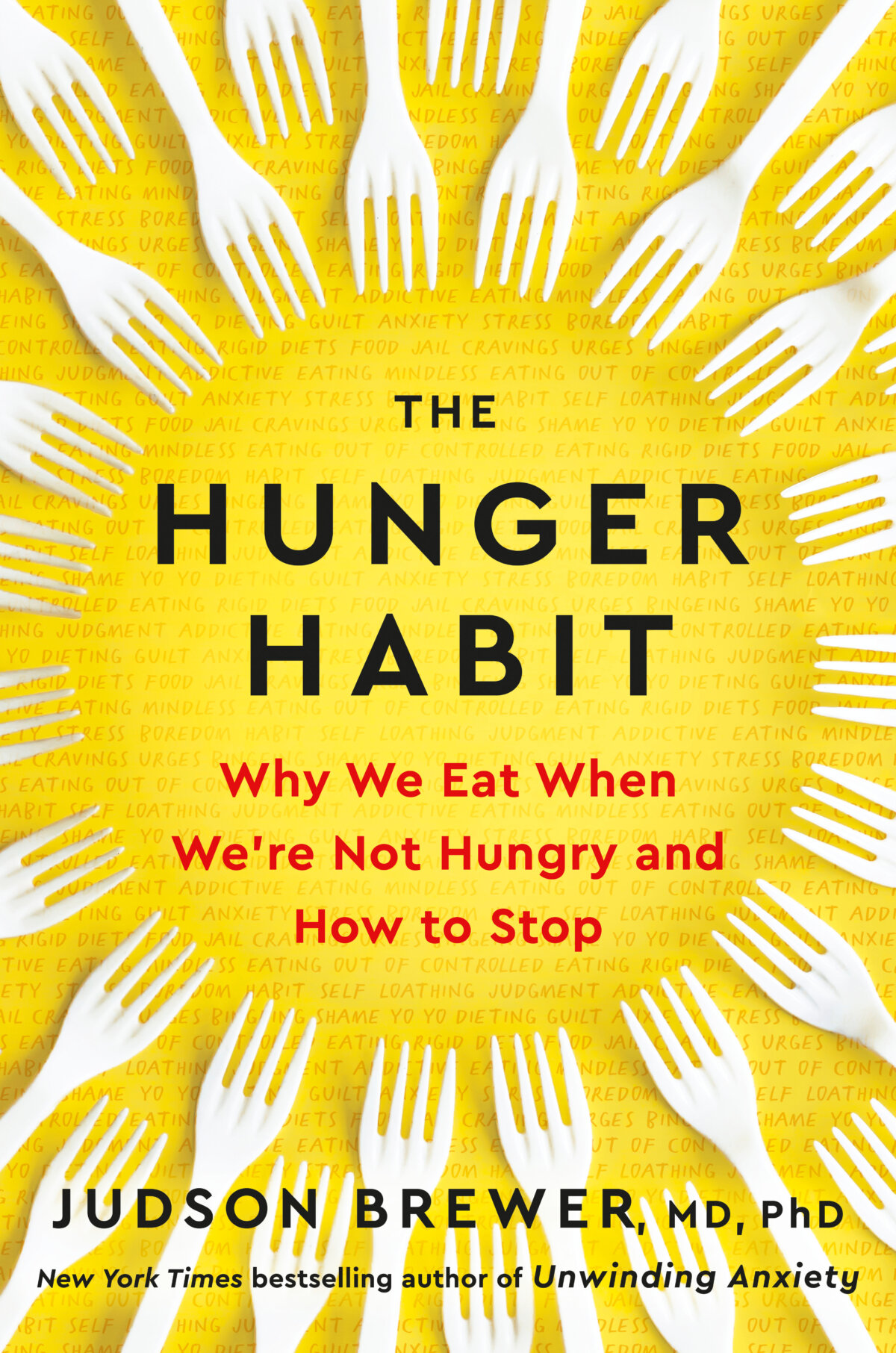
Do you have a complicated relationship with food? If so, you’re not alone, according to Dr. Judson Brewer’s book, “The Hunger Habit: Why We Eat When We’re Not Hungry and How to Stop.” Brewer, an addiction psychiatrist and neuroscientist, said he has seen as many different ways to have a bad relationship with food as he has patients.
Brewer told The Epoch Times that he wrote “The Hunger Habit” to address why we form bad eating habits and to help readers break them using a 21-day plan.
If we can understand what’s going on in our brains when we “can’t stop eating,” we can stop feeling guilty and frustrated about our inability to stick to a diet plan, he said.
“The Hunger Habit” zeroes in on “habit loops” that keep us trapped in what he calls “food jail,” unable to break free from eating for the wrong reasons.
How Food Habits Form
“We form all sorts of associations with food by learning to eat for celebration, connecting with others, consoling ourselves when we are sad, or simply eating as something to do when we’re bored,” Brewer said.

The sheer abundance of food in modern society contributes to the problem.
“If food isn’t around, we can’t make these associations,” Brewer said. More importantly, processed food is “engineered to be addictive.”
It’s very difficult to eat the way we know we “should,” he said, because “our thinking brain is not nearly as strong as our feeling body. An urge to eat is much stronger than [the thought that] we shouldn’t.”
- What you can’t have, you want more of.
- What you resist persists.
- Failure leads to backsliding.
- Willpower isn’t a good habit change strategy.
Habit Loops
Rather than relying on willpower, Brewer suggests in his book that a better strategy for breaking bad habits is to be aware of the loops that keep us repeating unhealthy behavior. He defines the elements of a habit loop as:- Trigger/cue
- Behavior
- Result/reward
When we face anxiety or emotional turmoil, we learn through using the same trigger/behavior/result sequence—that eating the ice cream will help us avoid “wallowing in our emotions.” In short, the behavior “crosses the food wires” with the mood wires in our brains, Brewer wrote.
The 21-Day Challenge
Brewer challenges those who have identified poor eating habits to “interrupt” them using awareness—“not willpower”—then to “leverage the power of the brain to step out of old and into new habits that nurture us mentally and physically.” He proposes a 21-day challenge to reset our relationship with food.
“The 21-day program is based on years of research and clinical experience,” Brewer said. “I’ve had several people report that they’ve lost more than 100 pounds and, importantly, have kept that weight off for more than five years.”
Part one of the challenge (days one through five) involves setting a “baseline” by exploring your relationship to food and eating throughout your life. The next steps are to map your food habit loops and determine the situations that prompt you to eat because of emotion and habit rather than hunger.
- Recognizing a craving is coming on and relaxing into it
- Allowing and accepting the “wave” of the craving
- Investigating or studying the craving
- Noting the physical experience the craving causes
Part three (days 17 through 21) helps readers identify new, healthy habits related to food—what Brewer calls “finding the bigger better offer” (BBO). Eating when hungry comes to feel like a BBO when it feels better than eating for the wrong reasons, he wrote. When a healthy habit is seen as a BBO, we choose it voluntarily.
In part three, we learn to become “disenchanted” with the effects of unhealthy foods on our bodies and “enchanted” with beneficial foods. An “enchantment databank” of foods that are healthy and satisfying is an important tool to develop at this point in the process, Brewer writes.
Near the end of the challenge, Brewer reminds us to be kind to ourselves and to be aware that past trauma may cause us to judge ourselves harshly.
“We are so accustomed to beating ourselves up for our unhelpful habits, we make a habit of that, too,” he writes. In short, self-kindness is a BBO rather than self-judgment, and it can make a big difference as we seek to change our lives and habits.
When we break free from unhealthy eating patterns, eating can be an “act of mindful self-care and pleasure.”