Ms. Wang had been suffering from migraines and neck stiffness for five years, and often experienced a tingling, numb pain in her glutes that felt like sciatica. Tests had ruled out nerve compression, but pain continued to recur even with an increase in painkiller doses.
Hsin Chung-yi, director of Dr. Hsin’s Herbal Clinic, found that the problem was not in the area where Wang felt the pain, but rather in the upper trapezius muscle at the junction of the neck and shoulder. He found a very sensitive “trigger point,” about the size of a peanut. With a gentle press, Wang immediately noted that her head was beginning to hurt.
On the “Health 1+1” program on NTD, a sister outlet of The Epoch Times, Hsin said that occurrences like this are not uncommon in his clinic.
Why Myofascial Pain Is ‘Pain in Disguise’
Myofascia can be thought of as a network that covers muscles, bones, organs, and nerves. Hsin said. When healthy, it allows muscles to glide smoothly; however, if the fascia is chronically tense, injured, or adhered, it can form small, sensitive nodules or trigger points. Pressing on a trigger point not only causes localized pain but may also transfer the pain to other areas.
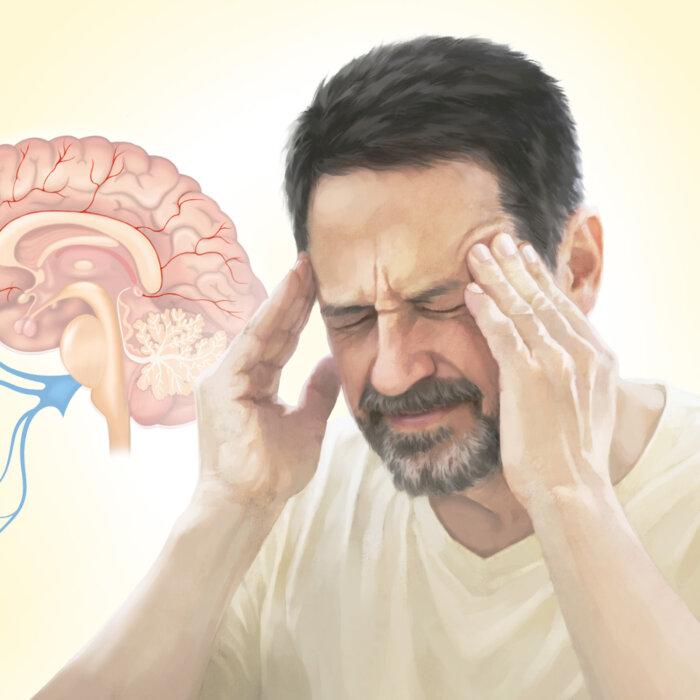
“Myofascial pain syndrome is a disease that’s good at disguising itself as something else because the pain it brings is so similar to that of other diseases,” Hsin said. Trigger points in the neck and shoulders might cause headaches, while others in the deep muscles of the buttocks might cause pain to spread to the thighs and calves, resembling sciatica.

Tenderness Upon Pressure and Spreading Pain
Since trigger points can be hidden in locations other than the pain source itself, how can we determine if we might have myofascial pain?
3 Areas to Note First
Hsin suggests that people with persistent aches and pains without an identifiable cause should first look at three common areas.
These self-observations can only serve as clues; a proper diagnosis requires evaluation by a physician or physical therapist.
Key to Treatment: Locating Trigger Points
“Treating myofascial pain is like finding a source button; you must first find the true trigger point,” Hsin said. Trigger points are like “stuck switches” in muscles. If you can accurately release these trigger points using dry acupuncture, some patients will immediately feel muscle relaxation and pain relief. Because of Hsin’s ability to find these points, some patients call him “Hsin the One-Needle.”
He once treated a middle-aged female entrepreneur who had suffered from headaches due to tension over many years. Every afternoon, her head would feel tight, as if a tight band was constricting it. Hsin found that the source of her pain was from trigger points in the deep muscles below her occipital bone.
After precise acupuncture, she reported that the “steel bar” that had been taut in her head for 10 years seemed to have snapped instantly. The acupuncture temporarily broke the cycle of muscle tension and pain, Hsin said.
Another patient experienced numbness from his inner thigh down to his feet, a symptom that had persisted for two years. He initially suspected a tumor near his groin compressing a nerve, but examinations consistently failed to pinpoint the cause.
During the examination, Hsin pressed on the adductor muscles of his inner thigh, causing the patient to immediately cry out in pain. This indicated that the real problem was not the nerves but trigger points in the muscles. After two acupuncture treatments, his symptoms significantly improved.
Preventing Recurrent Myofascial Pain
Acupuncture is not a one-time solution, Hsin said.
If you continue to spend prolonged periods with your head down, sitting for extended periods, or not getting enough sleep after treatment, trigger points may return, he said. What sustains the effects are subsequent posture adjustments, stretching, and muscle strengthening exercises. He offered the following advice for preventing recurrent myofascial pain:
He suggests raising your chair slightly and placing a small stool under your feet so they are placed firmly on the ground. Let your arms hang naturally, avoiding constant shoulder elevation, which reduces strain on the neck and shoulders.
For the most common neck and shoulder pain and tightness among office workers, Hsin suggested a stretching exercise:
When doing this exercise, you will feel a noticeable stretch on the side of your neck, helping to easily relax the tense muscle groups. Stretch until you feel a slight soreness and tightness; do not pull forcefully.
Myofascial pain is not simply about “pressing where it hurts,” Hsin said. Finding the real trigger point is only the first step. Improving posture, regular activity, stress reduction, and sufficient sleep are essential to reduce the chance of pain returning.