In 2006, Dr. Luciano Bernardi, professor of internal medicine at Italy’s University of Pavia and an enthusiastic amateur musician, designed an experiment to study the effects of music on the cardiovascular and respiratory systems of his participants.
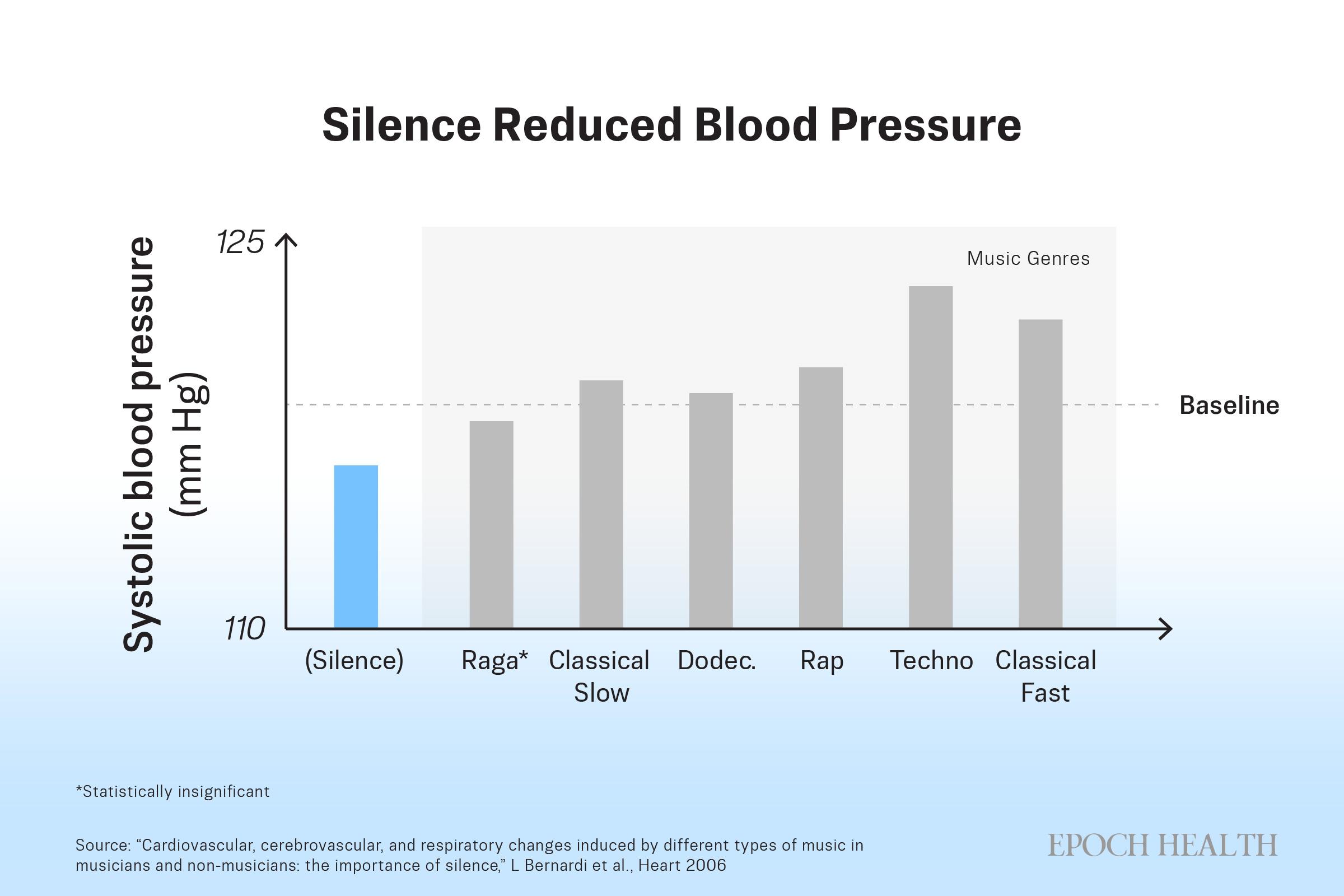
Bernardi randomly ordered six types of music and inserted two-minute “pauses” of silence to bring the subjects back to baseline—a control point for experiments. Yet contrary to his expectations, when the subjects listened to these pauses, they didn’t return to baseline at all—instead, they relaxed.
In fact, they relaxed so much more profoundly during the silent pauses than during even the slowest, most soothing pieces of music that Bernardi had to rethink the whole premise of his experiment.
“The effect was quite remarkable,” Bernardi told The Epoch Times.
He said that the pause (silence) was “much more effective than the music.”
The Body Listens
In 2006, Bernardi’s study was the most downloaded article in Heart, a peer-reviewed journal of cardiologists. While it might seem intuitive that silence would calm the body, no one had empirically demonstrated it before.

Why does silence have such profound effects? The answer lies in how our bodies respond to sound itself, both good and unwanted.
“Noise can be defined as unwanted sound,” said noise researcher Erica Walker, an assistant professor of epidemiology at the Brown University School of Public Health.
When noise travels via sound waves, it enters your eardrum, where it moves the inner ear bones, activating the cochlea, the spiral-shaped structure in the inner ear that stimulates tiny hair cells. These cells then convert vibrations into electrical signals that travel to the brain’s amygdala, releasing stress hormones.
Noise activates the same fight or flight response that you would have if you were harassed while walking down the street, Walker said. “Your body is responding with increased cardiac output. You start to sweat and release all these hormones,” she said.
On the other hand, silence, as demonstrated in Bernardi’s study, lowers heart rate and blood pressure. It’s so much so that silence “may be potentially useful in the management of cardiovascular disease,” Bernardi said.
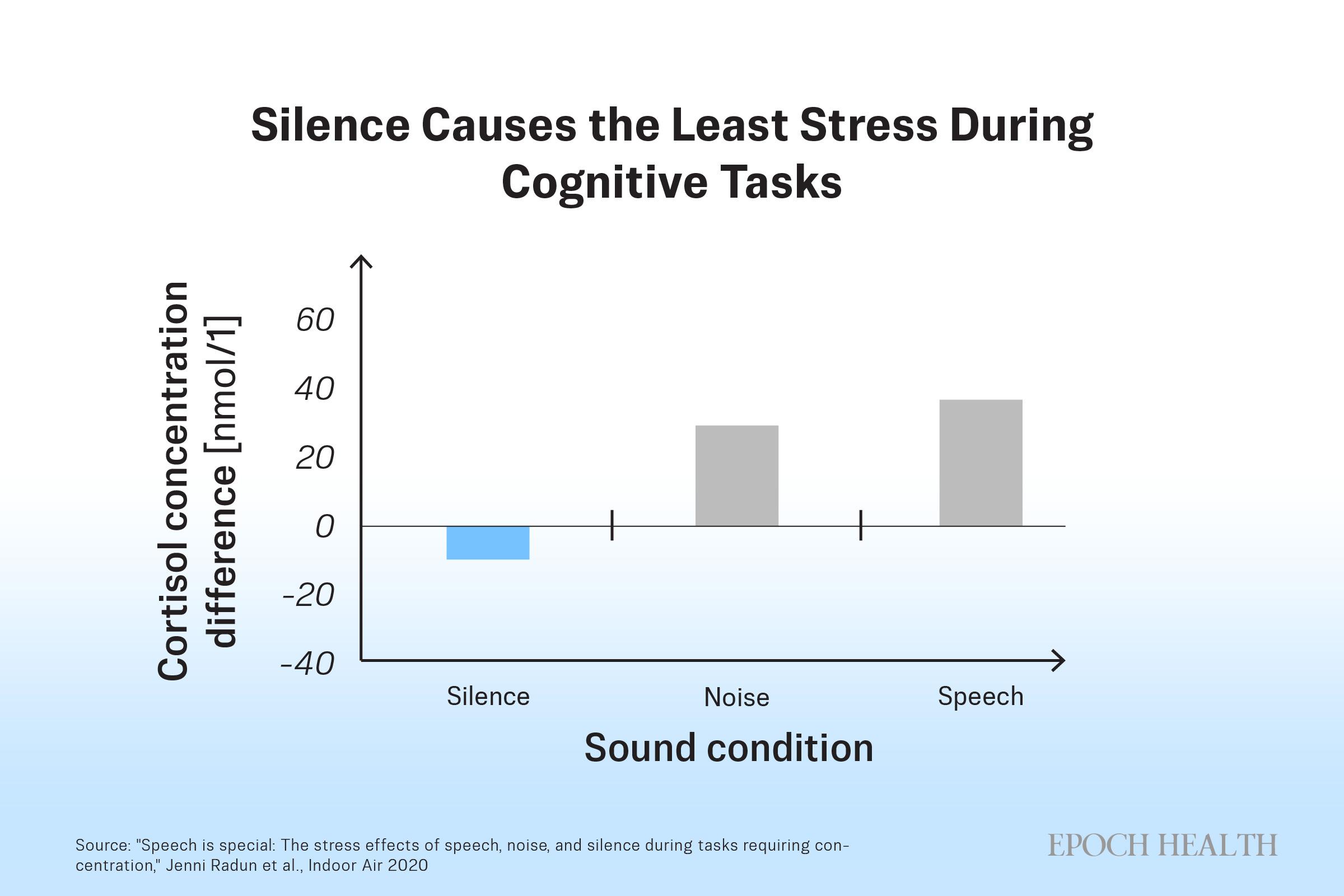
Silence may even help with cognitive functioning.
Listening to Silence
Silence’s benefits can be tangible—it may even help generate your neurons.The researchers expected baby mouse cries to spur brain cell growth in adult mice because they signal distress and, hypothetically, would boost the brain’s flexibility. The cries did cause some short-term cell growth. Yet, the surprise came when they found that giving mice two hours of complete silence each day led to the largest growth of new cells in the hippocampus—the brain’s center for memory, emotions, and learning—and importantly, those increases lasted the longest.
Contrary to Bernardi’s observation that silence led to relaxation after stimulus (music), Kirste reasoned that “listening” to silence actually triggered a sort of positive stress response, or “eustress.”
Silence then is not passive, but an active listening process—there’s something active about listening to “nothing.” Kirste hypothesized that the cell growth could be explained as an adaptive response to unexpected quiet, challenging the brain to develop new cells as a way to increase sensitivity or alertness.
Although this study was conducted on mice, it raises exciting possibilities about whether similar effects might occur in humans.
The concept of “active” silence becomes even more intriguing when one considers what happens in the human brain during quiet moments. Robert Zatorre, a cognitive neuroscientist at the Montreal Neurological Institute of McGill University, told The Epoch Times that psychologically, there may not be such a thing as silence.
His research shows that even in the absence of sound, the brain creates “internal representations of sound.” For example, if you are listening to a song, and suddenly it stops, you may still hear it in your head, he said. This ability, as far as we know, is unique to humans, and it’s a form and source of creativity. You can create visual or auditory representations in your mind, which can allow you to plan for the future, or, as a musician, allow you to create entire compositions in your head.
Strategic Silence
Beyond the physical and brain-building benefits of silence, researchers have discovered that strategic silence can facilitate a change in perspective and enhance future outcomes across multiple domains.The effect was strongest when pauses lasted between three and 10 seconds, giving both sides space to think, calm emotions, and move from rigid positions to problem-solving. The silent pause disrupts what researchers call the “fixed pie” mindset, where each side sees the other’s gain as their loss, and instead encourages looking for options that benefit both.
Finding Quiet Medicine
True silence is rare, if not nonexistent, unless you are in outer space.Yet Cage could still hear two sounds, “one high and one low,” he wrote. “When I described them to the engineer in charge, he informed me that the high one was my nervous system in operation, the low one my blood in circulation.”
Cage concluded, “Until I die, there will be sounds.”
Bernardi thus suggests that we reconsider silence as the absence of bad noise.
The key is conscious listening and intention. Zatorre recommended that, apart from silence, people simply sit down and listen to a piece of music from beginning to end. “Try to enjoy it,” he said. “Get as much meaning as you can from it. Don’t just hear it, but actively listen.”