The psychiatrist reaches for his prescription pad—not to prescribe an antidepressant, but a walk.
“Ten minutes a day,” he says. “No copay. No waitlist. No warning labels.”
“We still separate physical and mental health in ways that don’t make clinical sense,” he told The Epoch Times.
The separation began in the 17th century, with philosopher René Descartes arguing that the mind is distinct from the body. Modern medicine absorbed that divide, and it continues to shape how we diagnose, treat, and heal.
But depression doesn’t respect that boundary.
How Strong Is the Evidence for Exercise?
“Across studies, [exercise’s] effect size is at least as good as an SSRI, and it may have a longer-lasting tail,” Dr. Charles Raison, professor of psychiatry at the University of Wisconsin, where his lab studies novel mechanisms in depression treatment, told The Epoch Times. Selective serotonin reuptake inhibitors (SSRIs) are the most commonly prescribed type of antidepressant.However, six months after treatment, those in the exercise program had the highest rates of continued recovery and less relapse. Regular exercise after treatment may explain why some patients recover better.
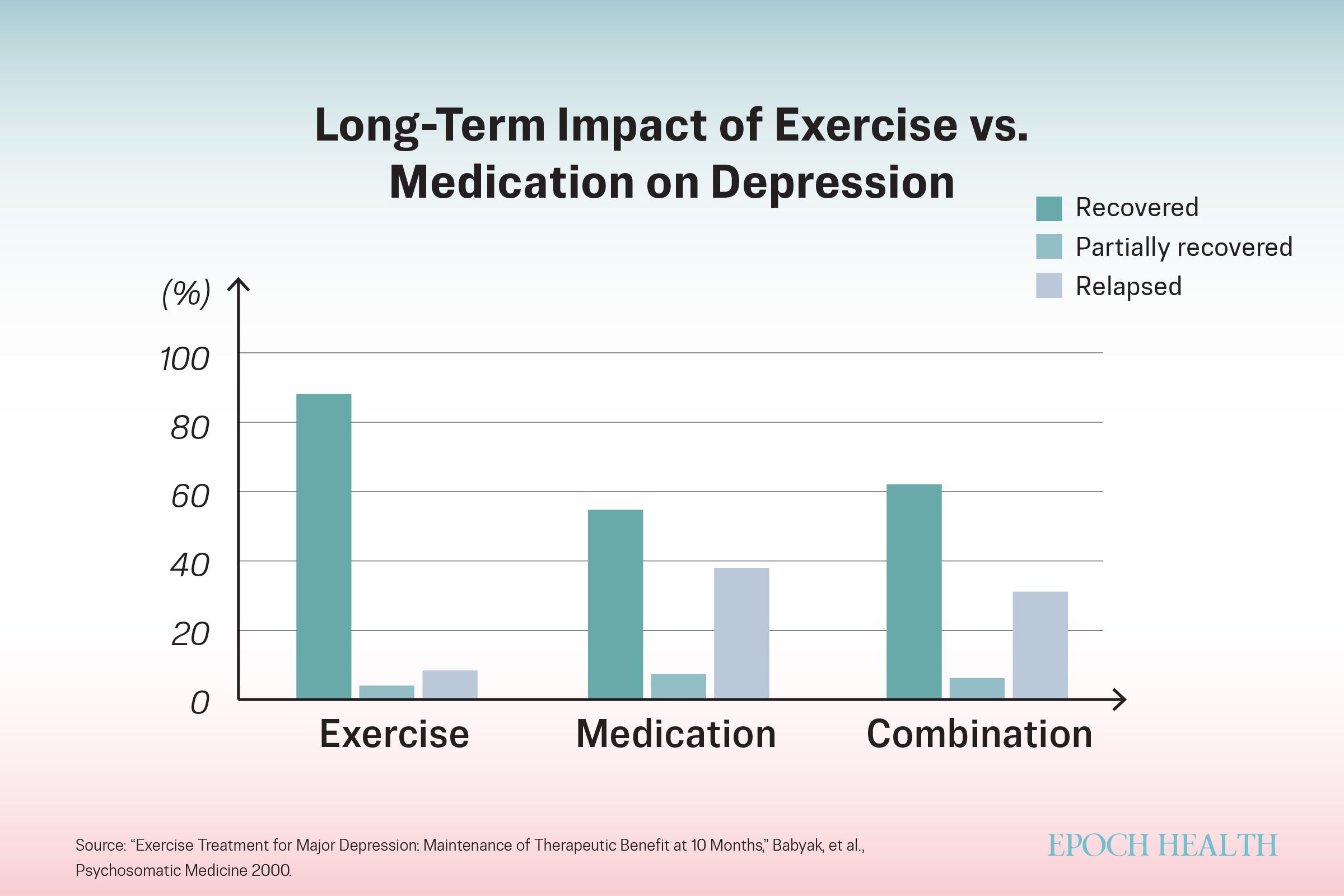
The effects of antidepressants often fade once the medication stops, Raison notes, meaning many patients require ongoing drugs or additional support.
How Movement Resets the Body
Think of exercise as a biological reset button—one that helps your whole system find its balance again.Anyone who’s felt a mood shift after a walk on a bad day knows that change isn’t just mental. Shoulders loosen. Breathing deepens. Everything starts to ease.
“Exercise acts as an adaptive stressor—a short, controlled dose of stress that prompts the body to recalibrate,” Raison said. “You don’t get stronger while you’re lifting; you get stronger when your body rebuilds after. Exercise works the same way [for mood].”
Even a short walk can start this process. As your heart rate and core temperature rise, your body cools itself through two simple mechanisms: sweating and widening blood vessels near the skin. Those temperature changes might seem minor, but they ripple through your immune system—calming down inflammation.

How Movement Rewires the Brain
Movement doesn’t just affect the body—it helps restore the brain, too.The real benefit, however, goes beyond a quick lift in mood.
Over weeks and months, these physiological and neurological changes help the brain and body regulate stress more effectively, reduce inflammation, and therefore lower the risk of relapse.
And it doesn’t require a marathon. Just a few minutes of movement, done consistently, can start this positive chain reaction.
Yet, for many patients, even the small shift of exercise remains frustratingly out of reach.



Why Care Doesn’t Match the Science
The science on exercise and depression is clear. But the U.S. mental health system isn’t designed to act on it. The problem runs deeper than individual doctors—it’s built into how medicine is taught, practiced, and paid for.As Abrantes noted, many clinicians simply don’t know how to move beyond vague encouragement. “Most don’t really know how much more to say to patients beyond ‘You should exercise because it’ll help you feel better,” she said.
The system doesn’t make it easy. Unlike pills and therapy, movement isn’t built into the treatment guidelines, billing systems, or referral pathways. If a psychiatrist wants to prescribe a medication, it takes seconds—the pharmacy fills it and insurance covers it.
However, there’s no billing code for exercise and no insurance coverage for structured movement programs. Even when clinicians want to recommend it, patients usually have to sort out the details themselves—deciding what to do, how to do it, and how to pay for it, whether that means a gym membership, fitness classes, or a personal trainer.
If exercise is framed as a real treatment and people have a place to go and someone expecting them, they’re much more likely to do it, Raison says.
Why ‘Just Go for a Walk’ Isn’t That Simple
On paper, “10 minutes a day” seems simple. In real life, it’s anything but.“We have to be realistic about what depression feels like,” Fabiano said. “Getting out of bed, let alone going for a run, can feel impossible.”
On the hardest days, depression itself actively works against the very behaviors that would help ease it. And “just get outside” can sound less like encouragement and more like blame.
“It’s not laziness,” Raison said. “It’s biology.”
What Exercise Prescriptions Could Look Like
To make exercise a real clinical tool, Fabiano and others argue, it needs the same structure and follow-through as any other treatment.“With medication, patients know what they’re taking, how often, and what to expect,” Fabiano said. “With exercise, the advice is usually something vague like ‘go for a run.’ That’s the equivalent of saying ‘take a pill’ without any details.”
One practical framework is FITT, which breaks a plan into four parts: frequency (how often), intensity (how hard), time (how long), and type (what kind of activity).
Using FITT, a psychiatrist can tailor activity to a person’s fitness, symptoms, and goals. For some, that might mean gentle walking three times a week. For others, it might mean supervised group sessions.
And just like any treatment, prescribing exercise isn’t a one-time conversation. It works best with monitoring, follow-up, and adjustments over time. Psychiatrists don’t just hand out medication and walk away—they check in to see if and how it’s working.
But for that to happen, the system has to make it possible.
For patients with low energy, fatigue, and hopelessness, supported exercise, such as with a coach, joining a group, or regular check-ins, creates accountability that improves follow-through.
Trials in the updated Cochrane review echo this, with many of the most effective interventions delivered as structured, supervised programs, often in groups, rather than as “be more active” advice. When motivation is low, accountability gives people the social support to show up and lets motivation catch up later.
What’s Already Working
Other countries have already shown what a system built to use science can look like.One U.S. health system is following suit. In Colorado’s Vail Valley, Vail Health’s Healthspan program builds movement, sleep, and nutrition into treatment from day one. Patients enrolled in the multi-month, lifestyle-first program receive baseline fitness testing, including VO2 max, strength assessments, and body-composition scans, along with personalized exercise plans and regular check-ins with coaches, nutritionists, and functional-medicine clinicians.
Walk into the outpatient clinic and the emphasis is immediately visible: The front room is filled with exercise machines.
“All of our psychiatric providers look at root cause and whole-person health,” psychiatrist Dr. Elaine Sandler, director of outpatient psychiatry at Vail Health Behavioral Health, told The Epoch Times.
Medication and therapy may still be part of treatment, she said, but Vail Health also focuses on “the fundamentals—movement, sleep, and nutrition.”
After piloting the program with its own employees in 2025, Healthspan is now open to patients across its system, inviting anyone in its care to enroll.
In a country where exercise is still rarely written into the treatment plan, programs such as Healthspan offer a blueprint of what U.S. care could look like. Prescribing movement for depression is one way to start stitching the mind and body back together, centuries after Descartes split them apart.
“Movement is medicine,” Sandler said.