In Emily Cherkin’s seventh-grade English classroom, the end of class used to bring a rustle—chairs scraping, planners snapping, a small line forming at her desk. Students gripped their papers, asking why a grade was low and what they could do differently.
Then the line disappeared.
Homework, due dates, and grades—all of it moved online.
“At first, I thought, sure, why not just look it up online?” Cherkin told The Epoch Times. But she knew that the real value was in writing it down.
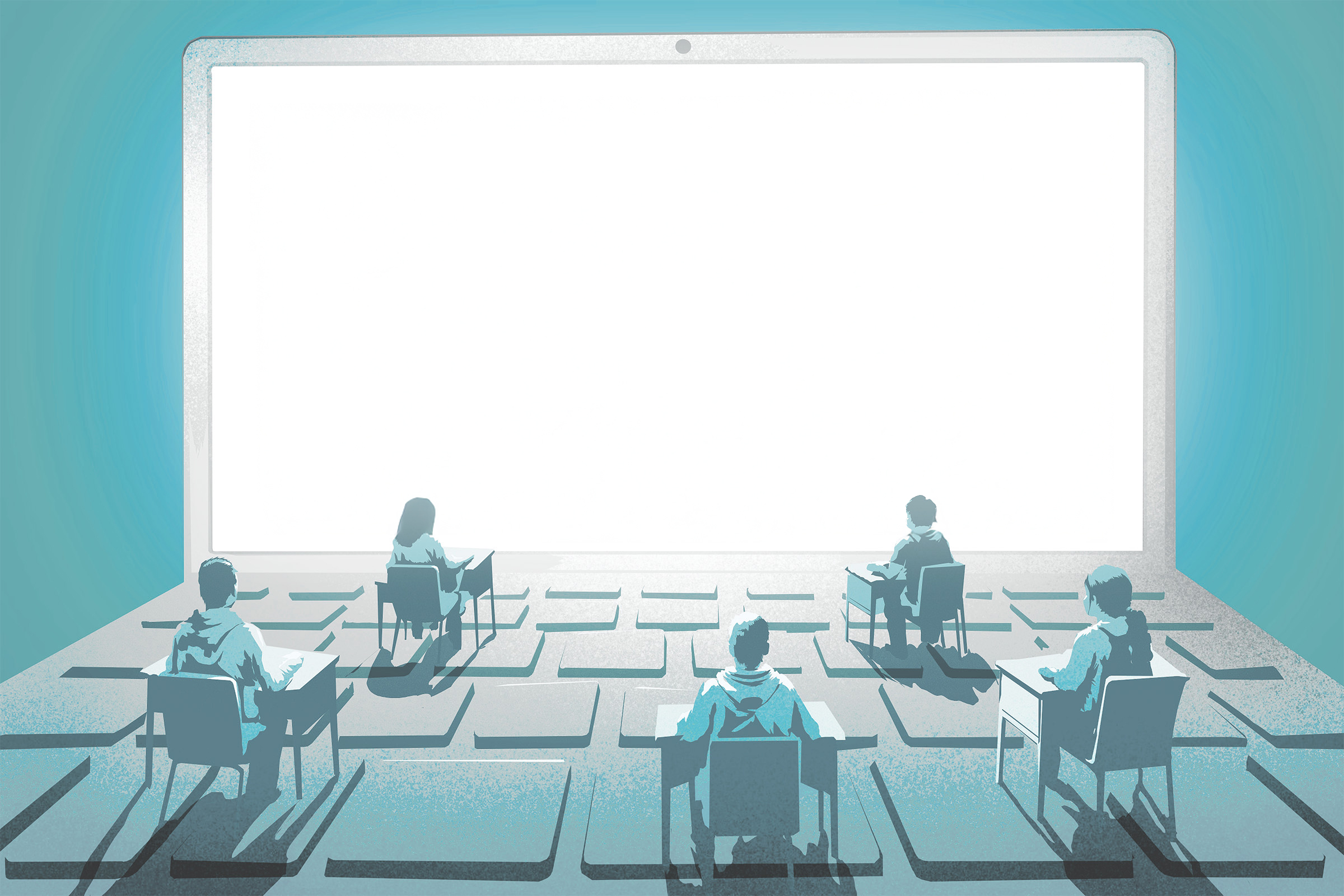
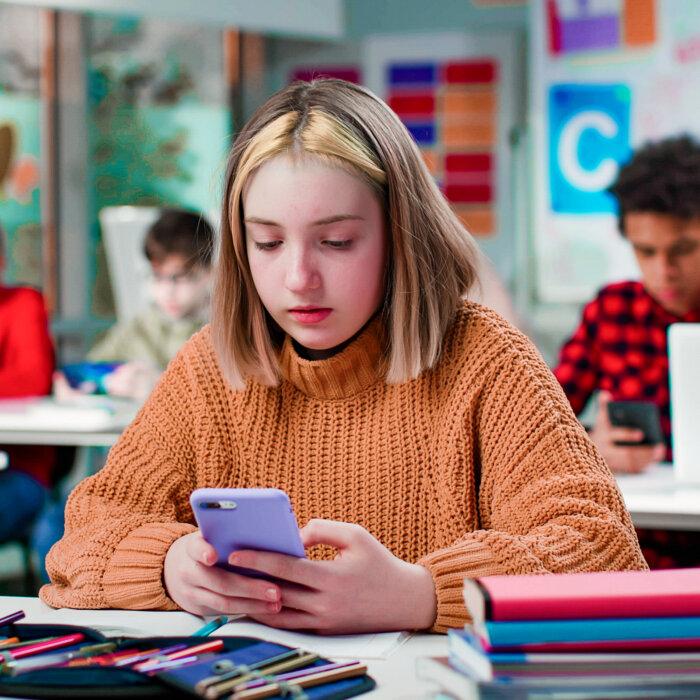
However, a bigger problem soon emerged—technology was taking her place at the center of the classroom.
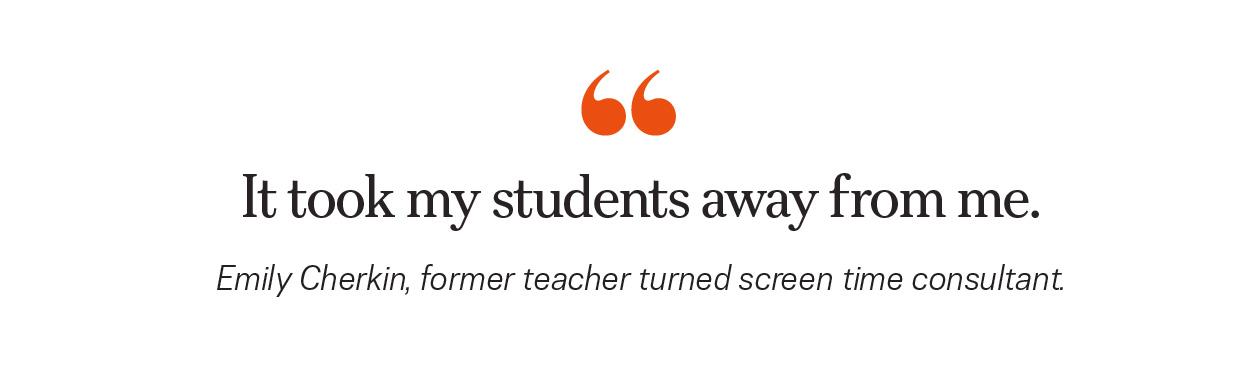
“It took my students away from me,” she said. “I was told to have my students look up their grades in the portal, instead of coming to talk about what they could do differently.”
Cherkin’s classroom was an early warning sign.
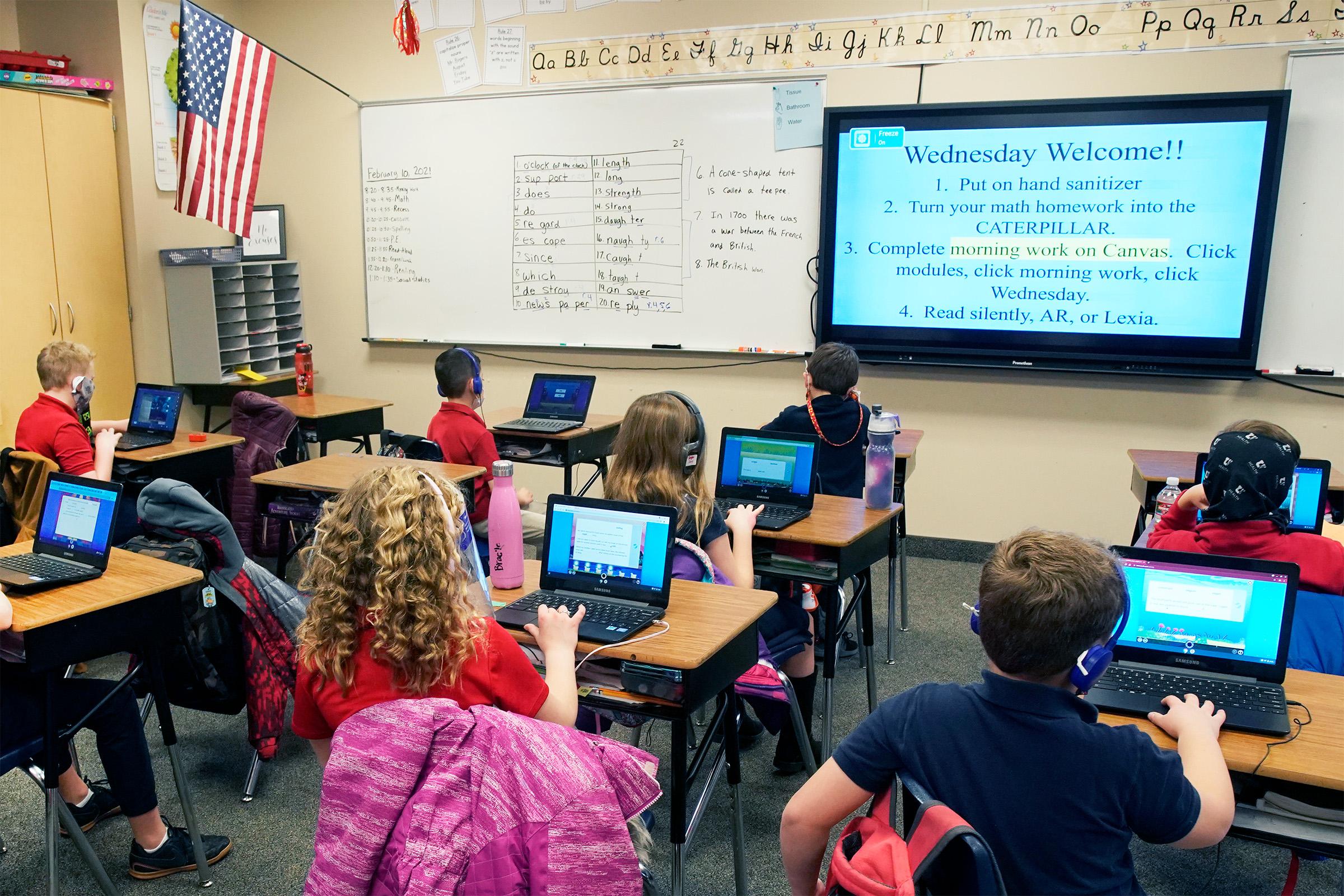
She began teaching in the early 2000s, the decade in which students had laptop carts rather than one-to-one devices. Today, 6-year-olds toggle between apps, responding to rapid-fire prompts. At the same time, national exam scores continue to fall in reading, math, and problem-solving.
“Our kids are less cognitively capable; for the first time, this generation is doing worse than the one before it on the very skills school is supposed to build,” neuroscientist Jared Cooney Horvath, a former teacher turned researcher in human learning, told The Epoch Times.
Few Are Getting Smarter
For much of the 20th century, intelligence scores climbed about three points per decade, or six points every generation. Researchers called the ascension the Flynn Effect. Over the past 20 years, however, the pattern has broken down.Holding information in mind, reasoning through problems, and juggling multiple ideas are the kinds of abstract thinking skills that students practice in school—and the ones that IQ tests mostly measure, according to Daniel Willingham, a cognitive scientist at the University of Virginia.
“IQ tests were designed to predict success in school,” Willingham, whose research focuses on how children learn, told The Epoch Times.
The timing of this fall is difficult to ignore. The downturn overlaps with a massive expansion of classroom technology. What began in the late 1990s as experimental “one-to-one” computing programs—giving each student a device for personalized instruction and to narrow the achievement gaps—has become commonplace in districts across the country.
In 2013 and 2014 alone, U.S. schools purchased more than 23 million laptops, tablets, and Chromebooks for classroom use. The COVID-19 pandemic dramatically accelerated the shift: Billions of dollars in federal relief helped put a screen in nearly every student’s hands and pushed annual spending on educational technology into the tens of billions of dollars.
Although Horvath sees more than coincidence between increased use of educational technology and declining academic performance, other scholars point to the COVID-19 pandemic, rising child poverty, and worsening adolescent mental health as causes.
What isn’t in dispute is the scale of the slide.
Is EdTech Just Screen Time?
Educational screen time is considered beneficial compared with recreational use because it is designed to teach rather than to entertain.However, Horvath sees no meaningful difference. EdTech is just more screen time, he said. He defines it as “any student‑facing, internet‑connected device”: laptops, tablets, learning platforms, artificial intelligence tutors, and full online instruction.
Whether recreational or educational, students are still staring at a screen and loading their brains with much of the same stimulation: bright visuals, rapid feedback, constant engagement, and blue light.
Because most EdTech relies on internet-connected devices, the same tools used for learning can also open the door to distraction.
Even with school filters and monitoring software, students often find ways to drift into games, messaging, or other online entertainment during class. The devices also introduce familiar digital risks: cyberbullying, exposure to inappropriate content, and mental health concerns tied to heavy screen use.
“People assume because the school bought it, or because it has the word Ed in front of it, that it must be different,” Horvath said. “All the problems you’re seeing in the real world outside the classroom with screen use are going to happen on the screen inside the classroom.”
He likened the difference between the two to switching from cigarettes to vaping.
Erin Mote, chief executive officer of InnovateEdu, a nonprofit that convenes educators and technologists to design K–12 tools, said that purpose and design matter.
Consumer or recreational apps, she told The Epoch Times via email, are engineered to maximize engagement—“a child’s eyes on the screen for as long as possible.”
Well-designed classroom technology, in contrast, aims for productive struggle—challenging students just enough that they have to work through a problem rather than simply receive the answer.
Effective platforms let students try different approaches to a problem, see why one works and another doesn’t, and adjust their thinking—rather than just clicking through multiple-choice questions. Edtech can also provide real-time data, allowing teachers to step in when a student gets stuck.
At their best, Mote said, EdTech acts as “a force multiplier.” Software can handle rote tasks—grading quizzes and assigning exercises to drill basic fluency—freeing teachers to focus on discussion, feedback, and mentorship. In elementary classrooms, especially, she said, learning should be fundamentally between people.
Horvath sees limits.
Even thoughtfully designed tools can short-circuit skill-building. Much of the EdTech wasn’t designed for kids’ learning but rather are adaptations of software originally built for adult productivity, he said.
“The tools experts use to make their lives easier are not the tools a novice should use to learn how to become an expert,” Horvath said.
Students need to build foundational skills first.
The Valuable Effort
Researchers have long compared traditional learning methods with screen-based ones.
However, it’s not just about screens versus paper—there are deeper reasons why students learn better from a teacher.
Students learn by thinking.
In his book “Why Don’t Students Like School?,” Willingham said that to remember something, one must first think about it—if an idea does not demand attention and effort, it won’t stick.
“When work is too easy, students get bored and drift,” he said.
Many EdTech platforms are designed to reduce friction. Instant hints, autofill, gamified rewards, and seamless searches create momentum. Students may move quickly and feel successful—but speed and fluency are not the same as mastery.
“What is learning, if not friction?” Horvath asked. “If you’re not huffing when it comes to the classroom, you’re not working out.”
However, when it is too hard, students disengage.
Delivering that “just-right” difficulty was one of the promises of digital learning, Willingham said.
In practice, the just-right difficulty unfolds in a relationship with a teacher who can sense when to push, pause, or explain.
Personalized learning, however, is much harder to achieve with technology, Willingham said, citing a 2018 open letter from an industry leader who acknowledged its limits: Larry Berger, chief executive of Amplify and an early champion of EdTech, wrote that true personalization would require a detailed map of every student’s knowledge, precise measurement of understanding, and a vast, high-quality content library for algorithms to draw from.
“The map doesn’t exist, the measurement is impossible, and we have, collectively, built only 5 percent of the library,” Berger wrote.
A Real Teacher
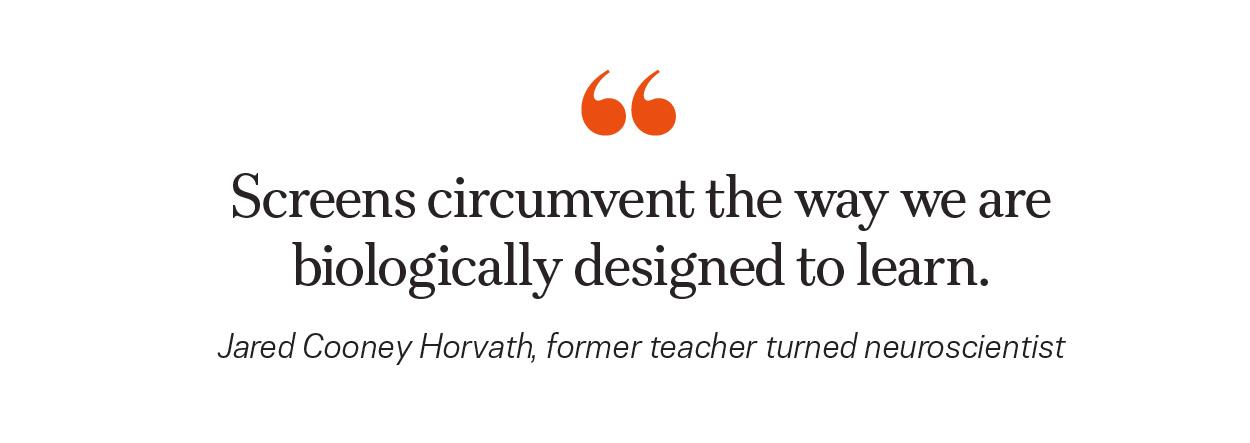
Humans learn from other humans.“Screens circumvent the way we are biologically designed to learn,” Horvath said, because, besides the friction, learning requires empathy, and empathy needs to be built through human connection.
When the real challenges hit, what motivates students to persevere is not animations or flashy features—it’s a person they trust.
Empathy can’t come through a screen. “Most people think empathy is an emotion,” Horvath said. It’s not a feeling—it’s something that arises only through people interacting and coming into synchrony.
In that moment, he said, hearts start beating together, breathing slows in sync, and blinks and gestures align. Even brain activity begins to mirror each other.

In person, internal synchrony helps students read and respond to a teacher’s expression, sensing encouragement, absorbing cadence and tone—guiding whether they keep going or give up.
“Once you empathize with somebody, you are no longer learning from them,” Horvath said. “You are thinking like them.” Students don’t just absorb information; they begin to mirror a teacher’s reasoning and persist through confusion together.
The Teacher Who Opted Out
Cherkin’s teaching experience became personal when her own children entered school.Her son’s first-day-of-kindergarten handout began: “Our new little techies need to learn to press Control-Alt-Delete,” to log in to state tests.
“He didn’t even know how to write his name with a pencil,” Cherkin recounts. “And the first thing we were teaching him was control-alt-delete.” The school even sent home a life-size paper keyboard for practice.
Years later, when his district adopted an entirely digital sixth-grade science curriculum, she pushed back. “Science at that age should be hands-on, not sitting in front of a Chromebook,” she said.

With her younger child, the consequences were physical. Within weeks of starting sixth grade, in which every student received a laptop for all-day use, her daughter developed daily headaches. A pediatrician visit led to reading glasses and a standard handout about screen breaks.
“Adults get ergonomic workstations,” Cherkin said. “We hand kids a device and tell them nothing.”
This time, Cherkin asked that her daughter forgo laptop use entirely. After months of back-and-forth, the school agreed, and “the headaches disappeared,” Cherkin said. Two classmates followed her daughter’s lead in math class, completing tests on paper. “That’s the kind of middle school peer pressure I can get behind,” she said.
For her older son, Cherkin asked that he complete the school work on paper. His teacher agreed, but the teacher had to re-enter his answers into the system online.
A Course Correction
Technology is reshaping how “our kids think, behave, and relate,” Horvath said.Schools are starting to reshape learning to fit digital habits, Horvath told lawmakers, rather than the other way around. He cited changes to the SAT.
Cherkin made a similar point from a different angle. “Technology itself isn’t inherently harmful; it’s the default, always-on use that poses risks,” she told lawmakers. When devices are handed out without regard for developmental readiness, they can crowd out the activities that build language, self-control, and social skills. She urged lawmakers to not be swayed by claims that education apps differ from other tech platforms, arguing that the business model is the same.
After the January Senate hearing, Cherkin said, Byrnes contacted her as a line from her testimony caught the lawmaker’s attention: “EdTech is just Big Tech in a sweater vest. ... We are not giving kindergarteners ‘tools for learning’—we are giving them access to the internet.”
Byrnes’s legislation preserves exceptions for students who rely on assistive technology, but its aim is clear: a developmental course correction that puts children’s hands, bodies, and attention back at the center—and asks technology to fit around that.
The Ultimate Question
“People don’t like learning from screens very much,” Willingham said. Even with a human on the other side, students tend to feel more exhausted than they do in person—a pattern that became impossible to ignore during the COVID-19 pandemic.For parents and teachers, the question is no longer whether screens belong in school at all, but what kind of childhood they are shaping—and whether the friction being engineered out of classrooms is exactly the friction that children need most.
The answers will be written not just in code and curriculum, but in the decisions that educators make about how much struggle—and how much face-to-face learning—they are willing to preserve in children’s days.