
Florence Nightingale couldn’t sleep. It was 2 a.m. in the military hospital amid the Crimean War, and the noise never stopped. Buckets clanging, people shouting, and machinery grinding drowned out the groans of wounded soldiers.
The famous nurse wasn’t troubled by the chaos of war, but by something she observed that her colleagues readily dismissed: Patients engulfed by noise simply couldn’t heal.
“Unnecessary noise is the most cruel absence of care which can be inflicted either on sick or well,” she wrote in her 1859 book, “Notes on Nursing: What It Is, and What It Is Not.”
A Crisis Hiding in Plain Sound
We are immersed in noise.Long-term noise exposure is linked to chronic stress and inflammation, which are further linked to many health conditions, including cardiovascular disease and diabetes, Charlie Roscoe, assistant professor in environmental systems and human health at the Oregon Health and Science University–Portland State University School of Public Health, told The Epoch Times.
The Body That Never Rests
The intensity of sound—or its loudness—is measured in decibels (dB). Zero dB is the lowest and faintest sound that people with healthy hearing can detect, such as a soft whisper in a quiet room or near-silence. As decibel levels increase, sounds become progressively louder and more intense.The effect of noise ripples across the body through two pathways: direct and indirect via the stress circuitry.
Hearing Loss
The ears are the gateway through which sound enters the body and are the first body parts to be directly affected by it.Physiologically, after the invisible waves of sound hit your eardrums, vibrations are transmitted through the middle-ear bones to the cochlea, the snail-shaped spiral structure in the inner ear, in which sensory hair cells are present. These hair cells convert sound vibrations into electrical signals that the brain interprets as recognizable sounds.
During the process, sound vibrations move and rub the inner hair cells, which naturally subjects them to mechanical shearing. Frequent exposure to intense sound can cause physical damage to the inner ear and lead to a temporary hearing shift, according to Dr. Chandrakiran Channegowda, professor and head of the Ear, Nose, and Throat and Head and Neck Surgery Department at M.S. Ramaiah Medical College in India.
However, prolonged noise exposure can permanently damage these cells and nerves, leading to irreversible hearing loss, he told The Epoch Times.
Brain Health
Your brain continues to respond to noise automatically.“Harmful effects can occur quietly, without people being consciously aware of them,” Omar Hahad, a senior medical scientist at the University Medical Center of the Johannes Gutenberg University Mainz, told The Epoch Times.
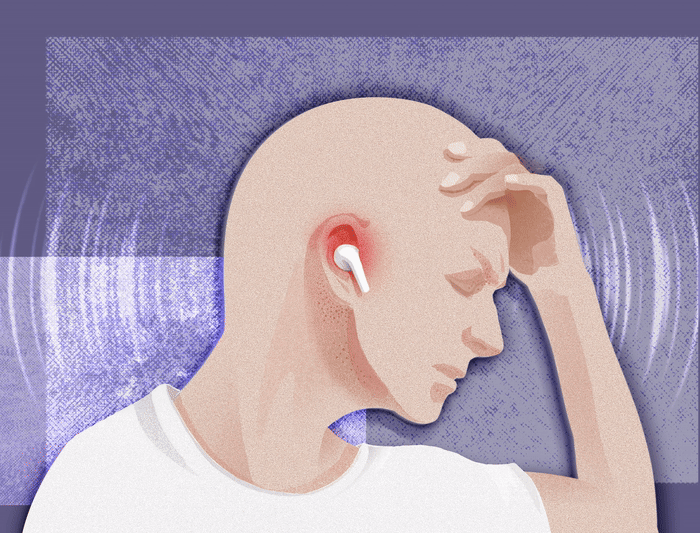


In the long run, noise is linked to mental health issues, and even a small change in noise levels matters.
Additionally, long-term exposure to road traffic noise is linked to a higher risk of developing Alzheimer’s disease, with the risk particularly high for those exposed to louder noise at night.
Heart Health
Your heart health is equally affected by noise.Reproductive Health
When the levels of the stress hormone cortisol remain persistently elevated, it can negatively affect reproductive health by downshifting the sexual hormones.Hospital Noise
Nightingale’s complaint still rings familiar in today’s health care wards.“Most alarmingly, the analysis revealed that the highest sound pressure levels were recorded inside ambulance vans,” Ravindra Khaiwal, lead author of the study and an expert in environment and public health policy, told The Epoch Times.
Khaiwal, a professor at India’s Postgraduate Institute of Medical Education and Research, said that noise pollution in hospitals is “a serious health concern” and not merely a nuisance.
Turning Down the Noise
There isn’t truly “a single safe threshold” below which noise has no effect, according to Hahad.Even when people close their eyes while sleeping, their ears are open, keeping their brains and stress systems automatically responding to noise.
Protecting the sleep environment is the most crucial step in preventing noise, Hahad said. He suggests keeping bedrooms quieter, improving insulation, or closing windows. To substantially reduce daily noise dose, choose quieter routes or avoid peak traffic times.
The most effective step is to avoid exposure to loud noise in the first place, Channegowda said. He recommends using ear muffs and earplugs to block sound waves, thereby damping the direct impact of noise. People who work in noisy environments, or are even temporarily exposed to loud noise—such as when a subway arrives at the station, there’s drilling at a nearby construction site, or a loud police siren rushes by—should try covering their ears.
A nutritious diet goes a long way in preventing hearing loss, Channegowda said. Eating vegetables and fruits rich in vitamin B complex can help protect your auditory nerve and keep your ears healthy, along with regular checkups with your ear, nose, and throat doctor.
However, experts hold that noise is a public health problem and that the burden of solving it should not fall only on individuals. Society needs to “think more holistically than quick-fix solutions,” Roscoe said. Retrofitting cities to support quieter, calmer, more active lifestyles can deliver major health gains, she said.
It’s clear that more than a century and a half after Nightingale’s experience in the noisy Crimean ward, her standards for sincere care and healing still hold.