This copy is for your personal, non-commercial use only. Distribution and use of this material are governed by our Subscriber Agreement and by copyright law. For non-personal use or to order multiple copies, please contact The Epoch Times Reprints.
Bell’s palsy is a neurological condition involving sudden facial paralysis or weakness. Every year, it occurs in about 15 to 30 people per 100,000, and the lifetime risk of a person developing it is 1 in 60. Resulting from damage to the seventh cranial nerve, which controls facial movements, Bell’s palsy is usually temporary, with approximately 70 percent to 80 percent of patients recovering spontaneously after a few weeks or months. However, in some cases, the symptoms may linger or become permanent.
Bell’s palsy is named for Scottish neurologist Sir Charles Bell (1774–1842), who many claim was the first to describe the condition.
What Are the Symptoms and Early Signs of Bell’s Palsy?
Bell’s palsy develops over two to three days. Signs and symptoms may include the following:
Drooping of one side of the face, including the eyelid, mouth, and cheek (both sides of the face may be involved, but this is extremely rare).
Twitching facial muscles.
Difficulty in closing or inability to close one eye due to impaired eyelid movement.
Inability to furrow half the forehead.
Pain in the face.
Pain in the ear.
Speaking difficulties.
Tinnitus or hypersensitivity in the affected ear.
Loss of sense of taste.
Eating difficulties.
Drooling.
Dry eyes.
Headache.
What Causes Bell’s Palsy?
Most cases of Bell’s palsy are considered “idiopathic,” meaning they are of unexplained, spontaneous onset. Therefore, the exact cause is unknown, but the condition is often associated with triggers.
We know this condition often occurs when the seventh cranial nerve, which supplies the nerves to the muscles that control facial expression, becomes damaged or inflamed, leading to weakness or paralysis of the facial muscles.
Damage to this nerve may occur after an infection when the immune system is weakened or after an injury or traumatic event.
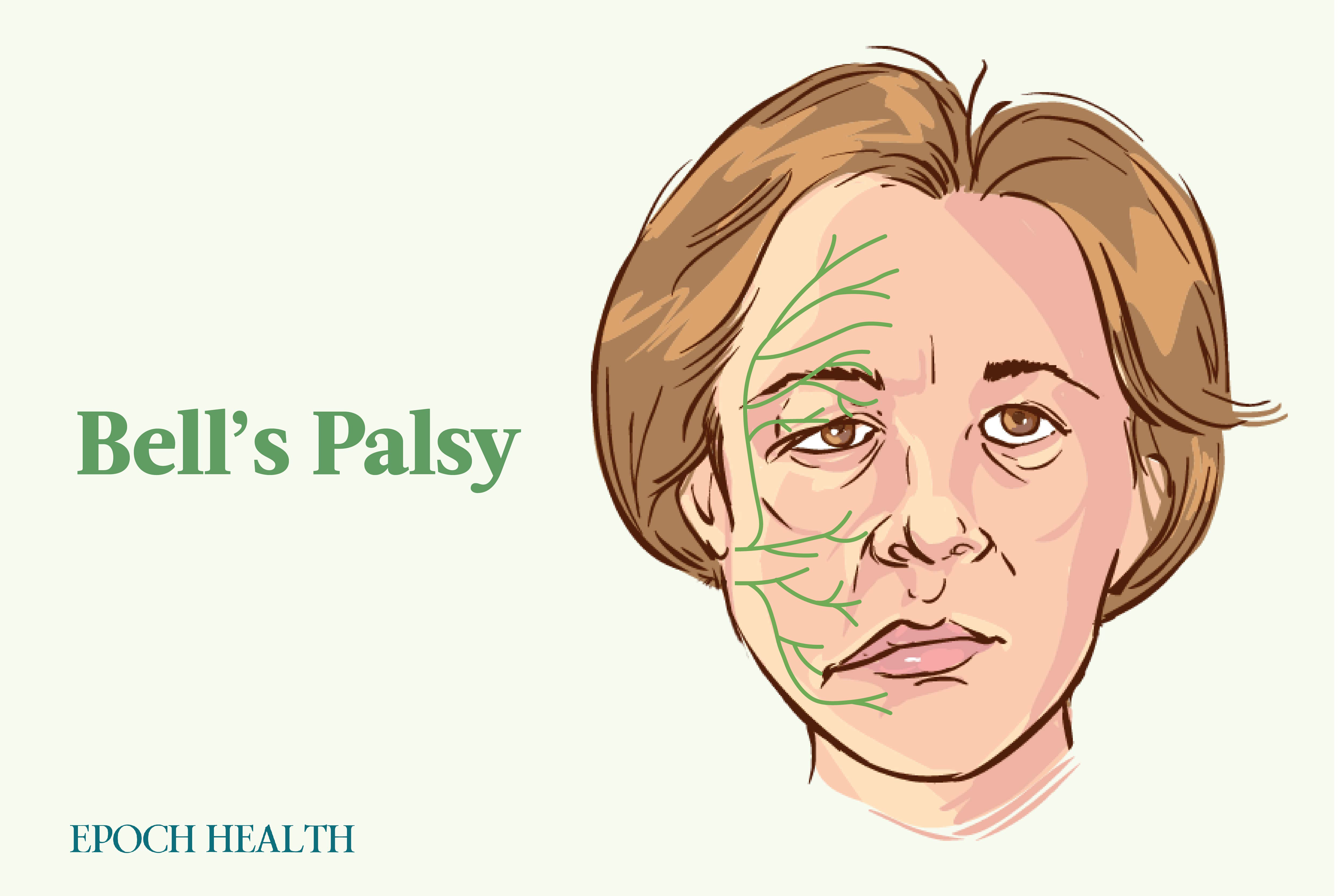
Bell's palsy occurs when something (often an infection) triggers damage or inflammation in the seventh cranial nerve, which controls facial muscles. Illustrations by The Epoch Times, Shutterstock
Infection Triggers
Triggering factors in the development of Bell’s palsy include infections, either active or dormant, such as the following:
Herpes simplex 1 (which causes mouth sores).
Upper respiratory illness.
Varicella-zoster (chickenpox).
Epstein-Barr virus.
COVID-19 virus.
Guillain-Barré syndrome.
HIV.
Lyme disease.
Multiple sclerosis.
Hand-foot-and-mouth disease.
Mumps.
Influenza B.
Myasthenia gravis (an autoimmune condition).
Sarcoidosis (an inflammatory disease that causes granuloma formation in organs).
Potential Links Between Certain Vaccines and Bell’s Palsy
Evidence exists that Bell’s palsy may follow both COVID-19 infection and COVID-19 vaccination. A review published on April 27 in JAMA Otolaryngology—Head & Neck Surgery analyzed 50 studies that included various types of studies, such as randomized controlled trials and observational studies, and found the incidence of Bell’s palsy was “significantly higher” in vaccinated groups compared to placebo groups. However, the review did not prove causality.
A meta-analysis compared the incidence of Bell’s palsy in both mRNA and viral vector vaccines (AstraZeneca and J&J). “For the mRNA vaccine subgroup, there were significantly increased odds of [Bell’s palsy] in the vaccinated group compared with the placebo group,” the review said.
However, observational studies analyzed in the review found the odds of Bell’s palsy incidence did not significantly differ between vaccinated and unvaccinated cohorts, they added.
“In the cohort studies, the analysis indicated no significant evidence of increased odds of [Bell’s palsy] in the vaccinated group compared with the unvaccinated group,” the review concluded.
Additionally, the reviewers found Bell’s palsy to be more common following COVID-19 infection than following COVID-19 vaccination. Specifically, compared with vaccination, infection tripled the risk of developing Bell’s palsy.
Studies have also shown an association between the flu vaccine and Bell’s palsy. After the introduction of an inactivated intranasal influenza vaccine (no longer in clinical use) used only in Switzerland, 46 cases of Bell’s palsy were reported. A recent study in Taiwan of 7.5 million older adults vaccinated against influenza between 2010 and 2017 found a positive association between vaccination and the risk of Bell’s palsy.
However, overall, “the adverse event rate of [Bell’s palsy] was low, and considering the morbidity and mortality of influenza infection, the benefits of [influenza vaccination] still outweigh the risks,” the study authors wrote.
Who Is at Risk of Bell’s Palsy?
Bell’s palsy may affect people of any age, and researchers disagree about which age group is most likely to be affected. It may most commonly affect those aged 15 to 45, according to some experts, but some say it is more common in people over 65. Other sources claim it is less common in those older than 60.
While men and women are equally affected, the following factors put a person more at risk of developing the condition, in addition to the viral and illness triggers listed above:
Diabetes.
Hypertension.
Obesity.
Preeclampsia.
Pregnancy, especially in the third trimester.
Physical or emotional trauma.
Factors that weaken the immune system, such as injury.
Having had Bell’s palsy before.
How Is Bell’s Palsy Diagnosed?
It is essential to see a doctor promptly if you experience any symptoms of Bell’s palsy. Stroke and tumors may cause symptoms similar to those seen in Bell’s palsy, so these possibilities will need to be ruled out. The diagnosis is one of exclusion, meaning if no other causes are found for the paralysis, a diagnosis of Bell’s palsy will be made.
Your doctor may perform the following tests:
Physical exam: If your doctor suspects you have Bell’s palsy, he or she will perform a physical exam. If the forehead muscles are also weak on one side, this is more consistent with Bell’s palsy, as forehead muscles are usually spared in a stroke. Your doctor will also confirm that you do not have other physical findings pointing to a different diagnosis.
Blood tests: No blood tests exist to diagnose Bell’s palsy. However, if a doctor suspects an underlying infection (such as Lyme disease) or condition (such as diabetes) is present, he or she may order blood work related to the condition.
Imaging tests: Imaging studies, such as magnetic resonance imaging (MRI) or computed tomography (CT) scans, are not needed for diagnosis but may be ordered if physical findings are not straightforward initially or fail to resolve as expected. A doctor may also choose to perform electromyography (EMG). This test involves placing electrodes on affected muscles to measure electrical activity and, thus, nerve function.
What Are the Complications of Bell’s Palsy?
If facial paralysis or weakness leads to the inability to close one eye, extreme eye dryness may result. Eye drops during the day and eye ointments at night will help to alleviate this. Often it is advised to use paper tape to keep the eyelid completely closed at night. Taping lightly over a cotton ball on the closed eye will minimize the points of adhesive directly on the eyelid, easing the tape’s removal after sleep.
If the damaged cranial nerve involved in Bell’s palsy heals improperly, a few threads of the nerve may regrow to the tear glands instead of the salivary glands, causing tear-shedding while eating. Improper nerve healing may also lead to abnormal and involuntary facial movements (synkinesis).
Researchers in Taiwan showed in one study that patients with Bell’s palsy have a two times higher risk of non-hemorrhagic stroke than the general population. A South Korean study also found the risk of ischemic stroke was significantly increased, especially within two years of the patient having had Bell’s palsy, but the risk of hemorrhagic stroke was not significantly increased.
Patients who have experienced one incidence of Bell’s palsy have an 8 percent risk of recurrence.
Facial weakness may be permanent in up to 20 percent to 30 percent of patients. Corticosteroid treatment appears to increase the chance of complete recovery.
What Are the Treatments for Bell’s Palsy?
Bell’s palsy is most commonly treated with steroids to reduce inflammation. Antiviral medications may also be used if the treating doctor deems them necessary, but research findings regarding their effectiveness are mixed.
The following treatments may be used to treat Bell’s palsy:
Steroids: A 10-day regimen of oral corticosteroid (prednisone) is the first-line treatment for Bell’s palsy and is most effective if begun within the first few days of symptom onset.
Antiviral medications: Antiviral medications valacyclovir or acyclovir may be administered along with steroids for seven to 10 days. This combination therapy may reduce rates of synkinesis (involuntary movement of certain facial muscles), according to an American Family Physician review. The use of antivirals alone is not recommended and has shown no benefit compared to placebo, according to the Mayo Clinic.
Surgery:Facial reanimation surgery, which may involve “static” cosmetic procedures (such as an eyebrow lift or facelift of the affected side), nerve grafting, or muscle repositioning, may be appropriate in some cases of Bell’s palsy.
Injections: The use of botulinum toxin (Botox) has been shown to improve facial hyperkinesis (excessive muscle movement) and synkinesis following Bell’s palsy, according to a 2021 practical guideline in the journal Toxins. The guideline states: “In order to create more symmetry at rest and with animation, [Botox] is injected in targeted muscles of the unaffected side to reduce hyperkinesis, resulting in a significant aesthetic improvement of the face. For the treatment of synkinesis, [Botox] injection into a specific muscle can reduce or eliminate the involuntary muscle action that is aberrantly triggered.”
How Does Mindset Affect Bell’s Palsy?
Bell’s palsy has been known to occur in people experiencing extreme physical or mental stress or trauma.
Instances of posttraumatic cases of Bell’s palsy are rare, but anecdotes do exist.
American actress Angelina Jolie in 2023 told The Wall Street Journal that she believed she developed Bell’s palsy in 2016 from the stress of going through a divorce. She claimed that acupuncture helped to resolve the condition.
Another high-profile case of Bell’s palsy was in actor Pierce Brosnan, who, according to the publication TV Guide, developed it in the 1980s following contracting a virus and working such long hours that he collapsed from exhaustion.
Avoiding extreme stress, if possible, may help lessen the chances of weakening the immune system and becoming vulnerable to many conditions, including Bell’s palsy.
A study in Taiwan published in 2017 found an association between Bell’s palsy and anxiety disorders. The researchers examined the records of thousands of patients with and without Bell’s palsy and anxiety and found a “bidirectional association.”
Researchers wrote: “After one of these conditions develops, the morbidity rate for the other significantly increases.” However, they also cautioned that additional studies were needed to determine how the two conditions are linked and if treating one condition will help prevent or alleviate the other.
What Are the Natural Approaches to Bell’s Palsy?
Physical therapy may be a beneficial adjunct (in addition to medical treatment) in patients with more severe paralysis. Massage and focused movement exercises may help damaged muscles.
Millions of videos demonstrating facial exercises for Bell’s palsy exist online, with millions of patients claiming they have benefitted from these exercises. A Kaiser Permanente patient resource demonstrates exercises for activating the muscles of the face.
Acupuncture may also help, according to the National Institute of Neurological Disorders and Stroke. Some Bell’s palsy patients have claimed this therapy helps. However, one large review of controlled trials concluded: “Current available evidence is unsufficient [sic] to support that acupuncture is an effective therapy for Bell’s palsy due to the poor quality of included researches, and no conclusions can be drawn as to the safety of acupuncture.”
One case study of a woman with dental gum hypertrophy (overgrowth) and Bell’s palsy showed improvement in symptoms following vitamin C supplementation. However, this was the first such case (to the researchers’ knowledge) of an association between vitamin C deficiency and Bell’s palsy.
They suggested vitamin C deficiency may be “a cause or […] risk factor for Bell’s palsy and at the same time immune-inflammation triggered in Bell’s palsy also leads to vitamin C deficiency as existing vitamin C in the body starts scavenging free radicals to prevent oxidative damage.”
Bell’s palsy patients may seek alternative therapies such as electrical stimulation, biofeedback training, and supplementation with vitamins B12, B6, and zinc. Still, there is no evidence these treatments are effective, according to the Johns Hopkins School of Medicine.
Some claim other natural approaches include relaxation and meditation to help relieve muscle tension, castor oil compresses to enhance blood flow to the affected areas, and antiviral herbs like echinacea and elderberry to improve immune function may help treat Bell’s palsy. Still, there is no conclusive evidence of these approaches’ efficacy.
How Can I Prevent Bell’s Palsy?
While no known methods exist to prevent Bell’s palsy, optimizing health through nutrition and exercise can help one avoid illnesses that may lead to conditions like it.
Too much stress affects our lives in many ways, and reducing stress levels can improve our physical health. “If your stress levels are high on a regular basis, it’s like having a smoking habit; it will take its toll over time,” according to author Leo Babauta, who recommends five ways to reduce stress in an Epoch Times article. These include practicing relaxation, breathing deeply, prioritizing commitments and duties, spending time in the natural world, and practicing gratitude.
California plastic surgeon Dr. Andre Panossian recommends the following techniques to reduce stress and prevent Bell’s palsy:
Exercise regularly. Regular exercise has also been shown to alleviate depression and anxiety, and recent research shows exercise may even be more effective than medication in managing these conditions.
Practice deep breathing and mindfulness techniques.
Avoid caffeine, alcohol, and other stimulants.
Eat a balanced diet with plenty of fruits and vegetables.
Spend time in nature or doing activities that bring joy.
Practice yoga or other forms of relaxation exercises.
Take regular breaks throughout the day to relax and unwind.
Get plenty of sleep each night to help reduce stress levels.
Listen to calming music or nature sounds to help relax your mind and body.
Connect with friends and family members who can provide emotional support.
Participate in activities that promote positive thinking, such as journaling or meditation.
Seek professional help if needed, such as a therapist or counselor.
The foods we eat can also affect our stress levels. According to GreenMedInfo.com, the top five anxiety-relieving foods are as follows:
Nuts (vitamin E, selenium, and amino and fatty acids).
Yogurt (probiotics).
Green tea (L-theanine and the polyphenol epigallocatechin-gallate). Of note, green tea contains about a third of the caffeine of coffee. If you are caffeine-sensitive, keep the amount you drink in mind.
Chocolate (antioxidants and magnesium).
Fish (omega-3 fatty acids, L-lysine, and L-arginine).
Susan C. Olmstead
Author
Susan C. Olmstead writes about health and medicine, food, social issues, and culture. Her work has appeared in The Epoch Times, Children's Health Defense's The Defender, Salvo Magazine, and many other publications.