Various eye issues, including presbyopia, myopia, dry eye syndrome, and eye strain, plague people of all ages. In addition to age-related eye conditions, today’s culture of looking at screens throughout the day can irritate otherwise healthy eyes.
Traditional Chinese Medicine Eye Care: Nurturing the Liver, Kidneys
According to traditional Chinese medicine (TCM), meridians are the channels through which energy flows in the human body. They’re responsible for transporting qi throughout the body. The body consists of 12 major meridians, each corresponding to a specific organ. Their activities follow specific times and pathways (biological clock), aligning with 12 “shi chen” (each representing two hours in modern times) in a day.During each two-hour period, the meridian corresponding to the specific organ experiences increased activity, as well as heightened physiological functions in that organ.
Establish a Sleep Routine
Staying up too late can harm the gallbladder, liver, and kidneys, leading to kidney deficiency. Most individuals with presbyopia tend to have kidney deficiency, making them prone to eye strain and issues such as dryness, soreness, redness, and tearing. It’s recommended to:• Maintain a regular sleep schedule and avoid staying up late. Aim to be asleep between 11 p.m. and 1 a.m., so that you can enter deep sleep from 1 a.m. to 3 a.m., as these two time periods are when the gallbladder and liver meridians are most active.
Massage 5 Acupoints Around the Eyes to Improve Presbyopia, Dark Circles
Along the meridians are specific points known as acupoints, which possess unique functions. TCM acupoint massage boasts a rich and extensive history. Directly massaging the five acupoints around the eyes (as shown in the diagram) can help to alleviate eye strain and discomfort.

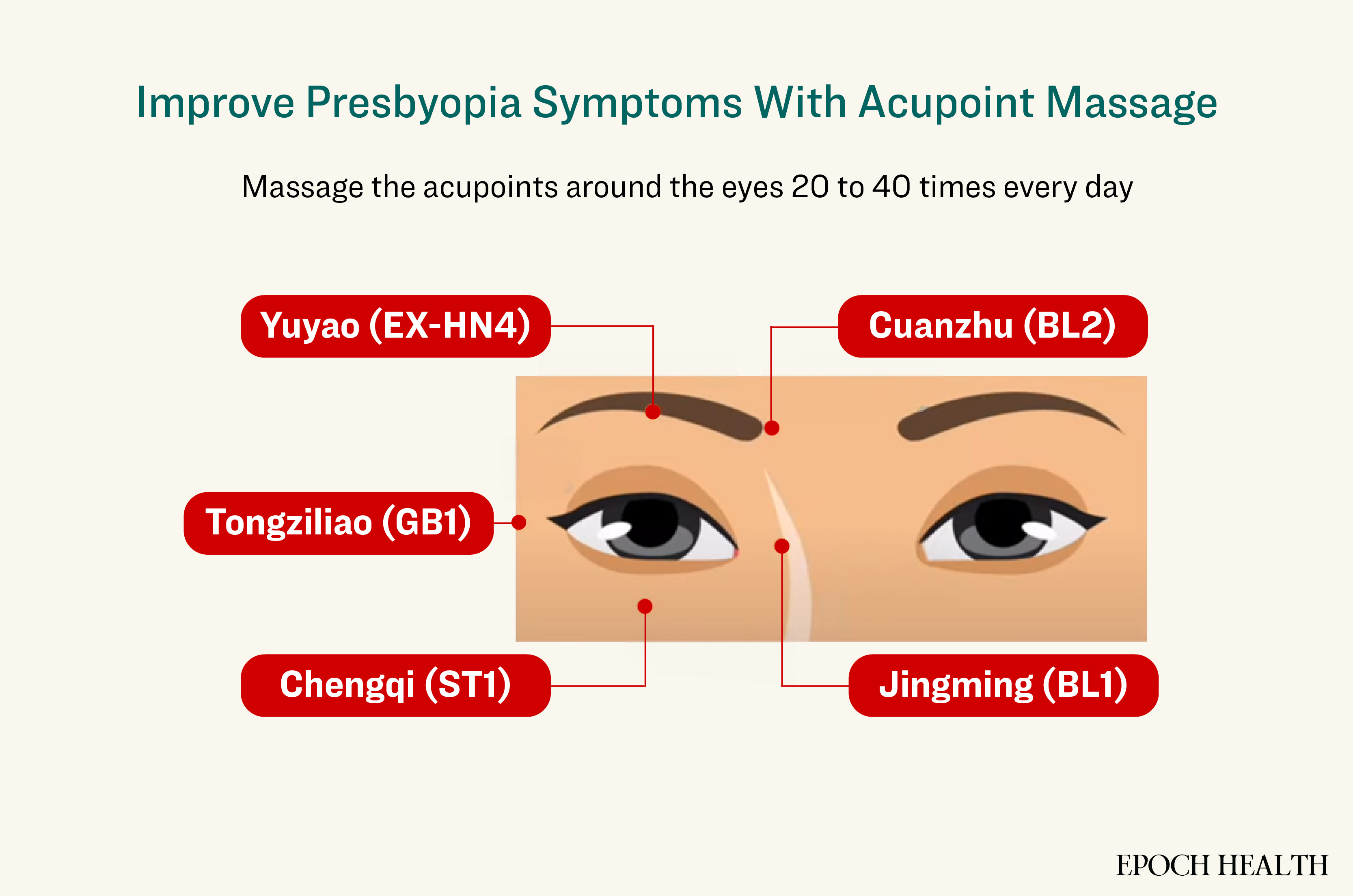
Acupoint Locations
• Yuyao: Depression of the orbital bone at the midpoint of the eyebrows.Instructions
Curl your index finger and gently press on these acupoints using the knuckle. Massage them in sequence, repeating the process 20 or 40 times daily to effectively alleviate presbyopia and improve dark circles.Herbal Teas for Improving Dark Circles
Dark circles are a prevalent concern, often associated with the appearance of fatigue and aging. The underlying cause is typically poor blood circulation around the eyes, described in TCM as “qi stagnation and blood stasis.” It accelerates the aging of the skin around the eyes, leading to sagging eyelids and the formation of dark circles. Factors such as poor sleep, staying up late, excessive eye strain, allergies, and dry eye syndrome can contribute to the development of dark circles.Drinking tea made from the following five medicinal herbs can help to alleviate dark circles:
Preparation
Combine herbs and bring to a boil in 35 fluid ounces (3.5 cups) of water, simmer for 15 to 20 minutes, and it’s ready to drink. This tea can help to alleviate eye strain and discomfort, as well as to slow down the aging of the eyes.In ancient Chinese texts, the pairing of goji berries and white chrysanthemum in this formula is documented as an excellent eye-protective remedy. These ingredients are often crafted into pills, and taking them regularly is believed to prevent eye diseases. You can also freeze goji berries and grab a few whenever you crave them. They boast a sweet taste, somewhat resembling raisins.
Exercises to Enhance Eye Accommodation Ability
Presbyopia, also known as age-related farsightedness, is a refractive error resulting from the loss of elasticity in the crystalline lens and the surrounding ciliary muscles inside the eyes as we age. This prevents light from accurately focusing onto the retina.Myopia, or nearsightedness, is also a refractive error that hinders clear vision of distant objects and can lead to eye fatigue or headaches. Myopia can develop in childhood, particularly in modern times when people start using mobile devices at a young age, spend extended periods staring at screens, and engage in prolonged reading—all of which are major contributors to its onset.
Both presbyopia and myopia stem from a decline in the eye’s accommodation ability and refractive errors. Extended periods of staring at the screens of various devices can lead to infrequent blinking. This diminishes the eye’s accommodation ability and can lead to issues such as myopia, presbyopia, and dry eyes.
We can train the eye’s accommodation ability, specifically the ciliary muscle, through some simple methods. Such training aims to enhance the elasticity of the lens, enabling them to clearly see objects at different distances. The training methods are as follows:
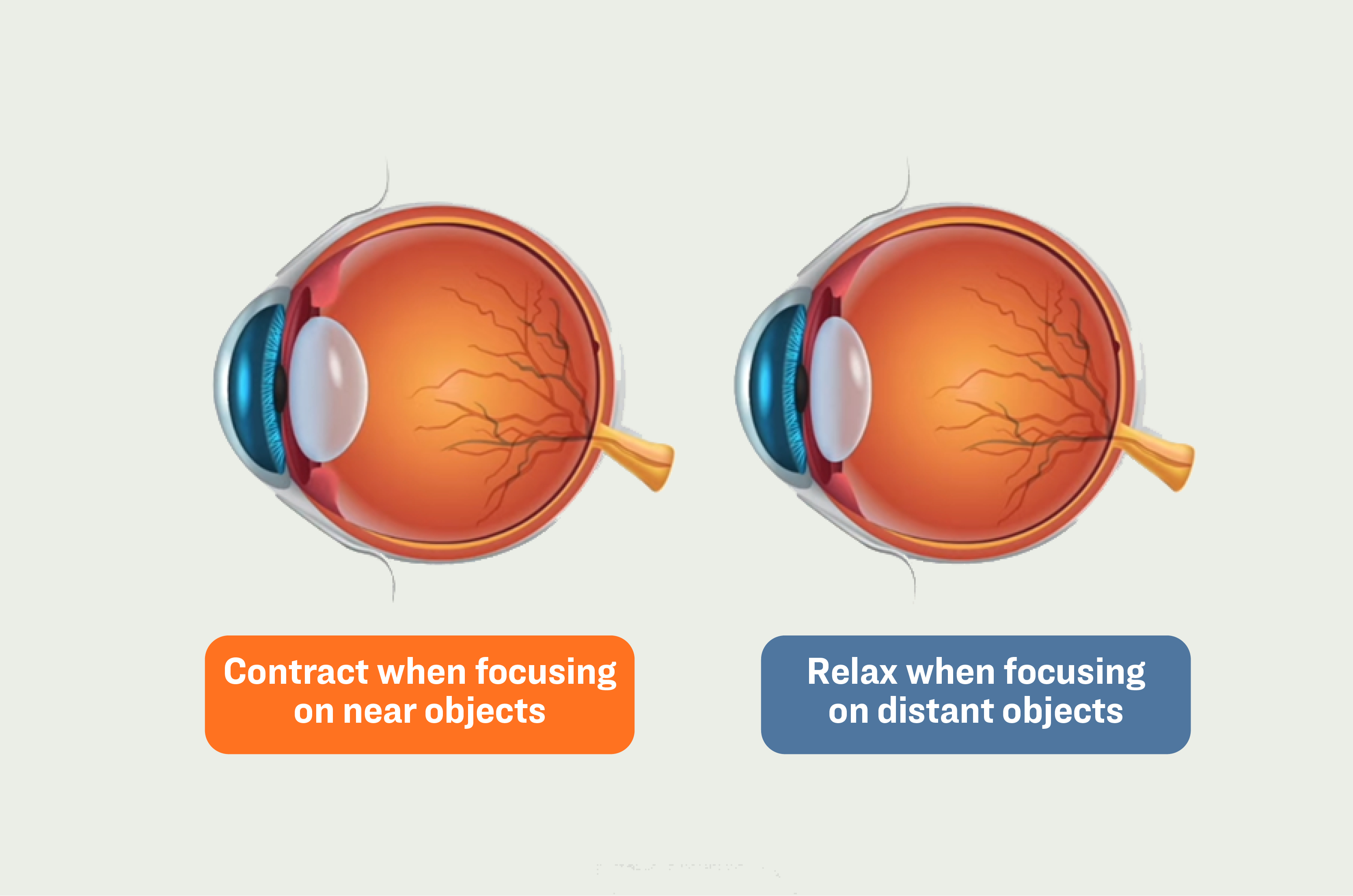
Alternating Focus Between Distant and Nearby Objects
In an outdoor setting, focus your eyes on a distant object, such as a lightning rod on a building or faraway tree branch, then shift your gaze to a nearby object approximately 1 foot away. Repeat this process of looking at distant and nearby objects, allowing the eyes to rapidly adjust their focal point. This exercise trains the ciliary muscle to contract and relax quickly, enhancing the eye’s accommodation ability.Enlarging Small Objects
In an outdoor setting, focus your eyes on a very small object, such as the tip of a tree branch. Then, try to make it appear larger, such as the size of a basketball. Next, shift your focus to an even-smaller object, such as the top of a wheat spike, and magnify it as well. Repeating this process allows the eyes to concentrate on details, enhancing their sharpness and accuracy.Adjusting Posture to Prevent Myopia
Sitting posture is also a crucial factor affecting the eyes. Incorrect posture can easily lead to eye strain. When writing or reading, be mindful of the following two points:Alleviating Pseudo Myopia With Ear Acupuncture
Ear acupuncture is a TCM treatment that involves inserting needles, attaching small magnet pellets, or placing rice grains on specific acupoints on the ear to stimulate the corresponding areas. This treatment approach aims to regulate qi and blood circulation and treat various health issues. The ear contains numerous acupoints related to the eyes, including the “cervical vertebrae C3 acupoint,” “optic nerve acupoint,” and “eye muscle acupoint” (as shown in the diagram).
- Choose the ear on the side with poor eyesight.
- Locate the three acupoints (mentioned in the diagram) on that ear.
- Attach a small magnet pellet or rice grain to each of these three acupoints, securing them with tape.
- Gently cover the eye with poor eyesight, and let it rest.
- Use your fingers to press on the three acupoints on the ear for about 30 minutes. Then, open the eye. Vision will gradually improve.