STORY AT-A-GLANCE
- Research has linked sweetened beverages—both sugar and artificially sweetened—with an increased risk of depression, the highest risk being associated with diet fruit drinks and diet soda
- Another study found adolescents who had elevated levels of sodium and low levels of potassium in their urine—two factors indicative of a diet high in junk food and processed food—had more frequent symptoms of depression
- A 2019 study found dietary intervention can effectively treat depression in young adults. Those who ate a Mediterranean-style diet reported a significant reduction in depression symptoms after 21 days
- A recent meta-analysis also concluded that “Dietary interventions hold promise as a novel intervention for reducing symptoms of depression across the population”
- As a general guideline, eating a whole-food diet can go a long way toward lowering your inflammation level and thus your risk of depression. A cornerstone of a healthy diet is limiting sugar of all kinds, ideally below 25 grams a day
The Sugar Trap
Research [1] published in 2014 linked sweetened beverages—both sugar and artificially sweetened—with an increased risk of depression. Those who drank more than four cans or glasses of soda a day had a 30 percent higher risk of depression compared to those who did not consume sweetened beverages of any kind.Interestingly, fruit juices were even more hazardous. The same amount of sweetened fruit drinks (four glasses) was associated with a 38 percent higher risk of depression.
- Those who drank primarily diet soda were 31 percent more likely to suffer from depression, whereas regular soda was associated with a 22 percent increased risk
- Those who drank primarily diet fruit drinks had a 51 percent higher risk for depression, while consuming regular fruit drinks was associated with a more modest 8 percent increased risk
- Drinking primarily diet iced tea was associated with a 25 percent increased risk for depression, whereas those who drank regular sweetened iced tea actually had a 6 percent reduced risk
Why Sugar Takes a Toll on Mental Health
There are at least four potential mechanisms through which refined sugar intake could exert a toxic effect on mental health:- Sugar (particularly fructose) and grains contribute to insulin and leptin resistance and impaired signaling, which play a significant role in your mental health
- Sugar suppresses the activity of a key growth hormone called brain-derived neurotrophic factor (BDNF), which promotes healthy brain neurons. BDNF levels are critically low in both depression and schizophrenia, which animal models suggest might actually be causative
- Sugar consumption also triggers a cascade of chemical reactions in your body that promote chronic inflammation. In the long term, inflammation disrupts the normal functioning of your immune system, which is linked to a greater risk of depression [4]
- Sugar impairs the microbiome and its influence on the modulation of the stress response, immune function, neurotransmission, and neurogenesis
“A higher national dietary intake of refined sugar and dairy products predicted a worse 2-year outcome of schizophrenia. A high national prevalence of depression was predicted by a low dietary intake of fish and seafood.
Three-Week Dietary Intervention Lifts Depression
More recently, a study [6], [7], [8] published in the October 2019 issue of PLOS ONE said to be the first of its kind, found dietary intervention can effectively treat depression in young adults. The researchers enrolled 101 individuals aged 17 to 35, whose stress and depression scores indicated moderate to high levels of depression.Participants were divided into two groups. One received dietary intervention while the other (controls) received no intervention. Dietary instructions were provided to the treatment group by a registered dietician via a 13-minute video, which could be revisited at will.
- Five servings of vegetables per day
- Two to three servings of fruit per day
- Three servings of wholegrain cereal per day
- Three servings of protein (such as lean meat, poultry, eggs, or legumes) per day
- Three servings of unsweetened dairy per day
- Three servings of fish per week
- 3 tablespoons of nuts and seeds per day
- 2 tablespoons of olive oil per day
- 1 teaspoon of turmeric and cinnamon on most days
“There is strong epidemiological evidence that poor diet is associated with depression. The reverse has also been shown, namely that eating a healthy diet rich in fruit, vegetables, fish and lean meat, is associated with reduced risk of depression …
Dietary Intervention Significantly Lowers Depression Scores
The first graph below illustrates the difference in primary depression scores (based on Centre for Epidemiological Studies Depression Scale or CESD-R) between the two groups. The second graph illustrates the difference between the two groups based on DASS-21 depression subscale scores.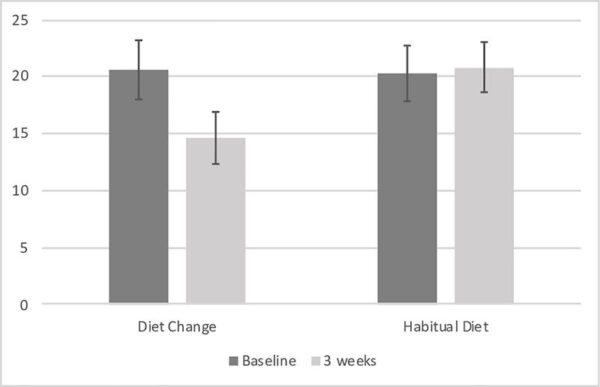
Source: PLOS ONE October 9, 2019, Figure 2[11]
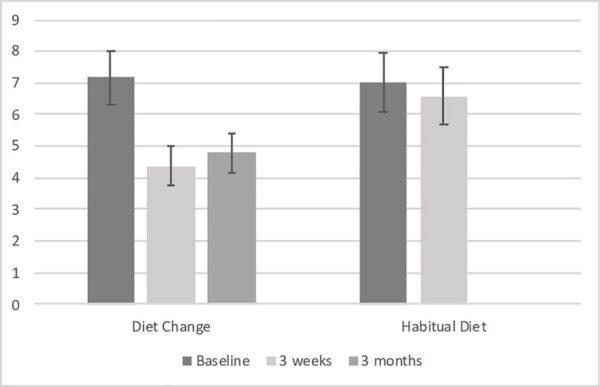
Source: PLOS One October 9, 2019, Figure 3[12]
“The results of this RCT provide support for improving diet as a useful adjunct treatment to reduce depressive symptoms … One of the most interesting findings is the fact that diet change was feasible in this population.
Other Studies Support Dietary Intervention for Mental Health
Another recent paper found similar results. The meta-analysis, [14] published in the April 2019 issue of Psychosomatic Medicine, looked at 16 randomized controlled trials with outcome data—based on a variety of depression scores—for 45,826 participants ranging in age from 21 to 85. Interventions ranged from 10 days to three years.While all but one examined nonclinical depression, dietary interventions were still found to significantly reduce symptoms of depression. Interestingly, women appeared to reap the greatest benefits, not only for depression but also anxiety. According to the authors, “Dietary interventions hold promise as a novel intervention for reducing symptoms of depression across the population.”
Interestingly, studies specifying the involvement of a nutritional professional had significantly better results than those in which the dietary advice was delivered without a professional’s involvement.
Mechanisms of Action
In the Implications and Recommendations section of the Psychosomatic Medicine meta-analysis, the authors point out a number of possible mechanisms of action allowing depressed patients to benefit from nutritional intervention [15]:“… diet may act via several pathways that are implicated in mental health. These include pathways related to oxidative stress, inflammation, and mitochondrial dysfunction, which are disrupted in people with mental disorders.
Nutritional Advice for Mental Health
Keeping inflammation in check is an important part of any effective mental health treatment plan. If you’re gluten sensitive, you will need to remove all gluten from your diet. A food sensitivity test can help ascertain this. Reducing lectins may also be a good idea.- Marine-based omega-3 fats—Omega-3 fats have been shown to improve major depressive disorder, [17] so make sure you’re getting enough omega-3s in your diet, either from wild Alaskan salmon, sardines, herring, mackerel, and anchovies, or a high-quality supplement.
I recommend getting an omega-3 index test to make sure you’re getting enough. Ideally, you want your omega-3 index to be 8 percent or higher. - B vitamins (including B1, B2, B3, B6, B9, and B12)—Low dietary folate can raise your risk of depression by as much as 304 percent [18], [19]. A 2017 study [20], [21] showing the importance of vitamin deficiencies in depression involved suicidal teens. Most turned out to be deficient in cerebral folate and all of them showed improvement after treatment with folinic acid.
- Magnesium—Magnesium supplements have been shown to improve mild-to-moderate depression in adults, with beneficial effects occurring within two weeks of treatment. [22]
- Vitamin D—Studies have shown vitamin D deficiency can predispose you to depression and that depression can respond favorably to optimizing your vitamin D stores, [23] ideally by getting sensible sun exposure..
“The Third National Health and Nutrition Examination Survey, which enrolled a sample of 7,970 non-institutionalized U.S. residents age 15 to 39, confirmed that people with serum vitamin D ≤50 nmol/L [20 ng/mL] are at a significantly higher risk of showing depression than individuals whose serum levels of vitamin D are greater or equal to 75 nmol/L [30 ng/mL] …
Helpful Supplements
A number of herbs and supplements can also be used in lieu of drugs to reduce symptoms of anxiety and depression, including the following:- St. John’s Wort (Hypericum perforatum)—This medicinal plant has a long historical use for depression and is thought to work similarly to antidepressants, raising brain chemicals associated with moods such as serotonin, dopamine, and noradrenaline. [28]
- S-Adenosyl methionine (SAMe)—SAMe is an amino acid derivative that occurs naturally in all cells. It plays a role in many biological reactions by transferring its methyl group to DNA, proteins, phospholipids, and biogenic amines. Several scientific studies indicate that SAMe may be useful in the treatment of depression.
- 5-Hydroxytryptophan (5-HTP)—5-HTP is another natural alternative to traditional antidepressants. When your body sets about manufacturing serotonin, it first makes 5-HTP. Taking 5-HTP as a supplement may raise serotonin levels. Evidence suggests 5-HTP outperforms a placebo when it comes to alleviating depression, [29] which is more than can be said about antidepressants.
- XingPiJieYu—This Chinese herb, available from doctors of traditional Chinese medicine, has been found to reduce the effects of “chronic, unpredictable stress,” thereby lowering your risk of depression. [30]