The plantar fascia is a thick band of tissue on the sole of the foot. It connects the heel bone to the toes and forms the arch. Plantar fasciitis occurs when the plantar fascia becomes inflamed due to excessive strain or pressure.
Common symptoms of plantar fasciitis include heel pain and stiffness. While many people turn to massage for symptom relief, preventing plantar fasciitis involves more than reducing pressure on the feet. It is crucial to improve foot flexibility, strengthen foot muscles, and enhance ankle stability. Rocky Liao a classical Chinese dance instructor, introduces four methods to help relieve fascia tension and activate the foot muscles.
Common Causes of Plantar Fasciitis
- Poor posture: Proper walking mechanics involve landing on the heel first, transferring weight to the ball of the foot, and pushing off with the toes. However, many people tend to drag their feet without fully lifting them while walking, or sit with their legs crossed or in a slouched position. These habits can negatively affect the health of the foot arch.
- Obesity: Excessive weight can cause improper foot posture while walking and flatten the arch, potentially leading to adult-acquired flatfoot.
- Inappropriate footwear: Wearing shoes that lack arch support, such as flat shoes or slippers, or using ill-fitting footwear over a long period, can result in uneven pressure distribution across the foot, eventually causing pain. Many people experience relief once they switch to proper, supportive footwear.
- Aging: As we age, the plantar fascia gradually degenerates and loses elasticity, reducing its shock-absorbing ability. This explains why plantar fasciitis is more common after the age of 40. However, modern sedentary lifestyles—characterized by prolonged standing, sitting, and a lack of exercise—can cause foot function to deteriorate earlier.
- Walking on uneven surfaces: Regularly walking on uneven surfaces over long periods, combined with insufficient shock absorption and foot flexibility, increases the risk of developing plantar fasciitis.
- Limited dorsiflexion: People with limited dorsiflexion (reduced ability to bend the foot upward at the ankle) often experience tight calf muscles, which can increase their likelihood of developing plantar fasciitis.
Exercise 1: Forward Bends
Tight calf muscles can also affect the knees and thighs. Rocky explained that if the tendons behind the knee are not stretched regularly, it can lead to poor knee coordination and decreased mobility, potentially accelerating degeneration and increasing the risk of ankle sprains or falls. Therefore, while relaxing the calf muscles, it is important to also stretch the tendons behind the knees and thighs.Standing Forward Bend
Steps:- Stand with your feet shoulder-width apart, ensuring a stable stance. Interlock your fingers and raise your arms above your head, palms facing upward.
- While keeping your back straight (without bending or hunching), slightly arch your lower back and engage your core.
- Using your lower back muscles, bend forward until your hands touch your feet or the floor. For an advanced variation, aim to press your stomach against your thighs. Focus on stretching the muscles at the back of your legs.
- Hold the stretch for five seconds, then relax and return to an upright position. Repeat 10 times. Advanced practitioners can gradually increase the hold time.
Seated Forward Bend
Steps:- Sit with your legs extended forward and toes flexed upward. Interlock your fingers and raise your arms above your head, palms facing upward.
- While keeping your back straight (without bending or hunching), slightly arch your lower back and engage your core.
- Using your lower back muscles, bend forward and wrap your arms around your legs, aiming to press your stomach against your thighs.
- Hold the stretch for five seconds, then relax and return to an upright position. Repeat 10 times. Advanced practitioners can gradually increase the stretch duration.
Exercise 2: Calf-Focused Lunge Stretch
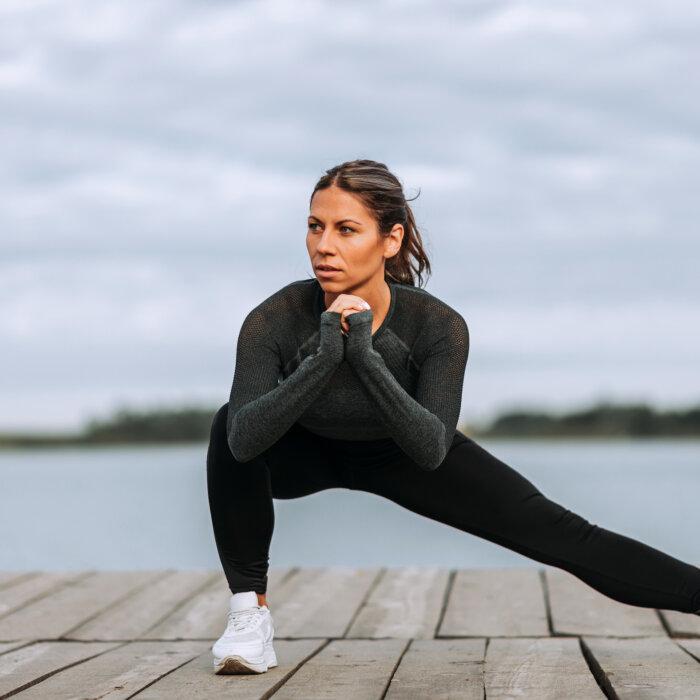
- Stand with both feet facing forward. Keep your left foot in place and step your right foot forward into a wide lunge.
- Bend your right knee while keeping your left leg straight, ensuring the left heel stays on the ground to stretch the calf and Achilles tendon of the left leg. Beginners can use a wall for support.
- Hold the stretch for five seconds, then relax. Repeat 10 times. Advanced practitioners can gradually increase the stretch duration.
- Switch legs and repeat the exercise.
Before starting ankle training, it is important to understand proper standing posture and learn how to balance your weight evenly without leaning or tilting.
Proper Standing Posture
Stand with your heels together and your toes pointing outward in a V-shape. Engage your calves, knees, and inner thighs, pressing them together until they make seamless contact. Tighten your glutes to activate the hip muscles, and engage your core by pulling in your lower abdomen.For the upper body, draw your shoulders outward, spreading them to the sides. Lift your chest slightly without arching your lower back, and keep your shoulders relaxed to avoid hunching or tension. Finally, shift your center of gravity slightly forward to complete the posture. Make sure to breathe naturally throughout, without holding your breath.

Exercise 3: Calf Raises
- Begin in the proper standing posture. Use only the strength of your Achilles tendon to lift your heels off the ground, rising onto your toes. Beginners can use a wall or chair for support.
- Lower your heels back down, keeping your heels, calves, knees, and inner thighs engaged and pressed together throughout the movement.
Exercise 4: Small Jumps
Small jumps, like those in jump rope exercises, are essentially an extension of calf raises, turning the motion of rising onto your toes into a jump. Start from the proper standing posture and perform small jumps in the sequence: squat, jump, squat, tighten. During takeoff, it is best to push off from your toes and extend them—this helps absorb the impact and act as a buffer when landing. Dancers land silently by using the second squat to distribute the impact and dissipate the force effectively, according to Liao.These videos are sourced from the Health Development Diary program.
Views expressed in this article are the opinions of the author and do not necessarily reflect the views of The Epoch Times. Epoch Health welcomes professional discussion and friendly debate. To submit an opinion piece, please follow these guidelines and submit through our form here.