Tune in Today: Godefroid’s Harp Concert Etude

Felix Godefroid and his support of the double-action harp assured the ancient instrument a place in the concert hall.
Tune in Today: Godefroid’s Harp Concert Etude
Harpist Felix Godefroid wrote Etude de Concert for the Harp. Internet Archive. Public Domain
|Updated:
0:00

The harp has an illustrious history. From the ancient Egyptian bow harp (called a “benet”) to the lap harps of Mesopotamia, the image of gleaming silver strings strung on a polished wooden frame has become synonymous with elegance and beauty.

Now, the modern harp has become a staple of the symphony orchestra, playing a crucial role in the symphonic repertoire. However, despite its orchestral success, the development of the harp as a virtuosic solo instrument was complicated. At one point, the harp seemed destined to be no more than an orchestral texture, or an accompanist at best. However, Felix Godefroid and his support of the double-action harp changed everything.

The Harp Virtuoso Godefroid

Felix Godefroid (1818–1897) was perhaps the most influential harp player of the 19th century. The composer Hector Berlioz said of the virtuoso, “Monsieur Godefroid, absolute master of his instrument, is of such power that he needs not fear any competition.” Godefroid’s skill as a player translated into his prowess as a composer, as the Belgian virtuoso wrote many solo harp masterworks, including the popular “La danse des Sylphes” and “La harpe éolienne.” These works pushed the technical possibilities of the instrument in fresh and previously unimagined ways.
Godefroid came at a crucial time, as the viability of the solo harp was in jeopardy. The pyrotechnics of Franz Liszt and Frederic Chopin had propelled the piano into super-stardom, while the harp, despite being a vastly different instrument, suffered from unfavorable comparisons to the piano. Godefroid’s own teacher, Théodore Labarre, wrote compositions that “marked an obvious tendency to want to compare the harp to the piano,” according to Godefroid’s student, Alphonse Hasselmans.

Godefroid was different in that his compositions emphasized the harp’s innate qualities, bringing out a sort of natural virtuosity in the player. This was possible through his championing of the double-action harp, a new type of harp that allowed the player to alter the pitches of strings up to a whole tone, allowing for chromaticism like that of the piano. Employing the new instrument, he wrote repeated note and trill patterns that were previously impossible to execute. The double-action harp is now the staple of the concert hall.
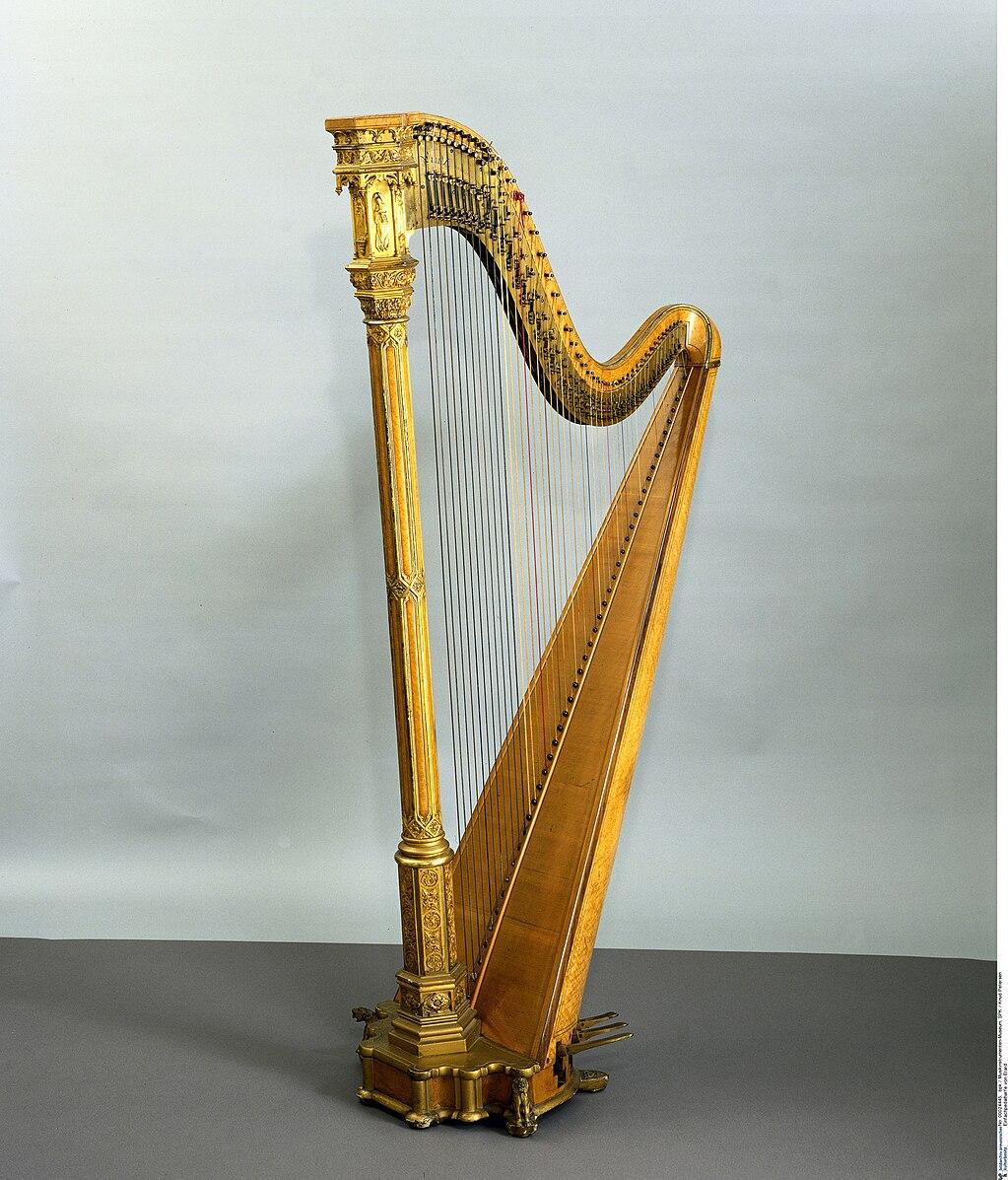
The German double-action harp has pedals, which enable it to create the kind of virtuosic music fit for an orchestra hall. State Institute for Musical Research, Berlin. (<a href="https://commons.wikimedia.org/wiki/User:Musikforschung">Museum of Musical Instruments/Knud Petersen</a>/<a href="https://creativecommons.org/licenses/by-sa/4.0/deed.en">CC BY-SA 4.0</a>)
The German double-action harp has pedals, which enable it to create the kind of virtuosic music fit for an orchestra hall. State Institute for Musical Research, Berlin. Museum of Musical Instruments/Knud Petersen/CC BY-SA 4.0

Etude de Concert

Emmanuel Ceysson performs Godefroid’s Etude de Concert Op. 193 in this superb rendition. (Listen)

The opening chords are somber and noble, setting the mood of the key of E-flat minor. After a flourish up to the high register, 0:50, the music intensifies. While the right hand performs a complex choreographed routine, the left hand is undisturbed in weaving the melodic line. The infamous repeated notes are almost constant through the piece, providing counterpoint to the gently sweeping melody.

What arts and culture topics would you like us to cover? Please email ideas or feedback to [email protected]
Google LogoMark Us Preferred on Google
George Cai
George Cai
Author
George Cai, a cellist and an enthusiast of classical music, has toured the globe from Carnegie Hall to the Deutsche Oper Berlin. He resides in New York.