The summer of 1788 saw Wolfgang Amadeus Mozart complete his final three symphonies. Over the course of six weeks, he completed No. 39 in E-flat Major, No. 40 in G Minor, and No. 41 in C Major, “Jupiter.”
Dubbed the “Great G Minor,” this symphony may be the culmination of the classical symphony. It’s also one of the darkest works in Mozart’s catalogue, captivating modern audiences with its sense of underlying intensity.
“God! I am in a predicament which I would not wish on my worst enemy,” Mozart wrote to friend and fellow Freemason Michael Puchberg in July of 1789. Citing his wife’s illness, Mozart made clear this wasn’t the first time he'd had to beg for money. Just a year earlier in June, also to Puchberg, Mozart asked for a “great favor,” despite still owing money. “Although I am currently not in a position to pay this back to you ... I venture to ask you to help me out with 100 florins until next week (when my concerts in the Casino begin).”
Mozart was likely composing music for gambling institutions. These “casinos” most likely bore more resemblance to country clubs than the casinos of today; the Symphony No. 40 was possibly intended for performance for the a proprietor, Philipp Otto. Biographer Otto Erich Deutsch suggested a series of three “Concerts in the Casino” took place, but that’s difficult to confirm.
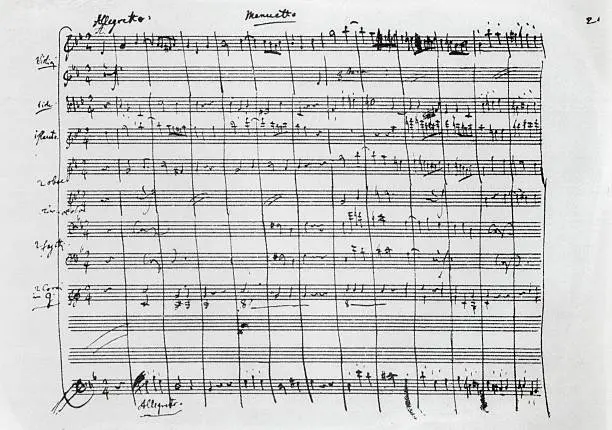
Mozart Symphony No. 40
Today’s recording of the first movement of Mozart’s Symphony No. 40 in G Minor, K. 550, “Molto allegro,” is by the Berliner Philharmoniker led by Karl Böhm. (Listen)
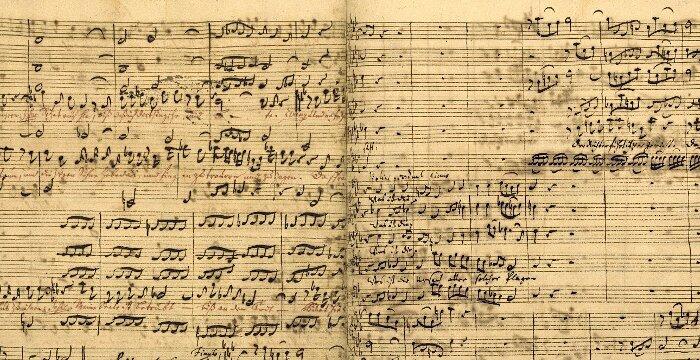
The beginning of the movement, a series of undulating eighth notes played by divided violas, was novel to audiences at the time. While the opening is simple, the idea of starting with naked accompaniment was unexplored territory. The technique became favored by later Romantics, such as Mendelssohn in his Violin Concerto in E Minor.
The melody enters almost immediately after, a sighing figure which sounds constantly questioning. The notes embody an internal struggle, famously described as an unrelieved “minorness” which carries through to the end of the work. At 0:55, the atmosphere grows more relaxed, exhibiting hints of a more uninhibited sound. The strings dance, followed by an echo in the flutes and clarinets, with the clarinets being a later addition that Mozart included in a revision of the score.
By 4:20, the sighing figure by the violins sinks lower and lower. When the cellos interrupt, the music devolves into a quasi-fugue, where different voices fight among themselves, all while an undercurrent of running notes raises the tension. The muted atmosphere that follows leads us back to the main subject at 5:34, this time with a mournful bassoon bass line embellishing it.
Conductor Nikolaus Harnoncourt viewed Mozart’s “Great G Minor” as part of a greater whole. He argues that Mozart’s final three symphonies form a unified cycle, bridging the musical keys of E-flat major, G minor, and C major. Deliberate or not, Mozart’s final statements in the symphonic genre are often scrutinized and juxtaposed against one another. In that sense, the turbulence and anxiety of Mozart’s “Symphony No. 40” can be understood not as a final destination, but as a bridge. Its darkness finds resolution in the triumph of his “Symphony No. 41” in C major, the “Jupiter,” bringing the emotional and tonal journey to a compelling close.