Many people assume poor posture is the main cause of spinal problems. But according to rehabilitation physician Dr. Scott Wang, posture is only one piece of the puzzle. The gradual wear and tear that comes with aging plays a much larger role in many common spinal disorders.
“As we get older, the joints, ligaments, and intervertebral discs that support the spine gradually wear down,” Wang told The Epoch Times. “That degeneration increases the risk of several spinal conditions.”
Although aging is inevitable, how quickly the spine ages is influenced by everyday habits. Regular exercise, maintaining a healthy weight, and avoiding smoking can all help preserve spinal function well into older age.
How Aging Changes the Spine
Age-related degeneration affects nearly every part of the spine. As supporting structures gradually weaken, the spine becomes less stable, bones lose strength, and intervertebral discs wear down. These changes underlie many of the spinal conditions seen in older adults.
The Spine Becomes Less Stable
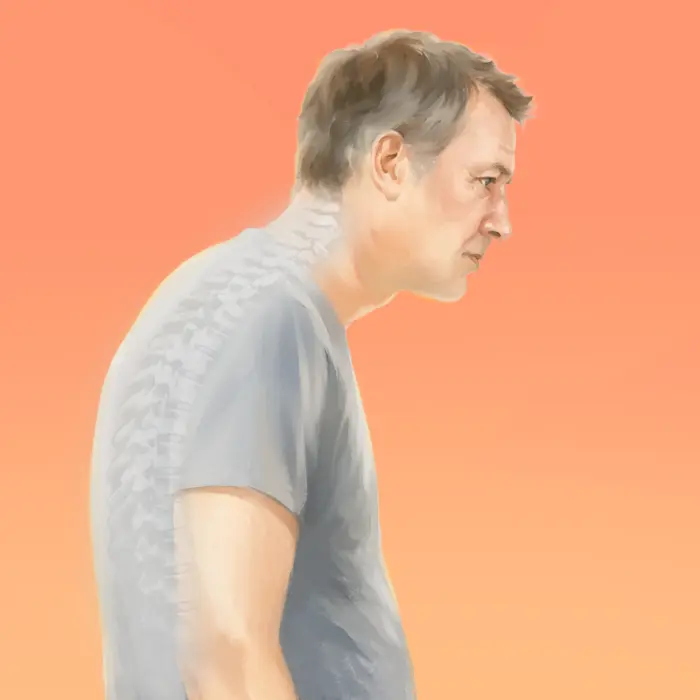
As people age, the joints, ligaments, and intervertebral discs that stabilize the spine gradually weaken. This loss of stability can allow one vertebra to slip forward or backward—a condition known as spondylolisthesis, which is especially common in women over 40.
Wang compares the spine to a stack of building blocks. As the supporting structures wear down, the stack becomes less stable, making it easier for one vertebra to shift out of place.
Bones Weaken and the Spine Can Curve
Scoliosis is often thought of as a condition affecting teenagers, but many older adults develop a different form later in life.
Unlike adolescent scoliosis, which is largely linked to genetics, degenerative scoliosis develops as osteoporosis and age-related wear weaken the spine over time.
Wang compares an osteoporotic spine to a tower of Jenga blocks that has become as fragile as crackers. As the supporting structures weaken, the spine may gradually tilt and curve.
Although peak bone density is generally reached before age 35, Wang said resistance training can still help slow bone loss.
“It’s never too late to start exercising,” he said.
The Discs Gradually Wear Out
Intervertebral discs act as shock absorbers between the vertebrae. Wang compares each disc to a water-filled balloon that cushions the spine during movement.
Over time, aging, repetitive stress, injuries, and congenital factors can gradually damage these discs, eventually leading to disc herniation.
One of the most surprising findings, Wang said, is that disc degeneration is extremely common even among people without symptoms.
MRI studies show that approximately 30 to 37 percent of people around age 20 already have evidence of disc herniation. By age 80, that figure rises to between 84 and 96 percent. In other words, abnormalities seen on imaging do not necessarily explain a person’s pain.
Everyday Habits Can Speed Spinal Aging
While aging cannot be avoided, lifestyle habits can accelerate the degeneration process.
Smoking reduces blood flow throughout the body, limiting the supply of nutrients to the intervertebral discs. Over time, poor circulation speeds disc degeneration and weakens the spine.
Excess body weight places additional mechanical stress on the spine while visceral fat releases inflammatory substances that can damage joints, blood vessels, nerves, and other tissues. Together, these effects make obesity one of the major accelerators of spinal aging.
How to Slow Spinal Aging
According to Wang, maintaining a healthy spine begins with slowing degeneration and supporting healthy circulation.
Maintaining a healthy weight reduces stress on the spine while lowering inflammation. Avoiding smoking helps preserve circulation to spinal tissues, and avoiding prolonged sitting while exercising regularly strengthens the muscles that support the spine.
For people recovering from spinal surgery, Wang also recommends following their physician’s rehabilitation plan and resuming movement as soon as medically appropriate.
2 Exercises to Maintain Spinal Health
Wang recommends combining moderate running with strength training.
Moderate running promotes repeated loading and unloading of the intervertebral discs, helping nutrients move into disc tissue and supporting disc health. Strength training improves core stability, providing better support for the spine.
1. Deadlift
I highly recommend that beginners practice deadlifts. During a deadlift, it is necessary to maintain a neutral spine and core stability, making it an effective exercise for training the gluteal muscles, legs, and core muscles. Beginners or those recovering after surgery can start with water bottles or light dumbbells.
Step 1: Stand with your feet shoulder-width apart, with your toes slightly turned outward. Hold a water bottle or dumbbell in each hand and let your arms hang naturally by your sides.
Step 2: Push your hips backward and slightly bend your knees. Keep your back straight, maintain a neutral spine, and keep your shoulder blades stable and pulled down.
Step 3: Inhale and engage your core. Push firmly through the floor with your feet, and use your glutes and thighs together to straighten your body until you are standing fully upright.
Step 4: Slowly return to the starting position and repeat.
2. Cat-Cow Stretch
The cat-cow stretch is well suited for daily practice. It can help improve spinal mobility and make the back more flexible.
Step 1: Start on all fours in a tabletop position. Place your hands directly under your shoulders and your knees directly under your hips.
Step 2: As you inhale, tilt your tailbone upward and backward, gently arch your back, lift your chest, and tilt your head back to look upward.
Step 3: As you exhale, tuck your pelvis under and curl your tailbone inward, allowing your back to round upward. Draw your chin toward your chest as much as comfortably possible.