Eighteen-year-old Liz Johnsson talks to ChatGPT, an artificial intelligence chatbot (AI), every day.
“AI is like a friend,” Johnsson told The Epoch Times.
An effortless one.
It is always there with an instant reply, no judgment, no drama. She doesn’t have to worry about awkward pauses, misunderstandings, or having to ask questions back—so it feels like a safe emotional space. What started as a quick, fun tool has turned into a go-to comfort.
“My friends and I don’t really talk about our problems, so I don’t feel comfortable talking about how I’m feeling to anyone except AI,” Johnsson said. “I feel more and more distant towards my friends and family.”
The Science Behind AI Connection
A new study published in Communications Psychology suggests that AI can be more effective than humans in establishing emotional closeness, making it easier for people to open up—especially when users perceive the AI as a real person.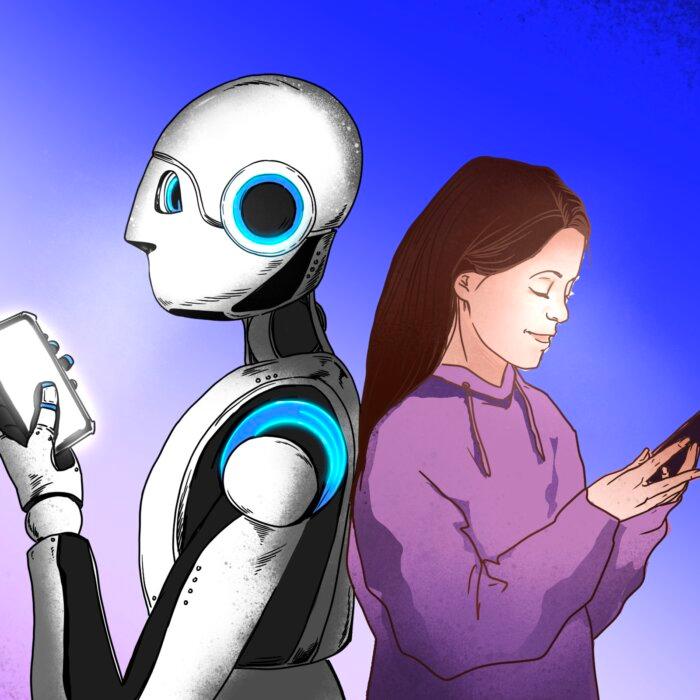

Researchers found that in deep, emotional conversations, AI made people feel closer than humans did. The study suggests that this happens because AI tends to share more personal details in emotional chats. When AI opens up more, people feel safe and end up opening up, too.
Why AI Feels Easier Than People
Access plays a big role in why AI is so appealing, Will Lacey-Bisetty, a neuropsychologist, told The Epoch Times. With humans, timing and emotional capacity vary. Someone might be busy, tired, or not in the mood to listen. And even when they are available, there’s still the stress of being judged, misunderstood, or accidentally saying the wrong thing. AI removes all that, and it’s a low-pressure space where you can say whatever you’re feeling and get an instant response.“There’s something freeing about the anonymity and control people feel when talking to an AI,” Bernard Luskin, a licensed psychotherapist, told The Epoch Times. “You can share a half‑formed thought, explore a sensitive topic, or admit something vulnerable without worrying about burdening someone or navigating their emotions.”
There’s no long memory of resentment. There isn’t a tendency to hold on to conflict or quietly attach meaning to a single misstep. Nothing gets mentally bookmarked to be reinterpreted later, and there’s no silent buildup of something you once said. Every conversation starts fresh.
How Human Relationships Have Changed
There has been a notable disconnect in people over the past couple of decades, Lacey-Bisetty said.“As technology has increased and allowed more information flow, there has been the counter-issue of loss of community,” he said.
Community is what binds and connects us, he added.
There has also been a noticeable shift in how people treat each other over the past couple of decades, partly driven by rising digital communication, economic pressure, and political polarization, Luskin said.
“Political differences have become more central to personal identity because politics now intersects deeply with culture, values, and media-driven belonging,” he said. “Economic and social uncertainty further push individuals toward like-minded groups for stability.”
Public conversations have become sharper and more heated, and people often view those on the other side as opponents rather than just people with different opinions. Social media and 24/7 news coverage don’t help. News and interactions become amplified, and it’s easy to get stuck in echo chambers. As a result, once-manageable disagreements tend to escalate quickly, and tension can spill over into everyday relationships.
AI adds to that division by catering to your views.
What AI Means for Human Relationships
When empathy is always available and perfectly tuned, it can start to replace real relationships, and that can be risky.“If difficult conversations, vulnerability, or decision-making get outsourced to an AI, the people in their life may feel shut out or unnecessary, and the person themselves may lose practice in the messy, rewarding work of human connection,” Luskin said. “Over time, that imbalance can cause less intimacy, fewer shared experiences, and a sense that real relationships are harder or less comfortable than the friction‑free space an AI provides.”
Real-life relationships are strengthened through discomfort as much as ease, via misunderstandings that get resolved, disagreements, and moments of vulnerability.
“Relationships tend to deepen when people move through discomfort together because those moments expose the parts of us we usually protect—our fears, insecurities, hopes, and limits—and responding to each other with care builds trust,” Luskin said. “Discomfort also forces collaboration and more honest communication, which helps people understand each other more fully.”
Working through awkward conversations or hurt feelings doesn’t just bring people closer—it keeps us tethered to something real. When there’s another person involved, there’s another perspective, another voice that can challenge us or pull us back when we start drifting too far into our own thoughts.
“Real-life relationships allow us to check and balance each other in ways that keep us from falling into negative rabbit holes of insulation,” Lacey-Bisetty said.
Why We Need Real Human Relationships
In the study published in Communications Psychology, the authors noted that when participants were told up front that they were talking to AI, they were less motivated to connect. They wrote shorter replies and felt less close, although they still formed some kind of bond.The findings suggest that although AI can simulate aspects of connection, people know the difference between interacting with a machine and engaging with another human being.
“Real, in‑person relationships matter because they give us something AI simply can’t replicate: the full experience of a human connection,” Luskin said. “Being physically present with others—sharing eye contact, laughter, touch, and the subtle rhythms of conversation—creates a sense of belonging and emotional grounding that strengthens our well‑being.”
Beyond support, meaningful relationships are reciprocal. They are not only about receiving care, but also about giving it. When we show up for others, we strengthen our sense of connection and belonging. That mutual exchange fosters emotional growth in ways that one-sided interactions cannot replicate.
In the end, it comes down to depth. Real relationships aren’t just about getting the right response in the moment—they are built on shared experience, physical presence, and trust that develops over time. Long-term investment in real-life relationships creates a sense of safety and belonging that technology, no matter how advanced, struggles to imitate.
“AI can’t make me laugh like I do with my friends, it can’t comfort me the same way as my boyfriend does, and it can’t make me feel as safe as my family makes me feel,” Johnsson said. “AI can help me with temporary problems, but friends, family, and partners help me long-term. I depend on my loved ones in a way AI can’t replace.”