Calorie counting fails for weight loss and usually leads to long-term weight gain. This pattern of yo-yo dieting is a well-recognized danger of calorie-restricted diets.
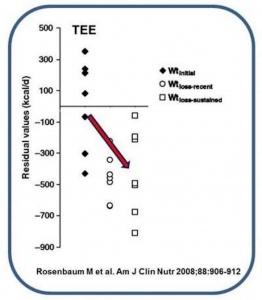
Long-term calorie-restriction diets result in two key adaptations that stymie further weight loss:- Decreased metabolic rate.
- Increased hunger.
Basal Metabolic Rate (BMR)
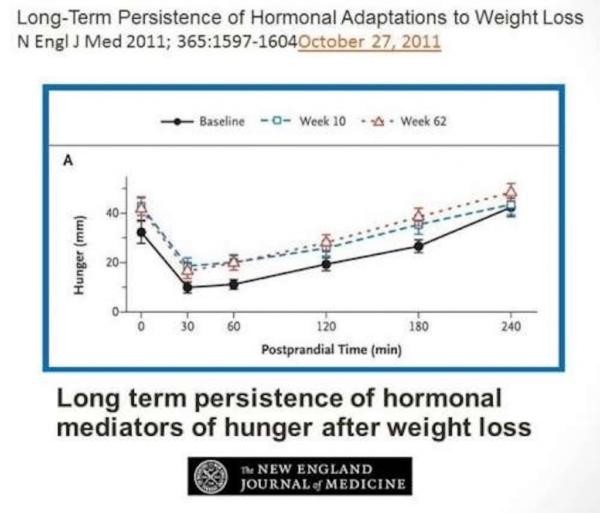
Hunger
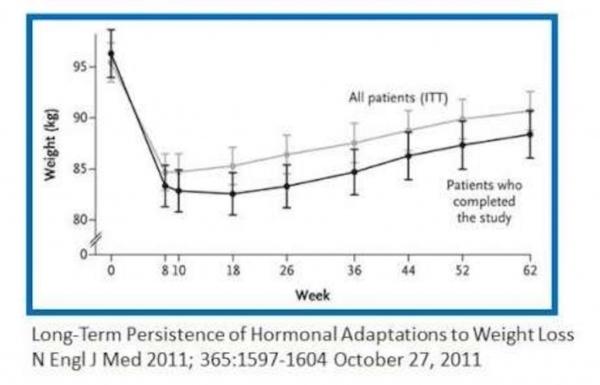
Despite participants’ best intentions, almost half of the weight was regained over the year. But what were the hormonal effects of this diet/weight loss?



Hormonal Change
Researchers measured the hormone ghrelin, sometimes called the hunger hormone. The higher the ghrelin, the hungrier we are. Ghrelin levels moved higher during the weight loss phase, but the higher levels persisted even after a year. The hormone peptide YY, a satiety hormone released in response to protein and fat, was also measured. Essentially, peptide YY makes us feel full. During the initial weight loss phase, peptide YY dropped and stayed low even after 62 weeks. The results for the other satiety hormones, amylin and cholecystokinin, are similar.What does this all mean? It means when you lose weight by restricting calories, you feel more hungry and less full (satiated). Even after a year, the feeling of hunger never leaves. This isn’t some psychological voodoo from weight loss or loss of willpower effect. Subjects were hungrier because their hunger hormones were higher and their satiety hormones were lower. There was a good physiologic reason for their hunger: the hormonal changes caused by calorie restriction.
Guaranteed to Fail
Let’s put all this together. Suppose you weigh 200 pounds and eat 2,000 calories per day. Because your weight is stable, you must also burn 2,000 calories per day (TEE). One day, you decide to lose weight and start a calorie-reduced diet but don’t change the types of foods much, nor meal timing. You now eat 1,600 calories per day, and to start, the weight comes down, say to 180 pounds. So far, so good.In response to the weight loss and calorie restriction, we know from the many scientific studies done over the years that the body will respond in a predictable manner. First, your body will reduce its TEE by 300 to 400 calories per day. So instead of burning 2,000 calories per day, you will only burn 1,600. This means that you will feel colder, more tired, and fatigued. But weight loss will also slow down because if you eat 1,600 calories and burn 1,600, there is no caloric deficit and, therefore, no weight loss.
The second predictable response is that your body increases hunger signaling by increasing ghrelin (the hunger hormone) and decreases satiety hormones (peptide YY, cholecystokinin). This makes you hungrier than before and increases your desire to eat. While you are consciously trying to eat less, your body is trying to make you eat more. This persists day after day, week after week, year after year.
The end result: weight regain. This, of course, is obvious to anybody who has ever been on a diet. This has NOTHING to do with a lack of willpower of any kind or moral failure. It is simply a hormonal fact of life. These are all real, measurable, and well-known physical effects of calorie restriction.
So here’s the bottom line. Focusing on caloric restriction alone for weight loss is virtually guaranteed to fail because of the two hormonal responses (decreased energy expenditure and increased hunger). This is why these diets have consistently failed despite thousands of doctors and dieticians giving this terrible advice over the last 50 years.
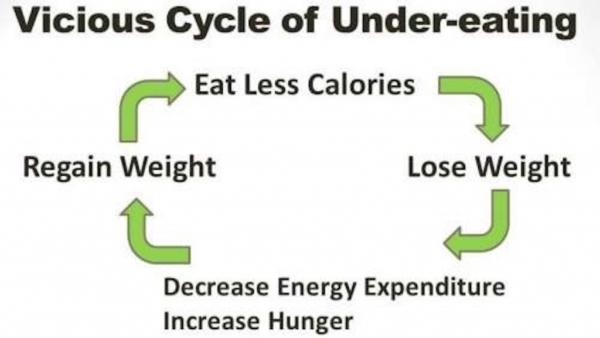
- Eat less.
- Lose some weight.
- Metabolism slows, and hunger increases.
- Weight starts to rise again.
- Redouble our efforts by eating even less.
- A bit more weight comes off.
- Metabolism slows more, and hunger increases.
- Weight starts to be regained.
- Repeat the cycle until intolerable.