In 1993, new mother Rothberg was facing a strained marriage and dealing with the illnesses of several close family members while maintaining a busy work schedule as a TV consultant. She was also suffering from a breast infection, which she would later learn was a malignant breast tumor. When it was finally diagnosed in 1999, her cancer had progressed to stage 4.
By the time of the diagnosis, Rothberg was divorced and single, raising her 5-year-old daughter, a situation which led to a deep conviction to continue living. Inspired by Norman Cousins, who used laughter as therapy, she decided to watch Eddie Murphy’s videos. She noticed that the laughter could dispel her trauma and fear, so she and her daughter made a commitment to do fun things and laugh every day.
Amid surgeries, radiation treatments, and chemotherapy sessions, Rothberg found her mission in life and envisaged and established The ComedyCures Foundation, to bring “joy, humor, a comedic perspective, and hope” to other patients to help them recover. She also realized that her cancer was a wake-up call and decided to rebuild her life with only positive values, such as happiness and fairness. She also became more spiritual.
She later started herbal therapy with a renowned Tibetan healer Yeshi Dhonden, who told her that she was “very well” during a face-to-face meeting. Rothberg attributed this to her optimism and laughter. Fortunately, she felt that the Tibetan herbs “woke up” her immune system, and her tumors started to shrink. In 2001, after taking the herbs for 18 months, her cancer was gone.
A Depressed Mind Negatively Impacts Cancer Survival
A study published in 2022 in the journal Cancer Medicine analyzed 2,263 patients with cancer and found that a person’s stress level and anxiety or depression symptoms—in other words, mental state—have more influence on cancer growth, treatment, and overall survival, than many social factors such as household income, number of children, employment, level of education, and living environment.Existing diagnosis and treatment indexes seem to heavily focus on biological indicators such as hemoglobin levels, but fail to address psychological or socioeconomic factors, which are important variables that can’t be overlooked when designing personalized health care plans, the study points out.
According to the study, people struggling with depression were, on average, 42 percent more likely to have shorter overall survival than those without depression.
That fact presents doctors with more treatment options because a patient can change their mental state, environment, and social factors much easier than their biological factors.
Lifestyle and Mindset: Foundational Factors
A report published in the Journal of Clinical Oncology summarized the lifestyle choices and survival rates among 2,230 breast cancer survivors.This study found four main domains influencing a person’s well-being, hence their ability to fight cancer and their cancer outcomes.
The first domain is physical well-being. Exercise, sleep, energy level, level of discomfort, eating habits, and sexual functioning are all encompassed in physical health.
The second is psychological well-being. That is, cancer patients should avoid negative feelings, psychological distress, or negative self-images and instead create habits that improve their cognitive functions.
Increased psychological well-being would have decreased the risk of cancer recurrence. Specifically, six months after diagnosis, having a total quality-of-life score in the highest tertile was associated with a 27 percent reduction in risk of recurrence, in comparison with having a quality-of-life score in the lowest tertile.
The third domain is social well-being. Social support from family and friends can change a person’s mental state, and one of the most important social factors is interpersonal relationships. This includes having recreational and leisure time with family and friends.
The fourth domain is material well-being, including housing and financial situation, both of which can affect a person’s stress level.
The MHI-5 score is a reliable international instrument to assess mental health in adults and can be used to detect depression symptoms. A score of 80 or higher is considered as having good mental health.
In turn, emotional distress, such as depression, anxiety, and even somatic symptoms, can also affect patients’ quality of life.
‘Target Mindsets, Not Just Tumors’
New treatment programs have started targeting patient mindsets in addition to targeting tumors. Surprisingly, zero stress isn’t the answer.There are many different ways to reduce stress, including removing the stressors, practicing meditation or yoga, getting enough quality sleep, and exercising.
Watching interesting and funny videos to uplift your mood and drive depression and anxiety away as Rothenberg did might be a good place to start in reducing your stress. For Rothberg, comedy helped ease her worry and fear, which greatly reduced her stress. As a result, her spirits were uplifted, she had more strength to focus on her recovery, and had more energy for others with her comedy foundation—which in turn gave her a mission in life—and her overall quality of life was significantly improved.
In addition to using comedy and laughter, you can try meditation to ease stress and develop a peaceful mind.
There’s also another way to face mental stress.
Such a mindset could lead to positive changes in motivation, mood, and physiology.
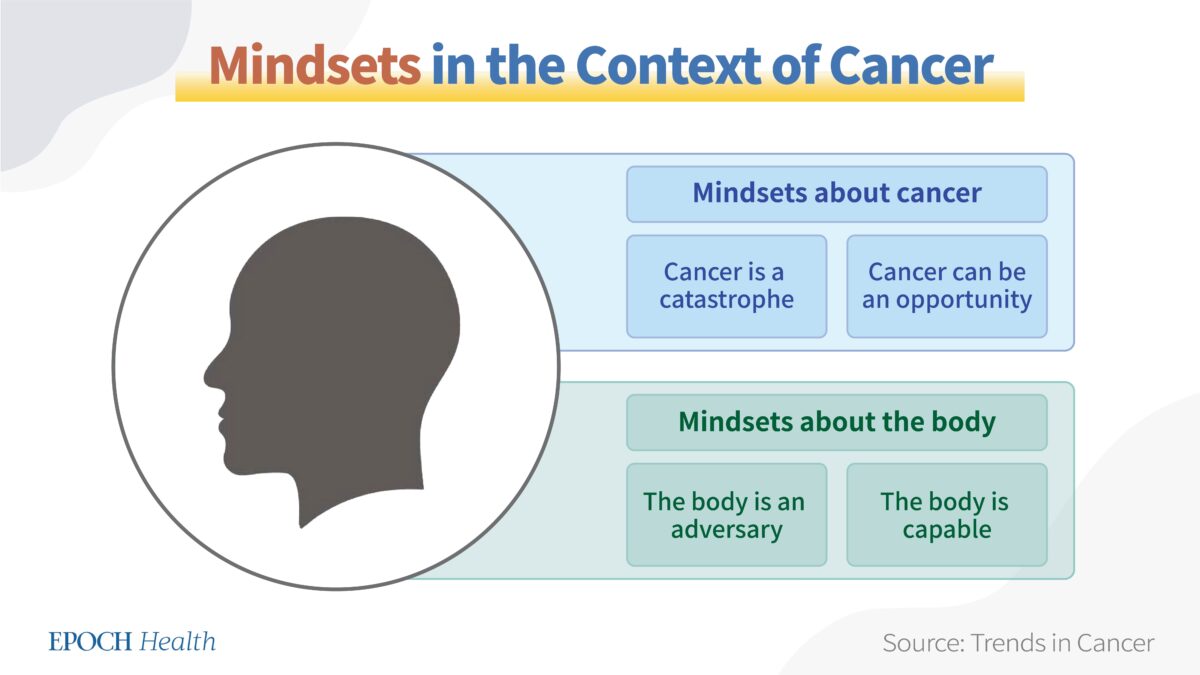
A mindset starts with core associations with the outside world. Mindsets are essentially beliefs about the world, and they can be right or wrong. Every day, people receive large amounts of external information and stimuli, and their mindsets help make sense of the information, including uncertain events and situations.
For instance, a mindset of “cancer is a catastrophe” would very likely plunge the patient into fear, worry, and depression. As a result, they may lose hope in their own treatment, become reclusive, and withdraw from their social life.
Therefore, mindsets influence attention, retention, motivation, and emotions during these processes.
Changing one’s outlook from perceiving cancer as a catastrophe to seeing it as an opportunity can have a profound influence on cancer treatment and remission.
You can better equip the body to fight cancer, and allow a person to have more confidence in doing so, by adopting a “stress-is-enhancing” mindset.
The “cancer-as-an-opportunity” mindset can help you focus on your body fighting cancer well, rather than on the symptoms, treatment side effects, or other negative aspects of cancer. It can also potentially motivate you to engage in activities that promote physical health and effective treatment.
Current existing psychosocial interventions for cancer treatment include mindfulness-based stress reduction, cognitive behavioral therapy, and psychoeducation. However, these interventions can be costly and time-consuming.
The study’s authors recommended well-timed and relatively short mindset interventions, which are more cost-effective and timesaving. The ways to help patients develop a “stress-is-enhancing” mindset include the use of digital toolkits and online modules that contain such interventions, and sessions with cancer survivor role models to help shift the mindset by sharing their own cancer-fighting experience.
Furthermore, the authors recommended that patient care teams be trained to identify mindsets that are negative or maladaptive to cancer treatment.