

Peptides aren’t new. They are naturally produced by our bodies with a myriad of effects.
For decades, scientists have been studying and using them in medicine.
Now, these small but powerful molecules are receiving a surge in attention—as potential tools for everything from muscle recovery and weight management to healthier skin and age-related conditions.
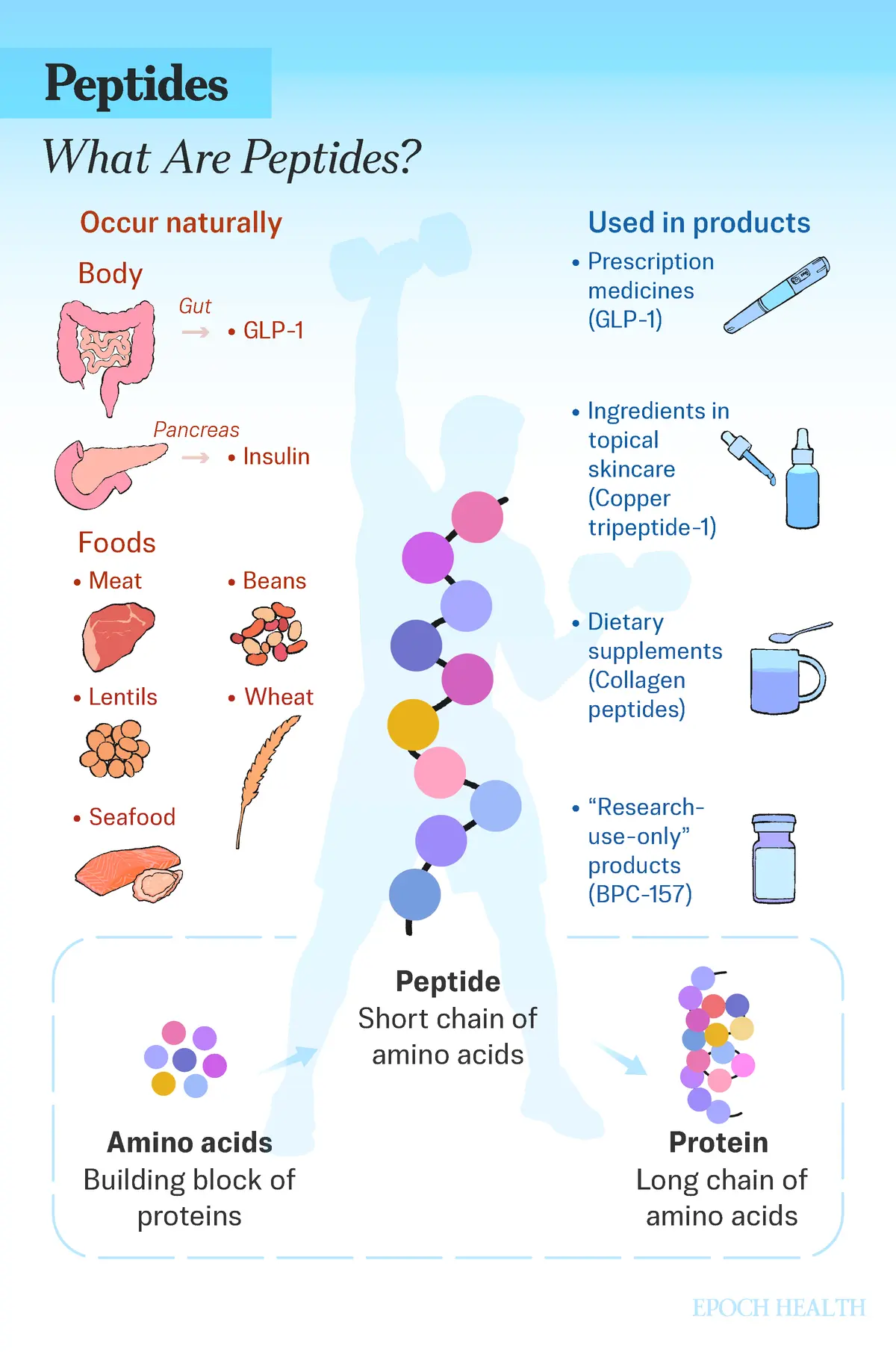
What Are Peptides?
Peptides are short chains of amino acids—the same building blocks that make up proteins—and they occur naturally throughout the body and in many foods, including meat, beans, lentils, wheat, and seafood.
Peptide products started with scientists mimicking peptides found in our bodies and in nature before progressing to designing peptides in a lab with specific, desirable benefits.
A common misconception is that peptides are one single thing. In reality, the term covers a wide spectrum of products.



Peptides are also widely used as ingredients in skincare products and marketed as supplements to support muscle growth, exercise recovery, weight management, and healthy aging.
There are also many experimental or investigational peptides, such as BPC-157, a popular regenerative peptide. These products are often sold online with claims that exceed the available evidence or without appropriate medical oversight.
Unlike many conventional medicines that introduce compounds designed to block or alter biological pathways, peptide medicines often work by mimicking the body’s own signaling molecules.
Using semaglutide and tirzepatide as examples, Andrea Colon, a licensed naturopathic medical doctor and founder of Reclaim Integrative Medicine, told The Epoch Times: “They copy a signal your body already uses to manage blood sugar and appetite, so they work with your biology instead of overriding it.”
Piyush Modi, a pharmaceutical regulatory affairs expert with more than 20 years of experience working on products that are regulated by the Food and Drug Administration (FDA), said peptides differ from traditional drugs mainly in size and how precisely they act.
“They are more complex and often act very specifically on certain biological pathways, which can make them highly effective in the right situations,” Modi told The Epoch Times.
That precision comes with trade-offs, however: Peptides tend to break down easily in the digestive system, which is why many have to be injected rather than taken as pills.
“They can also be more expensive to produce, and their absorption can vary,” Modi said.
Peptide products are more expensive because they are often more complex to manufacture, requiring precise assembly of amino acids, extensive purification, and rigorous quality testing. Many peptides are also less stable than traditional drugs and may require specialized storage and packaging.
What Are the Most Common Peptides and Their Effects?
Peptide products span a wide range of uses, with significant variation in how well-studied they are.
Peptide Medicines
GLP-1-Based Therapies (Semaglutide and Tirzepatide): They mimic natural gut hormones that regulate blood sugar and appetite, helping people feel fuller and manage blood sugar more effectively. They do come with side effects. Semaglutide can cause nausea, vomiting, diarrhea, and other rare but serious risks.
Insulin Analogs: The discovery of insulin in the early 1920s marked one of the first major breakthroughs in peptide hormone research. Modern insulin analogs are newer-generation, lab-modified versions of human insulin. Insulin analogs are engineered to change how quickly or how long they act in the body, for better alignment with the body’s natural insulin response. Conventional human insulin has the same amino acid sequence as naturally occurring human insulin, but it does not perfectly mimic the body’s natural timing of insulin release.
Teriparatide and Abaloparatide: These medications are used to treat osteoporosis, particularly in patients at high risk of fractures, such as postmenopausal women. They mimic parathyroid hormone activity to stimulate new bone formation and improve bone strength.
Cosmetic Peptides
Palmitoyl Peptides: Commonly used in antiaging products, these are amino acid chains bonded to a fatty acid, which helps them penetrate the skin’s outer barrier. Once absorbed, they can stimulate collagen production and strengthen the skin’s support structure, making them a popular antiaging tool. One well-known type, palmitoyl tripeptide-5, is designed to mimic the body’s natural signals for boosting collagen.
Copper Tripeptide-1 (GHK-Cu): Used in antiaging and wound healing products, this naturally occurring copper-binding peptide may help stimulate the growth of blood vessels and collagen production.
Acetyl Hexapeptide-8: Sometimes marketed as a “Botox-like” ingredient because it may soften expression lines, acetyl hexapeptide-8 is widely used in topical formulations for antiaging, scar management, and skin rejuvenation. It is a lab-made ingredient designed to imitate the natural peptides in the skin. It has emerged as a noninvasive alternative to actual Botox, but with comparatively lower efficacy.
Brightening Peptides: These peptides are typically used in cosmetic products targeting uneven skin tone and the appearance of dark spots, as they may reduce melanin production. One example is decapeptide-12, which may offer a better safety profile than hydroquinone, a common but sometimes irritating skin-lightening ingredient.
Dietary Supplements
While these products show promising benefits, further research is needed to establish their safety and long-term effects.
Collagen Peptides: These are the most widely used products in this group. Research suggests possible benefits for joint comfort and function, as well as some support for body composition, muscle strength, and recovery after exercise. However, collagen is not as effective for building muscle as higher-quality proteins that provide a fuller range of amino acids.
Plant Protein-Derived Peptides: These peptides are found in soy, seeds, tree nuts, and lupin. Beyond providing basic amino acids, some of these peptide fragments may support heart health, immune function, liver health, and blood sugar balance.
Chlorella and Spirulina Fractions: Derived from nutrient-rich microalgae, these peptides have been studied for antioxidant, anti-inflammatory, and immune-supporting properties.
Wellness and Performance Clinic Peptides
These peptides are a group of off-label, experimental peptides commonly marketed for goals such as tissue repair, muscle growth, and fat loss—despite limited high-quality clinical evidence. Many are banned in competitive sports.
BPC-157 (Body Protection Compound-157): This peptide is marketed for tissue repair, muscle recovery, chronic pain, and gut health. Research has shown promise in animal studies involving tendon, ligament, muscle, nerve, and gastrointestinal injury. However, human evidence remains limited, with no completed large randomized controlled trials or approved medical use.
TB-500 (Synthetic Thymosin Beta-4 Fragment): This peptide is marketed for soft-tissue repair, reducing inflammation, and enhancing athletic recovery. Most supporting evidence comes from lab and animal research. While the parent molecule (thymosin beta-4) has been studied in humans for wound healing and cardiac repair.
CJC-1295 and Ipamorelin (Growth Hormone Stimulators): These peptides are marketed for muscle gain, fat loss, exercise recovery, better sleep, and healthy skin aging by boosting the body’s natural growth hormone release. Although research demonstrates that these compounds can increase growth hormone secretion, evidence that they improve muscle mass, fat loss, athletic performance, or antiaging outcomes in healthy people remains limited.
What Are the Best Ways to Use Them?
There’s no single rule for how peptides should be used; it depends entirely on the specific product and its purpose.
Peptide products can be delivered through several routes, including oral, nasal, injectable, and topical forms.
Topical peptide products are commonly used in skincare formulations, where they may act on local tissues.
As for the duration of usage, Christopher Shade, a longevity expert who has a doctorate in environmental chemistry, told The Epoch Times that there is no universal formula. Providers typically weigh the condition being treated, how benefits change over time, side effects, and whether the body adapts to the treatment.
The monitoring required during peptide therapy may include tracking blood glucose, kidney and liver function, hormone levels (such as IGF-1 and thyroid hormone), blood pressure, and inflammatory markers—sometimes alongside specialized tests such as T-cell receptor excision circles.
Peptides are not a shortcut, and they don’t work in a vacuum. Colon emphasizes that peptides are most effective when paired with healthy lifestyle habits, not used as a replacement for them.
“If the basics are a mess, the peptide has very little to work with,” Colon said.
Shade points to specific mechanisms: Poor lifestyle habits, such as chronic sleep deprivation, can blunt a peptide’s effectiveness by disrupting gut health, raising oxidative stress, and dulling how the body’s cells respond to signals. In contrast, healthy behaviors, particularly regular exercise, may amplify the benefits of certain peptides.
What to Look for When Choosing a Peptide?
Modi said many peptides simply have not gone through the testing the FDA requires. Approval demands well-designed clinical trials, strict manufacturing controls, and solid proof of safety and effectiveness. Without that process, there is real uncertainty around dosing, purity, side effects, and long-term risk.
However, since many peptides offer limited patent protection or commercial returns, companies may be less likely to fund the expensive clinical trials needed for approval, Colon said.
“In many cases, not approved doesn’t mean proven dangerous. It means no one paid to test it. The catch is that it also means no one has proven it’s safe or that it even works, and that cuts both ways,” she told The Epoch Times.
It’s also worth understanding what FDA approval does and doesn’t guarantee. Shade notes that approval demonstrates a favorable benefit-risk balance for a peptide’s specific use but does not guarantee universal effectiveness, long-term safety, or superiority over alternatives. Approval also focuses on outcomes seen in trials, not on how an individual person’s genetics, lifestyle, and health history might change their results. And even approved drugs stay under review, as approvals can be revoked later if new safety concerns emerge.
A key warning sign: Many unapproved products are labeled “for research use only” but are marketed as if they offer real health benefits.
“This can create a misleading sense of legitimacy,” Modi said.
They may have quality concerns, including lower-than-claimed purity, inaccurate concentrations and dosage, or even unlabeled ingredients.
Colon offers a practical checklist of red flags:
No real prescription and no licensed clinician involved
Direct-to-consumer shipping with no pharmacy involved
No proof of third-party testing
Prices that seem too good to be true
A single product claiming to fix many unrelated problems
Big promises with no mention of risk
The field of therapeutic peptides started with natural hormones, and to make a real change, the answer may ultimately lie in our hands. As performance-optimizing physician Dr. Sean O'Mara told The Epoch Times previously when he talked about GLP-1: Lab-made molecules cannot duplicate the elegance of the human body.