Newly emerging Alzheimer’s disease hypothesis proposes that its symptoms may be triggered by one or more pathogens.
STORY AT-A-GLANCE
- Until very recently, it was considered official and proven that Alzheimer’s disease is non-infectious and caused by amyloid plaques.
- Last year, the news came out that the foundational study on Alzheimer’s that had been driving the overall direction of research in the past two decades had been based on fraud.
- The new emerging theory proposes that Alzheimer’s Disease may be triggered by pathogens, and amyloid plaques may form as an immune response.
- However, it is important to remember that even if a pathogen or a group of pathogens is truly involved in triggering the symptoms of Alzheimer’s Disease, the mainstream narrative will be inevitably twisted in favor of pushing for more vaccines.
Then more research shows up suggesting that amyloid deposits might be a reaction, an immune response to something, even though nobody seems to know exactly to what.
To add to the complexity of the plot, it is probably logical to assume that the microbes—whichever microbes they are—would have a much harder time causing wreckage if our bodies and our environments weren’t poisoned so devastatingly—so through and through. But environmental toxicity is a part of our lives, it is superimposed on us (and COVID-19 “vaccines” didn’t help).
We are like trees in a poisoned desert, stretching our branches toward the sun no matter what, fighting for life no matter what, and we will be stronger if we look at all factors involved.
(Yes, yes, I am nodding at the famous debate about germ versus terrain that—in its extreme form —seeks to strike down the concept of contagion as such, which to my senses is rather contrived since both germs and terrain exist—in fact, they are rather intermixed—and they both play a role in this very complex world of ours.)
Anyway, the biology and the etiology of Alzheimer’s is one part of the detective plot. But in parallel to the plot about the inner workings of our bodies, there is another detective story brewing underneath. That other plot is about financial and political factors that determine the timing of narrative “release.”
“Two studies presented Monday (July 27, 2020 ) at this year’s virtual Alzheimer’s Association International Conference have demonstrated that flu and pneumococcal vaccines are linked with a lower risk of Alzheimer’s disease.
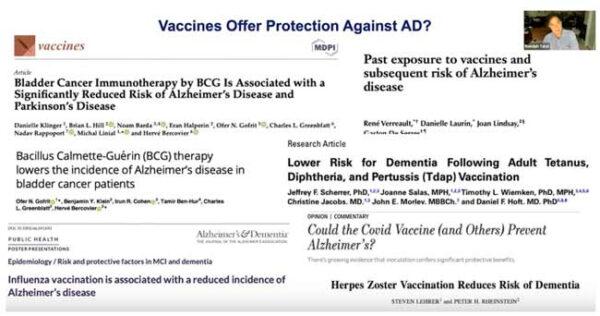
One could say, so what, there is always talk about vaccines against everything under the sun—they can talk! Yes, that’s true, there is always talk about them since the “v-word” is a famous cash cow and a required talking point in the mainstream.
However, in the light of the past three years and in the context of an objectively existing malaise (dementia, in this case) and an objectively prevalent but often misdiagnosed and misunderstood parasite (T. gondii), that direction of conversation alarms me quite a bit.
And methinks that it’s better for us to educate ourselves and start thinking it through now. It would also be tremendously helpful if the doctors with honest minds decided to investigate it thoroughly with our actual health in mind before the robo-eyed ones try to force a new “health countermeasure” on us that doesn’t help and that we hadn’t asked for.
What Is Alzheimer’s Disease, Anyway?
Given the prevalence of Alzheimer’s disease in elders and the amount of funding the topic receives, one would think that at the very least, we'd have a reliable definition of the disease and a solid way to diagnose. But not so fast, soldier, not so fast.“One of its biggest mysteries is also its most distinctive feature: the plaques and other protein deposits that German pathologist Alois Alzheimer ...” first saw in 1906 in the brain of a deceased dementia patient.
“In 1984, Aβ [protein amyloid beta] was identified as the main component of the plaques. And in 1991, researchers traced family-linked Alzheimer’s to mutations in the gene for a precursor protein from which amyloid derives. To many scientists, it seemed clear that Aβ buildup sets off a cascade of damage and dysfunction in neurons, causing dementia. Stopping amyloid deposits became the most plausible therapeutic strategy.”
And according to the NIH, “higher levels of beta-amyloid are consistent with the presence of amyloid plaques, a hallmark of Alzheimer’s disease.“ Additionally, ”most widely used CSF [cerebrospinal fluid] biomarkers for Alzheimer’s disease measure beta-amyloid 42 (the major component of amyloid plaques in the brain), tau, and phospho-tau (major components of tau tangles in the brain, which are another hallmark of Alzheimer’s).”- When Alois Alzheimer, the German pathologist who gave the disease its name, discovered those plaques in the deceased patient’s brain, could he or anyone else know that the plaques he had found were the cause of dementia and not a byproduct of something else that was going on, like an inflammatory presence of bacteria or parasites?
- An extracurricular question—Why do the scientists of today like to assume that our bodies are broken machines—and not wise wonders that usually do things for a reason? Why?
- Later, when the scientists claimed that they had found a reliable biomarker of Alzheimer’s disease, did they gain a new insight into the causation of Alzheimer’s—or did they just make a conventional industry-wide agreement to use the Alzheimer’s diagnosis whenever the biomarker was found? (Incidentally, I know the answer to that question. It’s the latter. I learned about it in 2019 at a legal conference about the ethics of AI (or something along those lines) and I remember how perplexed I was to learn from a doctor panelist that once the Alzheimer’s biomarker had been adopted as the primary way to diagnose the disease, some patients with the biomarker but without dementia would be diagnosed as Alzheimer’s, while other patients with dementia but without the biomarker would be left with a “mystery disease.”) Little did I know how “interesting” the following year of 2020 would be in that sense!
- And what if Alzheimer’s disease is not really one disease but an umbrella term for a heap of conditions caused perhaps by inflammation in the brain, and what if—so shocking and novel, I know!—inflammation can be caused by multiple factors, and when the scientists make confident statements about the cause of Alzheimer’s disease, they are mostly poking their fingers into the sky and puffing cheeks to justify their grants—while having very little idea about what causes what?
Speaking of Puffing Cheeks–the Fraud
Daily Kos:“Over the last two decades, Alzheimer’s drugs have been notable mostly for having a 99 percent failure rate in human trials.
“It’s not unusual for drugs that are effective in vitro and in animal models to turn out to be less than successful when used in humans, but Alzheimer’s has a record that makes the batting average in other areas look like Hall of Fame material ... And now we have a good idea of why.
Infectious Hypothesis: A One-Million-Dollar Challenge
In early 2018, Dr. Leslie Norins of Alzheimer’s Germ Quest (their website is no longer live) announced a one-million-dollar challenge award for the scientist who would find the germ causing Alzheimer’s disease.“Eight final honorees will divide $200,000 for meritorious entries in Alzheimer’s Germ Quest’s ‘$1 Million Challenge.’
“However, nobody provided persuasive-enough evidence that a particular infectious agent was the sole cause of Alzheimer’s disease, so the grand prize of $1 million will not be awarded … Six microorganisms were nominated: herpes, toxoplasma, Borrelia, mycobacteria, H. pylori, and P. gingivalis.”
Toxoplasma Gondii
I wrote about this tricky parasite last year, and I think it calls for a good look in the context of its prevalence in the population and the glaring gap between the recent Toxoplasma research and the outdated information that they seem to teach doctors in medical school.- At least one-third of all people on Earth are infected with the parasite Toxoplasma gondii, averaging from 11–20 percent in the United States to 50 percent and higher in some Western European countries.
- The parasite has been implicated in ocular issues, schizophrenia, epilepsy, Alzheimer’s disease, and various other neurological disorders, as well as in heart disease, pneumonia, recurrent headaches, and even cancer; it is also known for causing psychological changes in its hosts.
- While the official word is that most toxoplasma infections are harmless and asymptomatic, the impact of the parasite could be much more devastating than the current mainstream medical convention presumes; it may also be cross-reacting with the spike protein and possibly contributing to the mystery of “long COVID.”
- According to recent research and clinical evidence, toxoplasma tissue cysts, previously considered harmless in immunocompetent patients, are capable of causing major health issues without converting to the cell-blasting form.
- Commonly used antibody tests can only detect antibodies for the “tachyzoite” (cell-blasting) form of the parasite but not the “bradyzoite” (tissue cyst) form.
The State of the Alzheimer’s ‘Infectious’ Hypothesis
According to a 2020 paper titled, “Infectious hypothesis of Alzheimer disease”:“The infectious hypothesis proposes that a pathogen (virus, bacteria, prion, etc.) is the root cause of AD [2]. The hypothesis is supported by evidence that some pathogens, such as herpesviruses and certain bacterial species, are found more commonly in AD patients. There is some variation within the infectious hypothesis field as to how an infectious pathogen explains the pathological hallmarks of AD.
“To date, the most compelling evidence for the infection hypothesis comes from a large study in Taiwan, published in 2018, which looked at the progress of 8,362 people carrying a herpes simplex virus. Crucially, some of the participants were given antiviral drugs to treat the infection.
“But if the pathogen is repeatedly reactivated during times of stress, the amyloid beta could accumulate in the toxic plaques, harming the cells it is meant to be protecting.

What About Infectivity?
The funny thing is that billions of dollars in funding later, the honest answer is that nobody knows. That’s the humbling part. The earlier mainstream conviction is that it is obviously not infectious because it’s caused by amyloid plaques. With that hypothesis possibly on its way out, we are back to the drawing board.When Dr. Leslie Norins announced his one-million-dollar challenge award, he mentioned a few studies that suggested an infectious route.
But in any case, the most insane idea—in my book—would be to not hug our loved ones, Alzheimer’s or not.