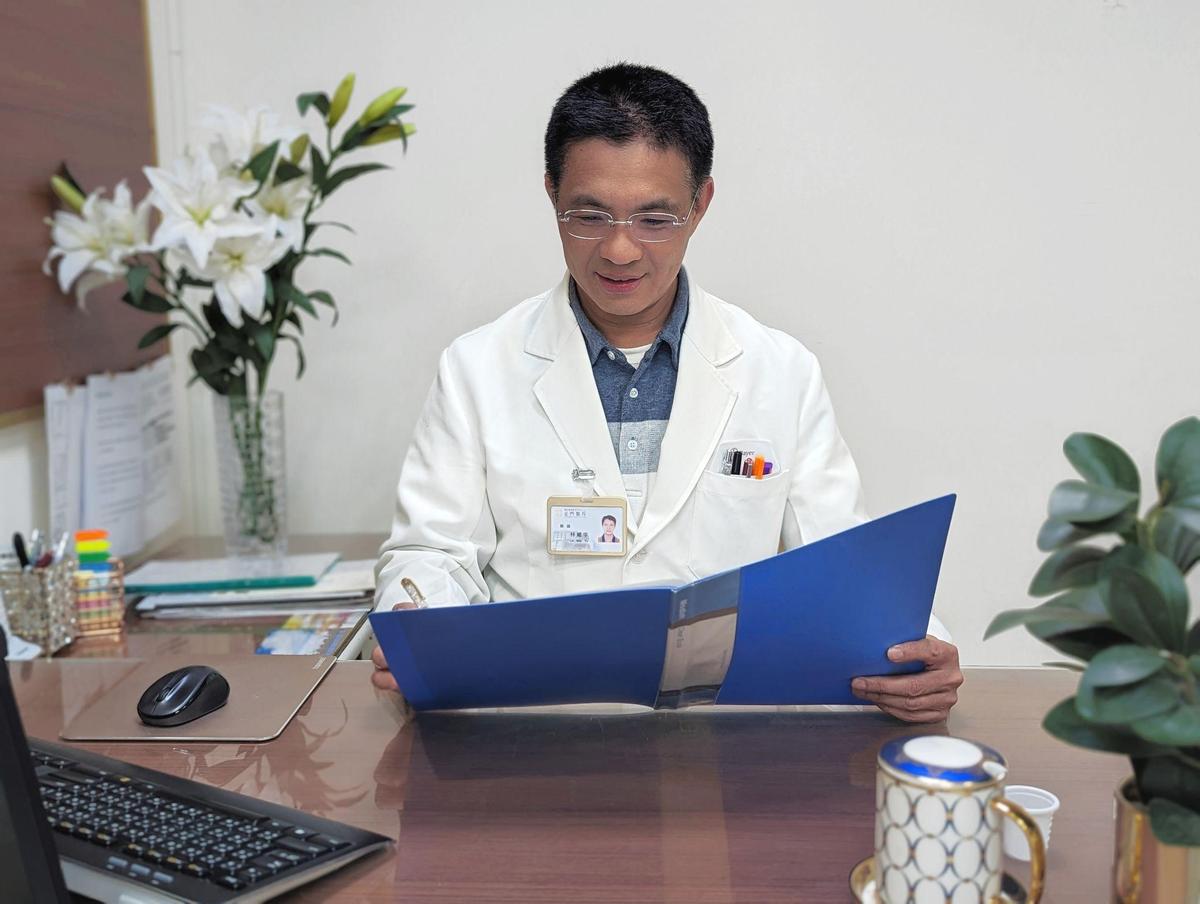
Wei-Yu Lin, a pharmaceutical doctor from Taiwan, has suffered from asthma and allergic rhinitis since childhood, having tried various medical treatments without achieving significant results. At one point, he believed he would never recover from these afflictions. However, a turning point came when he was 26 years old.
One morning in October 2000, Mr. Lin woke and realized his nose was clear. Before this, he had experienced severe nasal congestion, especially at night. He used to breathe through his mouth while sleeping, often waking in the middle of the night with a dry and uncomfortable throat. In the morning, he would awaken with a parched mouth.
“What’s going on?” He remembered attending a Falun Gong workshop organized by the Traditional Chinese Medicine Association at Kaohsiung Medical University the day before upon a friend’s invitation. However, he had only studied for 30 minutes. “Could practicing Falun Gong for a brief period have actually relieved my nasal congestion?” he wondered.
After Mr. Lin’s initial session of practicing Falun Gong, his improved nasal congestion lasted for several days. Following a conversation with the friend who introduced him to Falun Gong, he learned about the remarkable health benefits associated with the practice. Promptly, he purchased Falun Gong’s core book, “Zhuan Falun,” and finished reading it in just two days. One month later, he participated in a nine-day Falun Gong workshop, hoping to see if it would improve his health.
Since childhood, Mr. Lin has been a frequent visitor to the hospital. Coming from a less affluent background, Mr. Lin’s father often had to allocate half his monthly salary to cover medical expenses.


Mr. Lin has a family history of allergies. In addition to severe allergic rhinitis, he also suffered from asthma. During asthma attacks, he would experience intense coughing, struggle to breathe, and sometimes require emergency room intervention. Occasionally, he would also endure unexplained chest pain. At the age of 18, during a military service health checkup, doctors diagnosed a severe issue with his lung function, exempting him from military service. Subsequently, while pursuing his doctorate at Kaohsiung Medical University, his symptoms worsened due to poor local air quality.
Challenges in Curing Allergic Rhinitis and Asthma
Allergic rhinitis and asthma are common allergic conditions in children, often occurring together. Allergic rhinitis is an immune system overreaction to ordinarily harmless substances, leading to inflammation of the nasal mucosa. This reaction can also affect some people’s lungs and airways, resulting in asthma symptoms. Asthma refers to chronic inflammation of the airways, causing them to narrow, swell, and produce excess mucus. During an asthma episode, symptoms may include coughing, wheezing, chest tightness, and difficulty breathing, with severe cases posing a life-threatening risk.Asthma and allergic rhinitis currently have no cure and can only be managed to alleviate symptoms. Common relief methods include the use of steroids or antihistamine medications, which may come with side effects. Additionally, patients may opt for allergen immunotherapy, involving gradual exposure to small amounts of allergens to reduce the severity of allergies.
The Limitations and Prospects of Modern Medicine
Mr. Lin currently serves as the director of the Department of Pharmacy at Kinmen Hospital, Ministry of Health and Welfare in Taiwan. His journey from a long-term patient to a healthy individual, combined with his active involvement in the health care field, has prompted him to reflect on the limitations of modern medicine and the potential for future developments.“Modern medicine adheres to the principles of empirical science, demanding visible and verifiable evidence to validate its claims. Drawing from my personal experience, after reading the book ‘Zhuan Falun’ and practicing the exercises, a condition that doctors deemed incurable actually improved. This provides tangible evidence, aligning with the principles of empirical medicine. However, many people are confined by the existing scientific framework, viewing practices like qigong as unscientific and considering adherence to Western medicine as the only approach,” explained Mr. Lin.
Mr. Lin emphasized that he is not the only one; many individuals with incurable conditions have recovered through Falun Gong practice. Statistical data support this.
Mr. Lin pointed out that modern science labels the study of extraordinary phenomena, such as qigong, as “parapsychology,” deeming it non-mainstream science. If scientists could approach these phenomena with an unbiased perspective, it could potentially propel human science forward.
“Currently, modern empirical science focuses on studying why people get sick, but it does not delve into why people stay healthy. If scientists could impartially study practitioners of Falun Gong, exploring why they remain free from illness, I believe it would make a substantial contribution to human science and health,” said Mr. Lin.
How Mr. Lin’s Wife and Daughter Benefited From Falun Gong
Influenced by Mr. Lin, Mrs. Lin, Chin-Ni Hu, also started practicing Falun Gong. Previously, she experienced irregular menstruation with deficient flow, accompanied by anemia and low blood pressure, requiring a year-round reliance on a combination of traditional Chinese and Western medicine. Before practicing Falun Gong, she had missed her menstrual cycle for four consecutive months. Miraculously, after just one month of practice, her menstruation resumed, and both anemia and low blood pressure returned to normal shortly thereafter.Mrs. Lin said their 11-year-old daughter has been practicing Falun Gong with them since early childhood, maintaining excellent health since birth. Even when she occasionally experiences a fever, it naturally resolves within one or two days, and she has never required antibiotics or fever-reducing medication.

The Secret to Career Success
After practicing Falun Gong, Mr. Lin gained not only improved well-being but also success in his career and wisdom in life. He said, “Practicing Falun Gong has enhanced my wisdom, making me more tolerant in the face of interpersonal conflicts. That’s why I have been able to consistently progress on the path of life and career.”Mr. Lin recalled that before practicing Falun Gong, while conducting experiments earning his doctorate, he would sometimes manipulate data to make the results appear more polished and perfect. However, after taking up Falun Gong, his approach to experiments underwent significant changes. “I became more genuine, refraining from deception, and focused on conducting experiments diligently. In the end, I completed my studies successfully, even when the experimental data did not appear favorable. I believe that facing everything with sincerity will lead to better outcomes,” he said.
After earning his doctorate, Mr. Lin worked in teaching roles before transitioning to a pharmacist position at Kinmen Hospital. In about seven and a half years, he was promoted to director of the Department of Pharmacy. He attributes his promotion to Falun Gong, emphasizing that his adherence to the principles of truthfulness, compassion, and forbearance guided his professional conduct. Following these principles, he became more tolerant and considerate toward others. He stated, “When faced with challenging tasks that everyone avoids, I often step forward to shoulder the responsibilities.”
With a smile, Mrs. Lin shared that her husband is consistently selfless, whether at work, home, or the community. During the hospital’s annual dinner, he purposely schedules himself to work, allowing his colleagues to enjoy the event and participate in the lucky draw. On holidays, instead of staying home like others, Mr. Lin shares his lawnmower to help neighbors with grass cutting or plant trimming.
Mr. Lin added that practicing Falun Gong has taught him to approach difficulties with a calm mindset. “In the past, when faced with problems, I would rack my brains, and even then, a solution was not guaranteed. After practicing, whenever I encountered difficult situations, especially during work at the hospital, I would set them aside first. This is because I believe that things will naturally work out when the time is right. Eventually, when the moment to address them arrives, various solutions often emerge, some of which I had never thought of. Interestingly, such occurrence happens quite frequently.”
He believes that behind wisdom lies the power of goodness. “No matter what happens, we always try to interpret others’ actions from a more benevolent perspective. Therefore, in the end, it often leads to a better result, and the solutions we come up with tend to be more harmonious.”