This copy is for your personal, non-commercial use only. Distribution and use of this material are governed by our Subscriber Agreement and by copyright law. For non-personal use or to order multiple copies, please contact The Epoch Times Reprints.
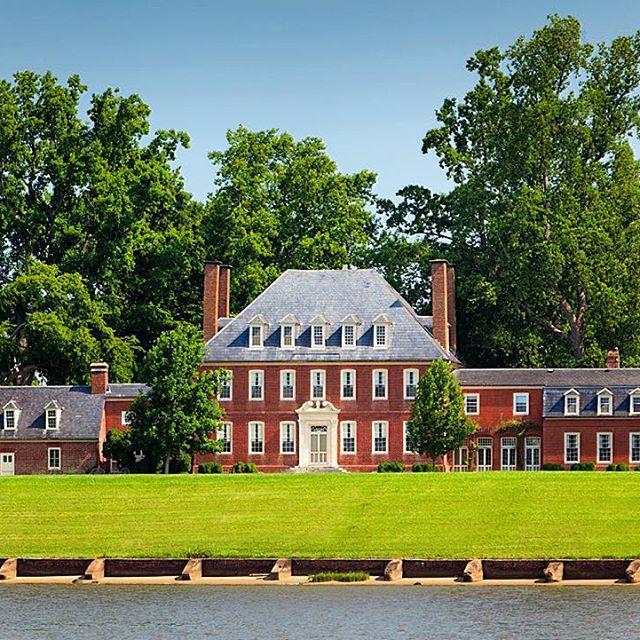
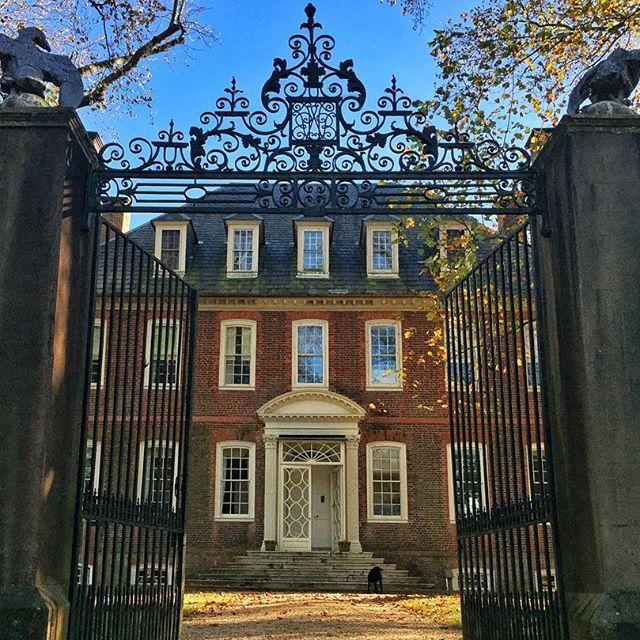
Towering mature tulip poplar trees grace the lawn of the brick Georgian mansion of Westover, in Charles City, Va. Courtesy of Don Williamson Photography
With a wide view of the James River in Virginia, Westover was built for colonial planter and politician William Byrd II (1674–1744) around the 1730s, and according to the National Park Service, remained in the Byrd family for many generations. Resting on 1,200 acres and located west of Williamsburg, Westover was built in the Georgian style that harks back to classical Renaissance themes of order, symmetry, and proportion.
At the approach to Westover, the visitor immediately notices the symmetry of the five dormer windows at the roofline, as the middle window lines up with the central second-floor window, which in turn is aligned with the decorative element in the middle of the swan’s neck pediment.
Although other examples of original Georgian-style architecture still exist in Virginia, Westover is notable for its size (14,000 square feet), making it many times larger than other 18th-century homes of its type. The mansion also features an underground escape route and a complex grid-arranged garden.
The architectural symmetry of the main house includes four chimneys situated in a square at each corner of the gambrel roof, which is steeply pitched to provide a third story for three bedrooms. Courtesy of Historic Westover
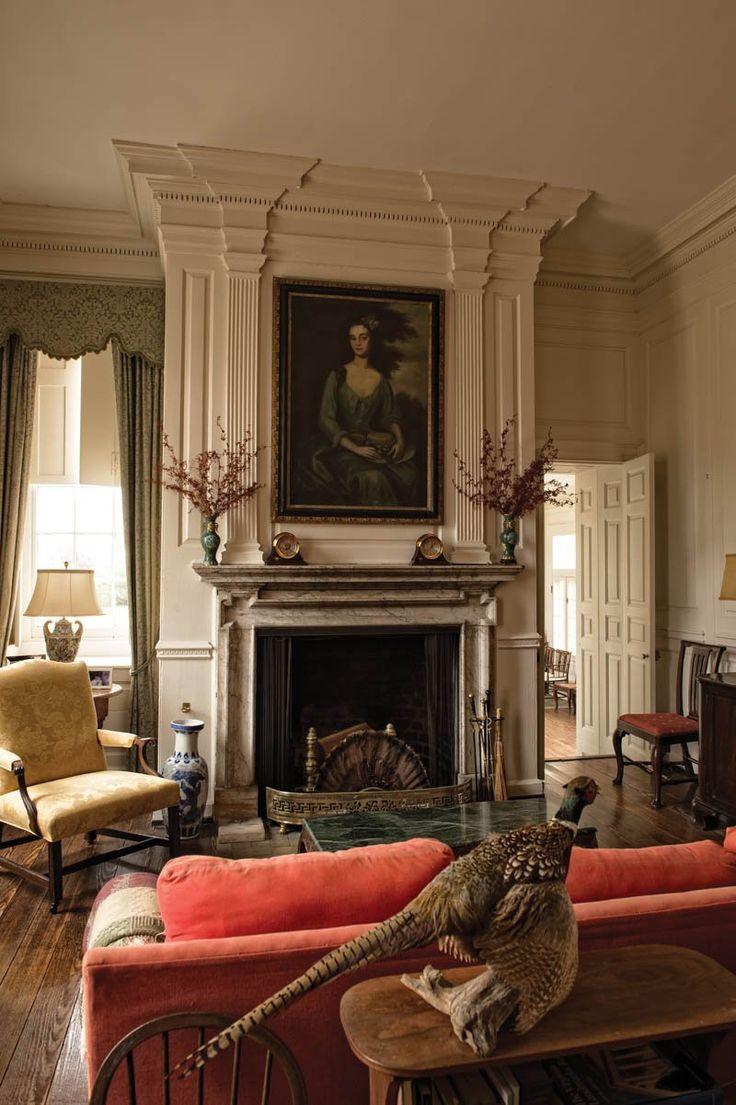
Every fireplace at Westover showcases a unique mantel. This one in the Green Room, a sitting and office area, is made of marble. The mantel supports fluted columns with a double capital treatment. The columns are flanked by wainscoted panels that complement the room’s doors and the walls, while a dentil molding treatment distinguishes layered crown molding. Courtesy of Historic Westover
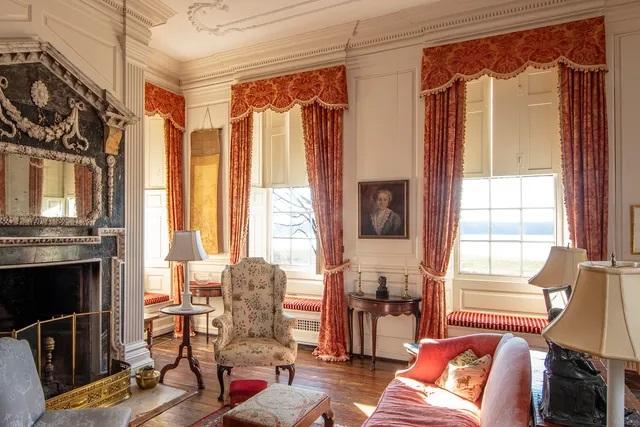
“This room is magical; it gets lots of light and overlooks the river,” said Andrea Erda, a fourth-generation owner. The drawing room, called the Red Room, uses primarily red fabrics in the curtains and furnishings. Three types of marble were carved on site and then assembled into this highly decorative statement piece. The design includes a dentil-molding pediment, classical swag, and a grapevine framed mirror. A shiny brass hearth screen sits atop marble, and the fireplace is flanked by fluted, capital-topped columns. Courtesy of Alston Thompson Photography
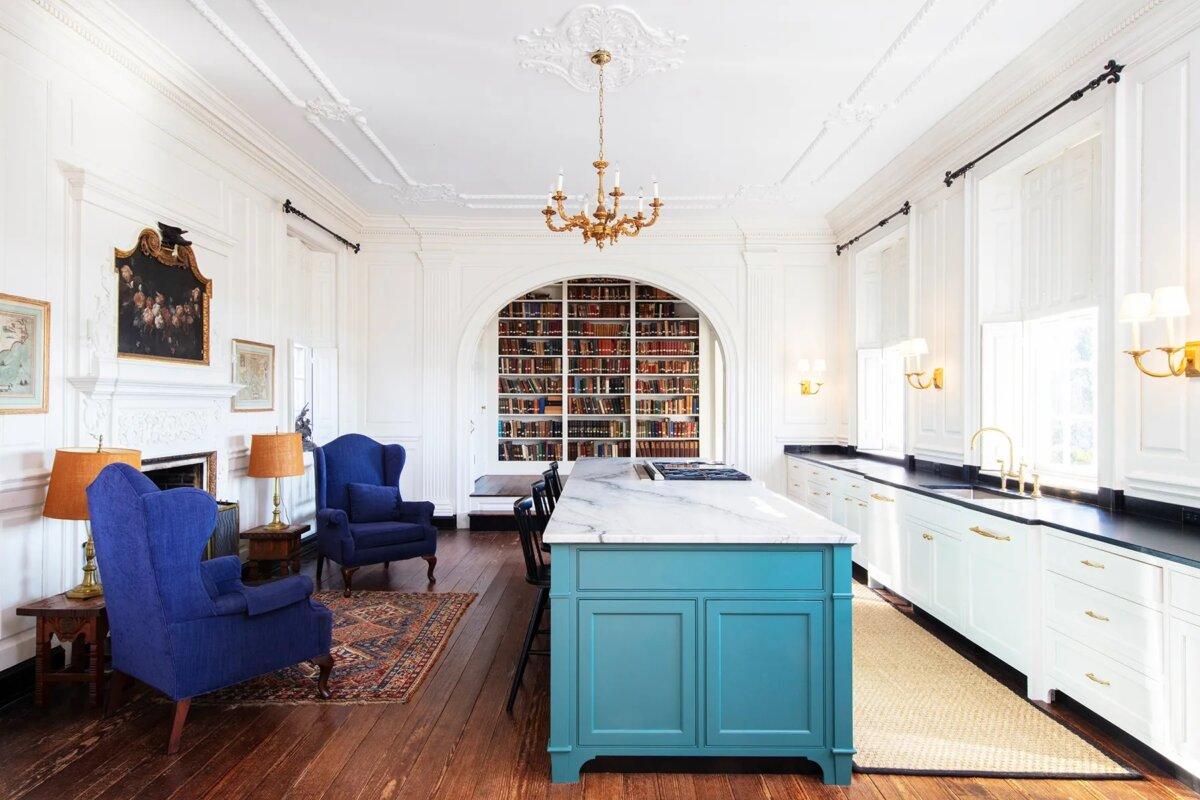
“This was a rebuilt area in 1899 after damage from the Civil War,” explained Erda, whose great grandfather, Richard Crane, purchased Westover in 1921. Her family recently transformed the area into an open kitchen for entertaining. She said the plaster ceiling and paneled walls were retained, as well as the elaborately framed painting over the fireplace. The inset arched bookcase flanked by fluted columns is filled with 18th and 19th century original volumes. Courtesy of Alston Thompson Photography
While the pediment over the back entrance door is less formal than the front door entrance, it still exudes colonial affluency in its half-dome dental molding details over fluted Corinthian columns. The outer decorative door’s standouts are the semi-elliptical fanlight and the circle and half-circle interplay. Courtesy of Historic Westover
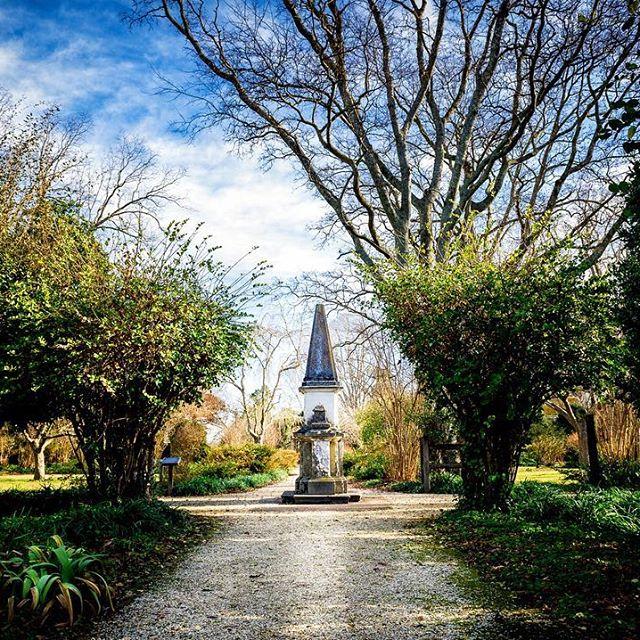
Westover’s formal walled garden, laid out in an exact eight-square-patterned grid, is accessible beyond the mansion’s west wing. The tomb of William Bird II is the centerpiece. Pathways lead to perennial flowers, annual vegetables, and a variety of old-growth trees, including 100-plus year old boxwoods. A featured element is a long-established wisteria arbor. Courtesy of Historic Westover
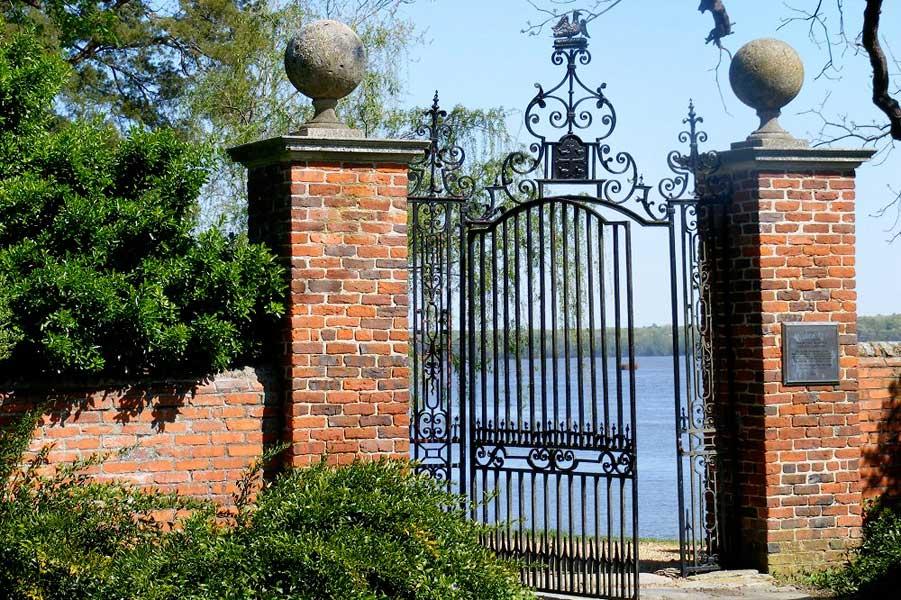
Open ornamental wrought ironwork, referred to by the French word “clairvoyée,” is prominent at Westover's gates, such as this one with globe-topped brick pillars that opens to a view of the James River. Courtesy of Historic Westover
Would you like to see other kinds of arts and culture articles? Please email us your story ideas or feedback at [email protected]
A 30-plus-year writer-journalist, Deena C. Bouknight works from her Western North Carolina mountain cottage and has contributed articles on food culture, travel, people, and more to local, regional, national, and international publications. She has written three novels, including the only historical fiction about the East Coast’s worst earthquake. Her website is DeenaBouknightWriting.com