This copy is for your personal, non-commercial use only. Distribution and use of this material are governed by our Subscriber Agreement and by copyright law. For non-personal use or to order multiple copies, please contact The Epoch Times Reprints.
Villa Zorayda Museum: Florida’s Moorish Revival Mansion
In this installment of ‘Larger Than Life: Architecture Through the Ages,’ we engage in a color and pattern visual feast at a Gilded Age home-turned-museum.
Sedimentary rock called coquina, which is a natural mixture of shells and remnants of ocean life, was combined with cement to make blocks used in the construction of Villa Zorayda. Other than the entryway, which is balanced by round columns with Corinthian capitals and hand-pierced brass lantern sconces, the architecture is not symmetrical overall. Instead, it is a conglomeration of angles, curves, and colors. Calligraphy in an Arabic script is another common element in Moorish architecture, and over Villa Zorayda’s doorway is carved the message: “There is no conqueror but God.” Villa Zorayda Museum
Moorish Revival-style Villa Zorayda in America’s oldest town, St. Augustine, Florida, appears as if it were plucked from the Arabian Desert to shine among the area’s predominantly Spanish Colonial structures. The late-19th-century dwelling’s overall design, inside and out, conveys the antithesis of the sparse and tumultuous Civil War era that predates it.
The Gilded Age, in fact, was a pushback against those war-torn years. Prosperity returned to America in the latter 19th century and into the 20th century, and affluent merchants, industrialists, and railroad tycoons often exhibited their wealth by purchasing or building imposing dwellings.
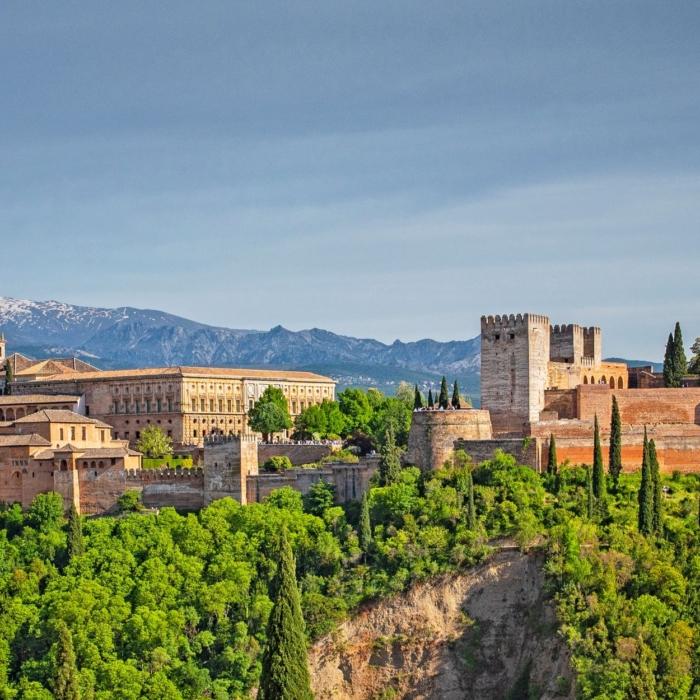
Affluent Boston hardware merchant and architect Franklin Smith designed his winter getaway home after traveling the world and studying ancient design and building techniques. He was particularly enamored with the 13th-century palace, Alhambra, in Granada, Spain.
“He went on 19 grand tours to Europe,” one of Villa Zorayda’s managers, Olivia McKay, explained in a phone interview. “He wanted to share European art and design with America. It was his life’s passion.”
Not only is the Smith’s design notable for its countless examples of Moorish Revival architecture, such as horseshoe and scalloped arches, geometric patterns, extensive tilework, and filigree carvings, but also the name he chose for his mansion is distinctive. He named it for one of the princesses in Washington Irving’s ‘Tales of the Alhambra.”
Built in 1883, Villa Zorayda is where Smith resided part-time for two decades before it became a restaurant and social club. In the late 1920s, new owner Abraham Mussallem and his wife resided in the mansion for a few years before deciding to preserve it as a historic museum, showcasing its stellar architecture and interior design, as well as priceless antiques and distinctive artifacts, to the public.
“It is now owned by the third generation of the Mussallem family,” McKay said, adding that Villa Zorayda underwent an eight-year renovation in 2000. “The family loves the building and the history. It’s just beautiful and unique. And it’s remarkable to think it’s 143 years old.”
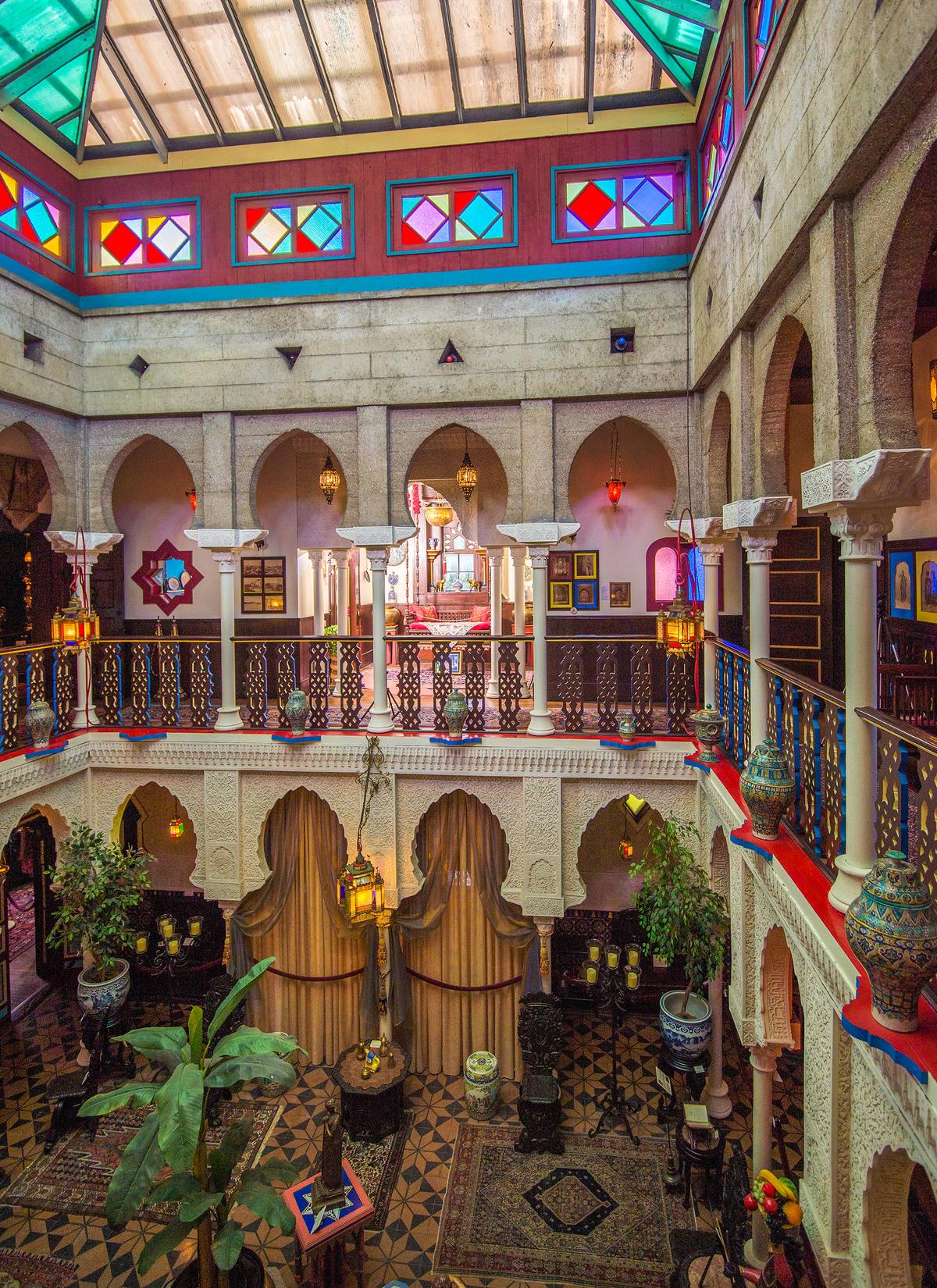
A tented atrium roof allows light to illuminate the vibrant, two-story main hall, dubbed the Court of Lions. A columned balcony with ornate filigree railings surrounds the upper level. Pilasters are between the horseshoe columns, while the entablature features geometric cutouts that complement the geometric stained glass. Fanciful carvings adorn the scalloped arches on the first floor. Villa Zorayda Museum
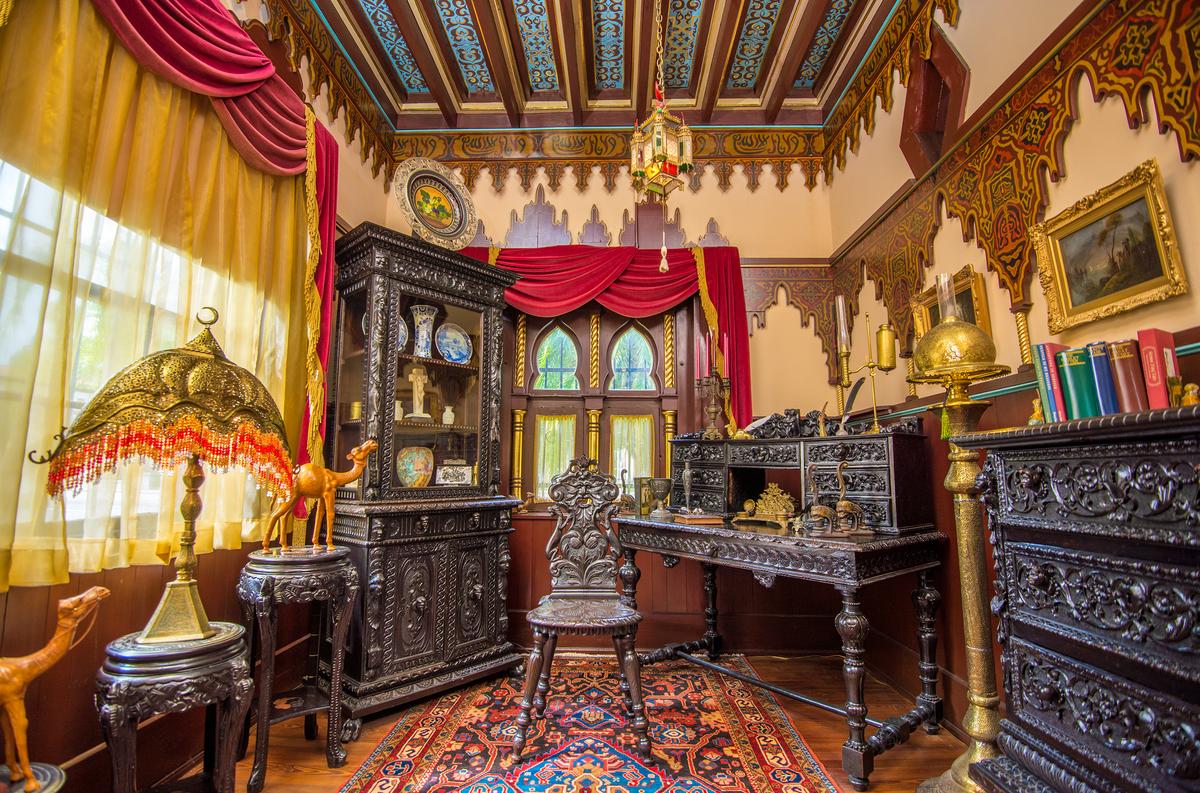
A gold gilt and blue design is painted between the exposed beams on the Prayer Room’s tray ceiling. The heavily carved, 17th-century German black walnut furnishings in the room were originally used by Franklin Smith, since the space was his study and office. Most of the mansion’s lighting fixtures are original, including the Moroccan hanging lantern and the hand-pierced brass lamp with beading. Hand-carved and painted overlay decorative paneling serves as crown molding at the ceiling as well as decorations on the walls around the room. Villa Zorayda Museum
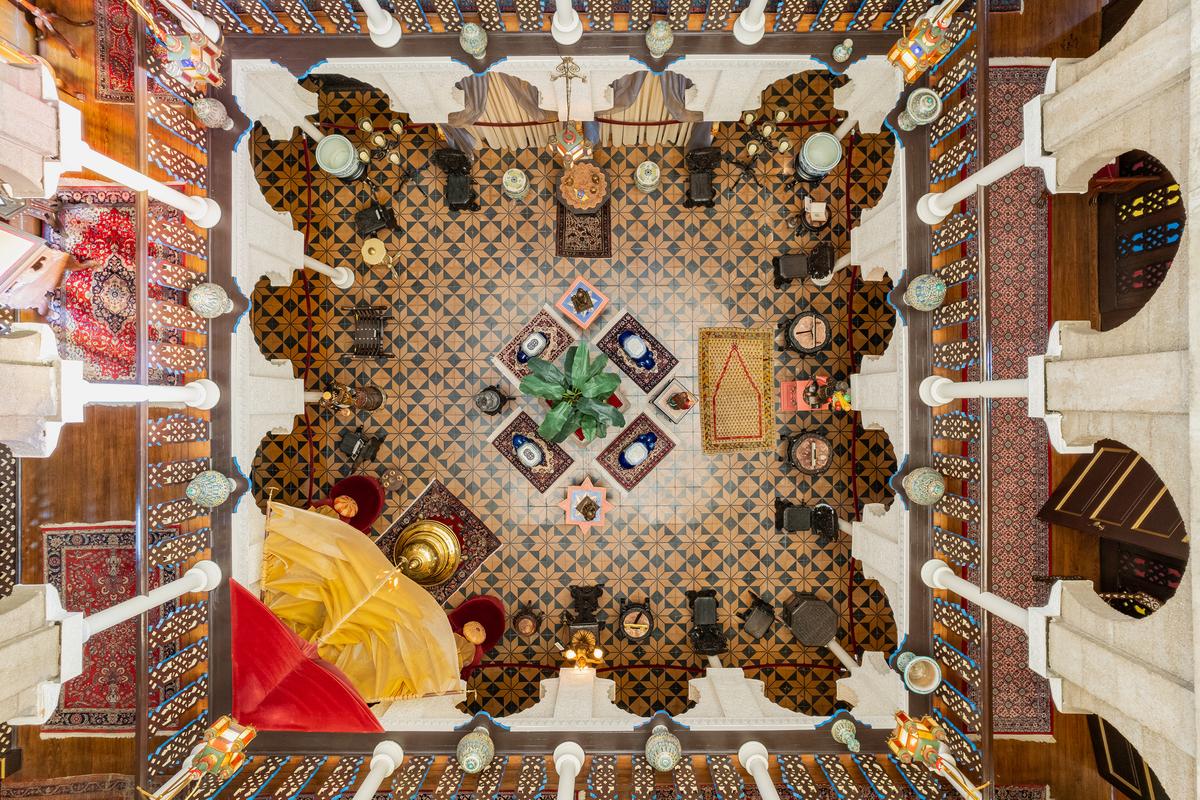
The central hall’s floor is crafted of 350-year-old tiles from Seville, Spain. Tiles on the walls are from Egypt. The view from above resembles a detailed painting, featuring jewel-toned shapes and patterns, as well as symmetry from the columns and arches. Villa Zorayda Museum
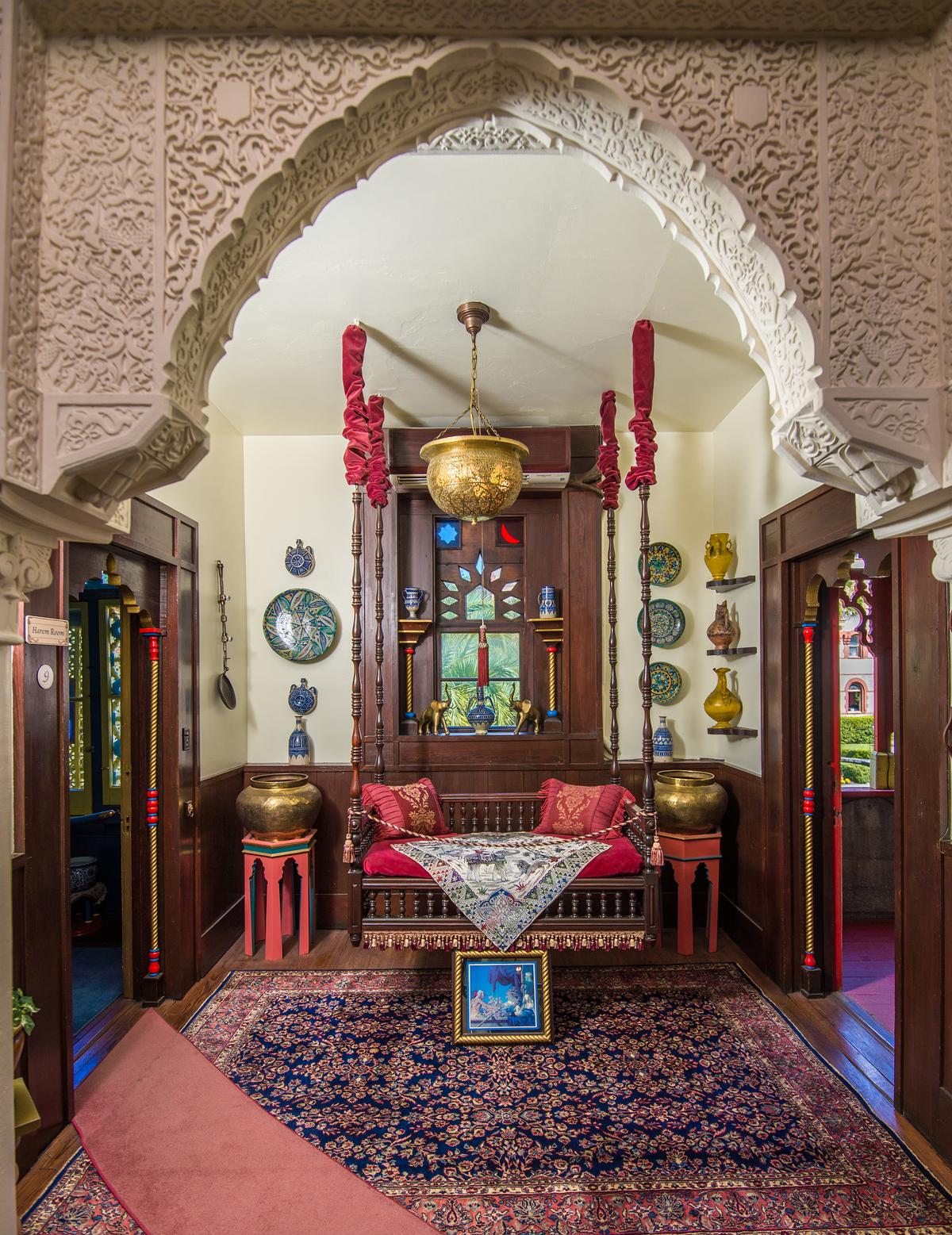
A swinging wooden daybed hanging from long spindles is aligned with this niche space, located next to the harem. Many of the carvings and much of the plasterwork around doors and on walls are exact replicas of those that ornament the Alhambra, a 13th-century palace in Granada, Spain. Every room, including this one, displays oriental rugs, decorative tiles, and fine art collected from Spain, the Middle East, and Egypt. Florida pine, along with imported mahogany and walnut, was used to craft paneling around door frames and at windows. The hand-pierced brass hanging lantern is shaped like the brass bowls flanking the daybed. Villa Zorayda Museum
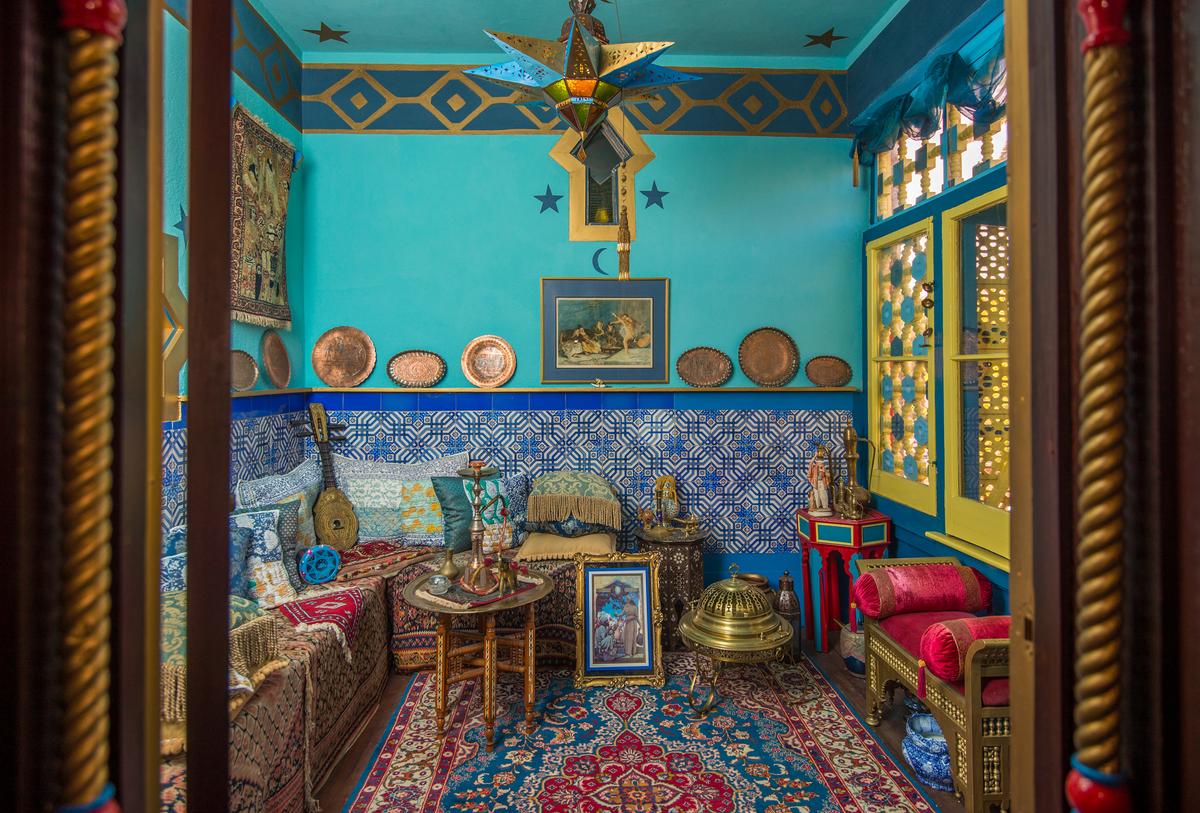
This is referred to as the Harem Room for two reasons: The cutout window design allows people to see out but not in, and family members gathered here. Stars, the sun, and crescent moons are motifs throughout Villa Zorayda, including on the aqua-blue walls and ceiling. The hand-pierced brass light fixture is a star shape. Hand-painted tile embellishes the walls up to the chair railing. Villa Zorayda Museum
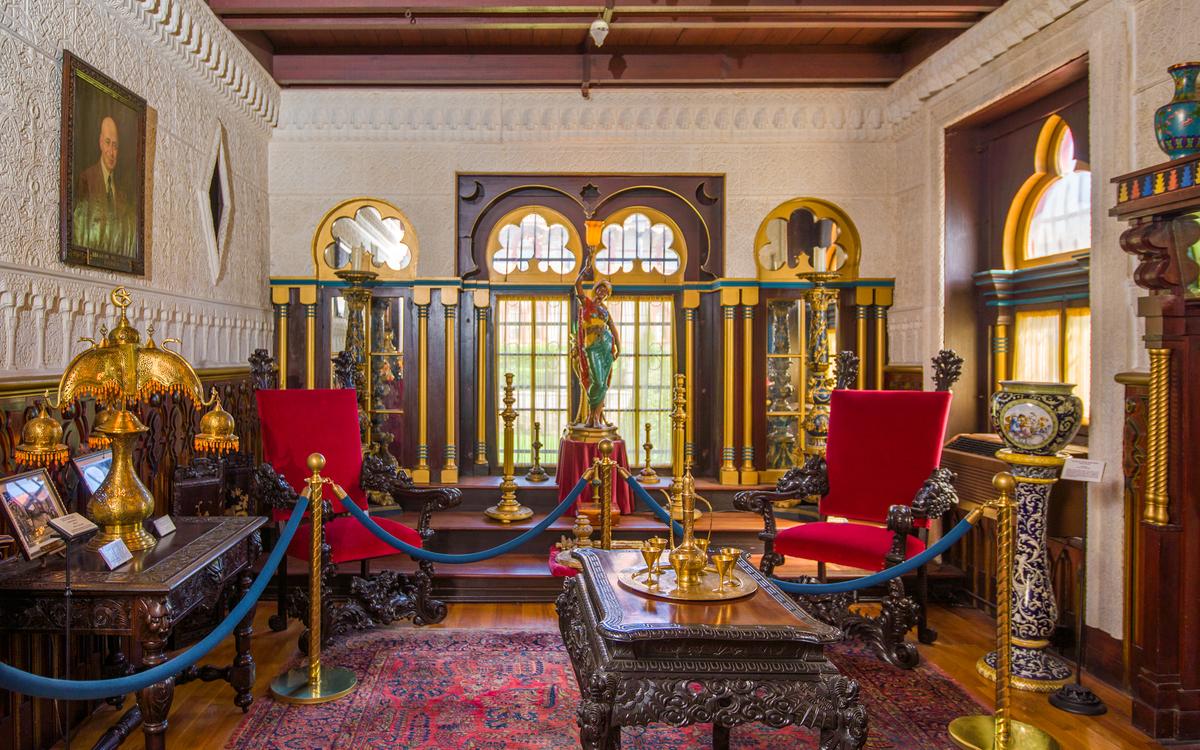
Named by Smith as the Hall of Justice after a room in the Alhambra, this space was once used as Villa Zorayda’s dining and living room. Since the mansion became a museum in 1933, the space presents various art and furnishings, including an Egyptian maiden lamp statue, which includes a signed Tiffany shade. Five-foot candleholders are positioned in front of floor-to-ceiling mirrors set within arches. These match the pair of windows, which are framed by wood carved with sun and crescent moon designs. Slender gilded columns are built into the walls, which are plastered in arabesque decorations of interlacing foliage and Moorish-style scrollwork and motifs. Villa Zorayda Museum
What arts and culture topics would you like us to cover? Please email ideas or feedback to [email protected].
A 30-plus-year writer-journalist, Deena C. Bouknight works from her Western North Carolina mountain cottage and has contributed articles on food culture, travel, people, and more to local, regional, national, and international publications. She has written three novels, including the only historical fiction about the East Coast’s worst earthquake. Her website is DeenaBouknightWriting.com