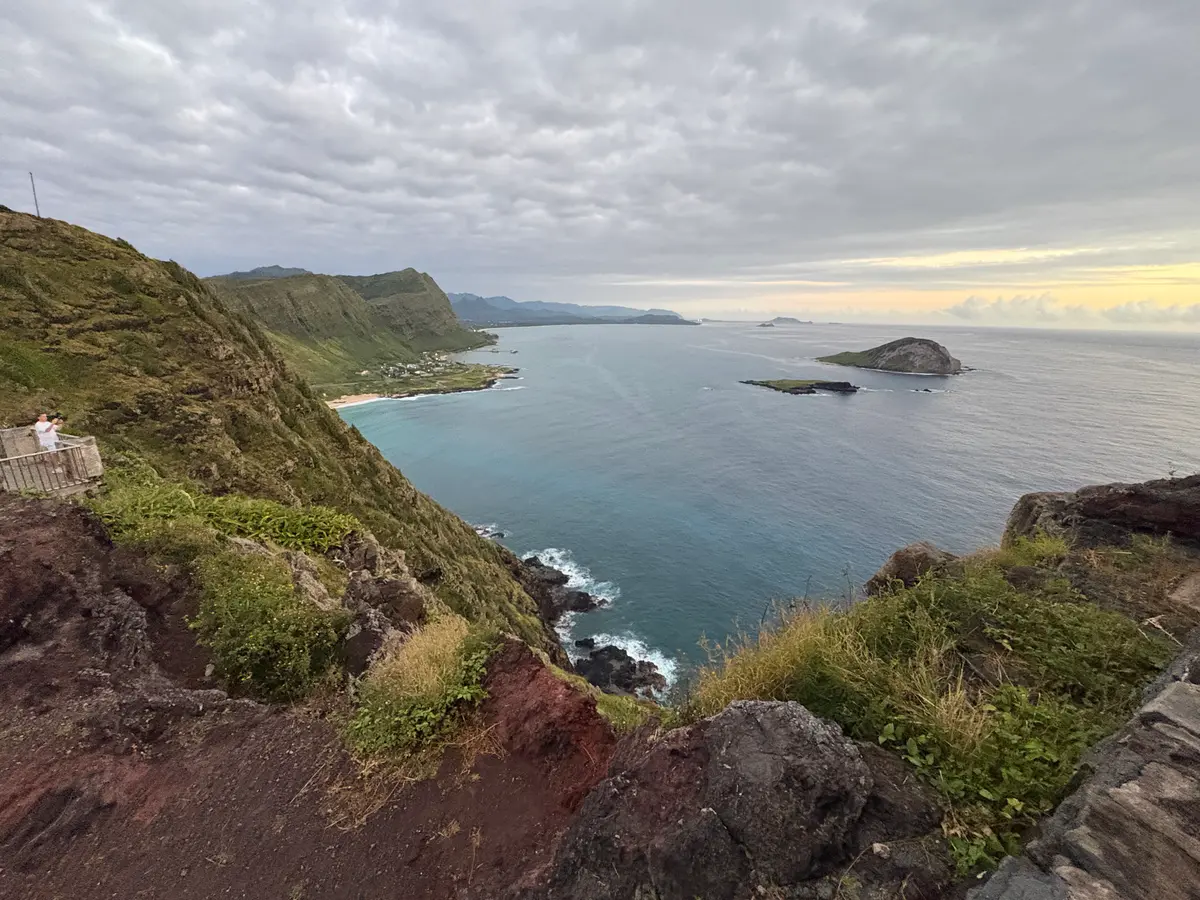
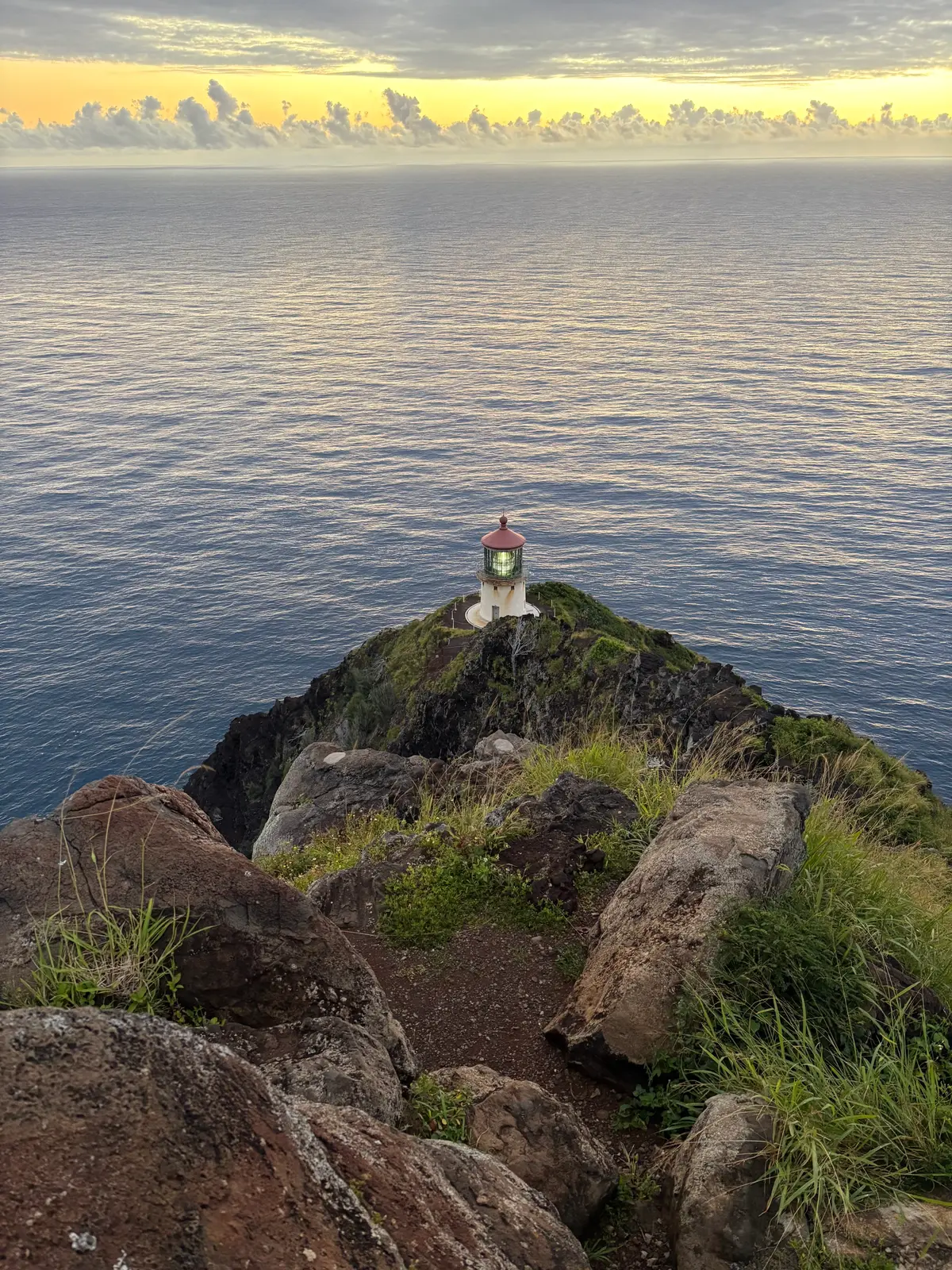
Although Oahu is globally famous for its Pearl Harbor memorials, Waikiki Beach’s two-mile shoreline and the hike-able Diamond Head volcanic tuff cone offers more to see. Discover a lesser-known but must-see engineering marvel in the Oahu’s Makapu’u Lighthouse. At just 46 feet tall, it isn’t the tallest U.S. lighthouse. But located at the southeastern-most point of Oahu, it appears impossibly perched on a rocky cliff 647 feet above the ocean.
At the time it was installed, this unique lens, larger than a first-order Fresnel lens, was the largest lens in any U.S. lighthouse. It still holds that title. Its beam radiates 420 feet over the Pacific Ocean and can be seen by boats and ships 28 miles away.
Signs near the observation deck overlooking the lighthouse are provided by the Department of Land and Natural Resources Division of State Parks. One the signs has historic black-and-white photographs of the lighthouse in the early 1900s.
The Makapuʻu Point Lighthouse Trail is two miles, round-trip. Along it are more remnants of the past. The lighthouse’s circa-1909 oil house that held drums of oil and kerosene is preserved. The lava rock and mortar stairs, walls, and floors are all that indicate three lightkeepers’ residences were once located on Makapuʻu’s summit. Stone and mortar guardrails also remain. The path is no longer open to vehicle traffic, but in the 1930s, guardrails kept cars and trucks from sliding off the steep drop into the ocean.
To even clear a path to the top of Makapuʻu so that houses and outbuildings could be built, people used dynamite, mules, and shovels. A perilous footpath about a quarter mile from the summit’s former structures winds around the northeast slope of the cliff to where the lighthouse is located. Although the footpath is currently closed to visitors due to danger, lighthouse keepers had to walk it regularly to maintain the light.
Shining a Light on Hawaiian History
Originally, the only modes of transportation for lighthouse keepers and their families were horses or mules. The animals were either ridden or pulled wagons to and from the nearest town, five miles away, so that residents could get supplies.In the 1920s, Makapuʻu Lighthouse was equipped with two radio beacons to transmit signals 200 miles away. In 1932, the lighthouse was wired with electricity; carrying heavy oil to operate it was no longer required.
Then, in 1974, the lighthouse was automated. Makapuʻu Lighthouse’s keepers became obsolete. However, the original hyperradiant lens is still operational—117 years later.
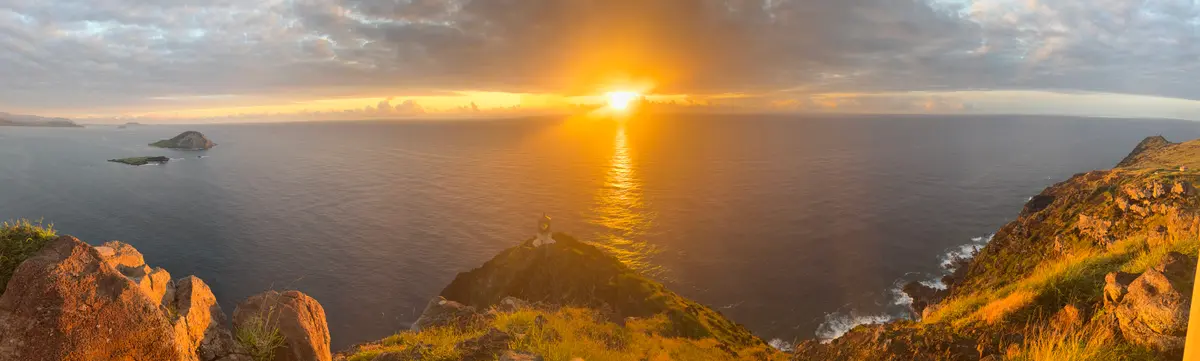
The Makapuʻu Point Lighthouse Trail is open year-round during the day, but a popular time to visit is at sunrise. This requires driving in the dark to reach the trailhead.
Depending on the time of year and the time of the sunrise, visitors may be required to park on the side of the road, outside the parking area—which doesn’t open until 7 a.m. Yet, the path is so well paved and maintained that a simple flashlight is all that’s needed to get to the summit in time to see a routinely spectacular sunrise.
Besides enjoying the colorful, natural light show across the vast horizon, sunrise walkers who arrive just before dawn are also treated to the periodic lighthouse lens’s glow. This living history spectacle enables visitors to marvel at how such ingenuity endures, more than a century later.