In a seven-acre public park named for Revolutionary War hero Marquis de Lafayette is an American president’s statue that’s important for a few firsts. Yet, most Washington residents and visitors know little-to-nothing about the statue or its sculptor.
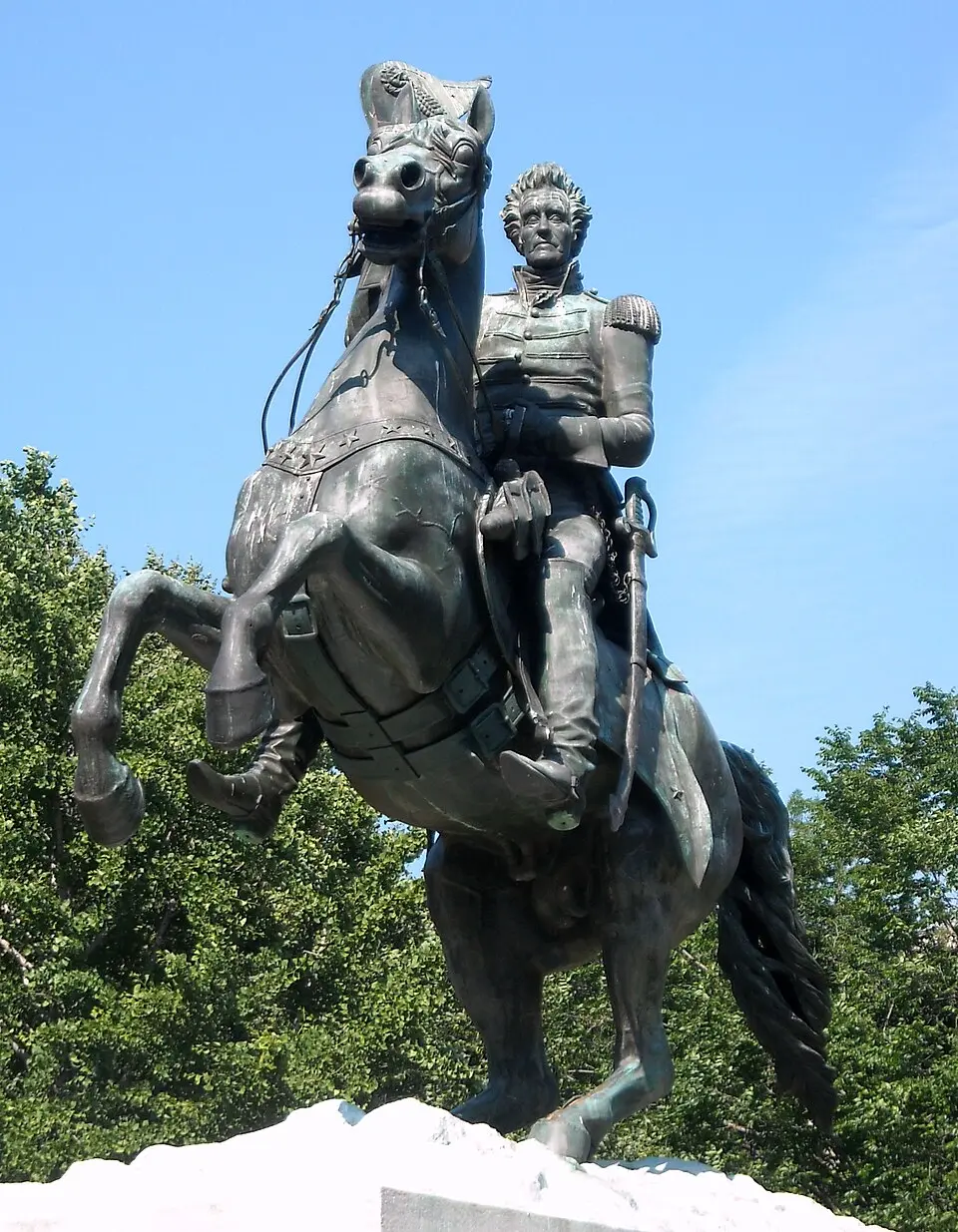
The statue of America’s seventh president, towering 12 feet tall on a marble base, weighs 15 tons; its backdrop, from one angle, is the White House and the Washington Monument. It depicts Andrew Jackson, the southern Revolutionary War veteran and War of 1812 hero as the avid equestrian that he was.
Raising, breeding, training, racing, and riding horses from a young age was an important part of Jackson’s identity. Therefore, the Jackson bronze sculpture in Lafayette Square fittingly shows him on horseback. The statue depicts when he led the Battle of New Orleans against the British on Jan. 8, 1815. On a muscular, rearing horse representing his real horse named “Duke,” Jackson raises his bi-cornered, 18th-century hat.
The fact that the horse is balanced on its hind legs, without extra support from its tail, was a first for a statue, not only in America, but for the world. In the United States, it was also the first statue cast in bronze.
An Engineering Quandary
Erected in 1853, eight years after Jackson’s death, the project was a challenging one for sculptor Clark Mills (1815–1883). Born in New York, Mills was initially a jack of all trades—he worked as a lumberjack, farmhand, carpenter, and millwright. But in his 20s, he took a job as an ornamental plasterer in historic Charleston, South Carolina.Mills stayed in the South and gleaned sculpting skills, but he also acquired knowledge of engineering. Mills required both disciplines to determine how to balance a horse statue on two legs. He had no reference point, because none existed. He used his own horse, named “Olympus,” as a model. He even trained the horse to rear.
Mills also built his own foundry near Lafayette Square to work out the bronzing process. After repeated casting attempts, Mills eventually worked out the statue’s intricacies. In order to be sturdy, it had to be sculpted and then cast in 10 pieces, instead of one. The horse is made of four pieces, while its rider is made of six. Additionally, the horse’s back two legs were equipped with interior iron cores to make them even stronger.
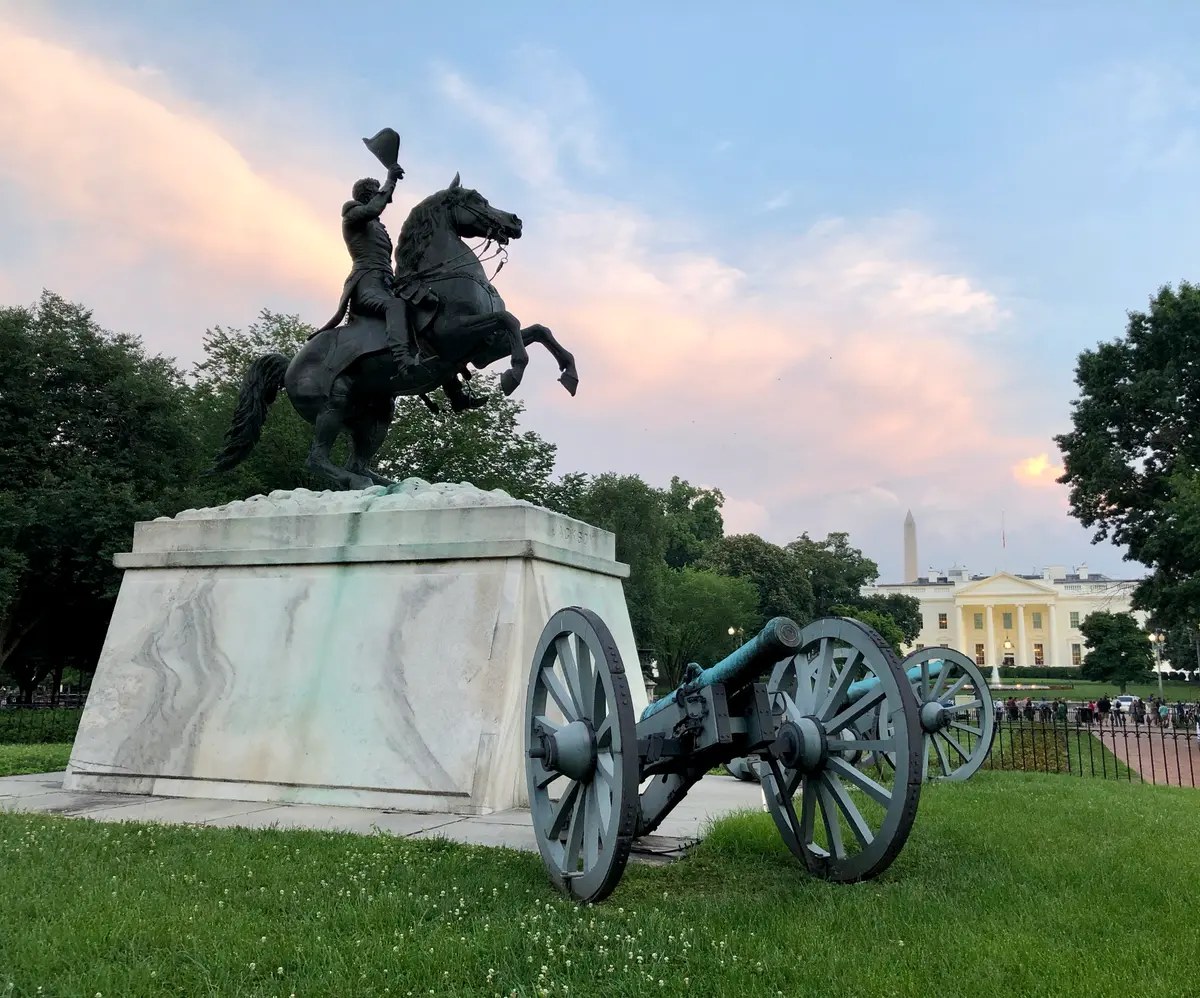
The statue faces west, toward the White House. Inscribed on the marble base is a famous Jacksonian toast made in 1830: “Our Federal Union / It Must Be Preserved.” Jackson wears a military uniform, and a breastplate adorned with stars is strapped across the horse’s chest. The statue is so detailed that, under the horse’s stomach, even the saddle cinch, which holds the saddle in place, appears realistic. Visitors can see veins on the horse, that its hooves are shod and nostrils flared.
The Andrew Jackson statue became Mills’s best-known work. In fact, during his lifetime, he was commissioned to make two copies of the statue. One was installed, appropriately, in New Orleans’s Jackson Square in 1856. Just a few years before Mills died, the other was placed on the grounds of the Tennessee State Capitol in Nashville, which isn’t far from Jackson’s preserved Hermitage plantation.
In 1987, a third copy of the Andrew Jackson statue was fashioned for a downtown spot in Jacksonville, Florida.
With Washington tourism surging for the third straight year, due to the sesquicentennial as well as new exhibits, programs, and events offered, it benefits visitors and residents alike to know more about the plentiful statues and monuments within the capital city.