Children spend a huge portion of their childhoods playing. And rightly so. According to the National Institute for Play, “play is essential to how humans and other species develop, function, and innovate.”
The NIP explains that play is deeply neurologically wired. It’s deeply rooted in our biology. Affective neuroscientists have located seven primary emotional systems that we are born with, and among them is play. Play circuits in the midbrain activate wide-reaching neural networks, strengthening neural connections related to socialization, movement, and emotional regulation.
Hardwired for Fun: How Play Shapes the Developing Brain
For children, playtime is crucial to development and learning, from the tiniest tot to adolescents (and beyond). Play helps infants develop coordination and eye-tracking skills, while toddlers build both physical and emotional resilience through it. Children who are allowed a reasonable degree of freedom in their play also develop creativity as their unbounded imaginations are allowed to roam and make fun of whatever surrounds them. Research has shown that encouraging playful curiosity improves learning outcomes, while a lack of play is linked to emotional and behavioral problems.
In imagination and play, children begin to make sense of the world, dream, create, and experiment. They learn that some of the most important human activities are things we do for their own sake, for the sheer delight of it, and not necessarily for practical results. It also initiates interests and pursuits that shape character and can develop into lifelong pursuits or even careers. The child who becomes obsessed with playing knights may grow up to study history, while the one fascinated by Legos may step onto a path toward engineering. In this way, play can become a gateway to vocation.
But it’s not just children who need playfulness in their lives. The biological disposition toward play doesn’t simply evaporate with age; all of us need some measure of fun in our lives. As the NIP observes, “Play is a fundamental biological, psychological, and social mechanism shaping how we learn, adapt, connect, and thrive across the lifespan … When play is absent or chronically suppressed, research links this deprivation to depression, impaired social development, and difficulties with emotional regulation and learning.”


The concrete benefits of play for adults are myriad. Among other things, it stimulates creativity, relieves stress-related tension, enhances brain function, and deepens connections with others. In his book “Essentialism: The Disciplined Pursuit of Less,” Greg McKeown recommends that adults–especially those with careers–engage in regularly scheduled play. To do so, we have to reject the idea that play is trivial, a concept we acquire as we move out of childhood. Why is McKeown adamant about play? For one thing, it helps us to think in new ways, which can help us solve problems and excel in any enterprise. McKeown relates a study of grizzly bears that found bears who played the most generally survived the longest because play had prepared them to think creatively and solve problems. The same holds for us. As McKeown writes, “Play expands our minds in ways that allow us to explore: to germinate new ideas or see old ideas in a new light. It makes us more inquisitive, more attuned to novelty, more engaged.”
Beyond the Sandbox: Cultivating Play for Adult Well-Being
Aristotle famously said that “we work to have leisure.” While play and leisure are somewhat distinct categories, they are related because both can be understood as the object of work, rather than simply breaks from work. Aristotle here contends that the most important, most humanizing things we do—contemplating truth, connecting with others, appreciating beauty, for instance—are not directly tied to the pragmatics of work. Rather, we work in order to have the ability to engage in these freeing, humanizing activities. Play—though less serious than what Aristotle considered “leisure”—still helps remind us that there’s more to life than clocking in and out and then crashing on the sofa.
In play, we often enter into a “flow state” where time disappears, and practical worries, concerns, and goals fade into the background. We are, like a child, simply alive.
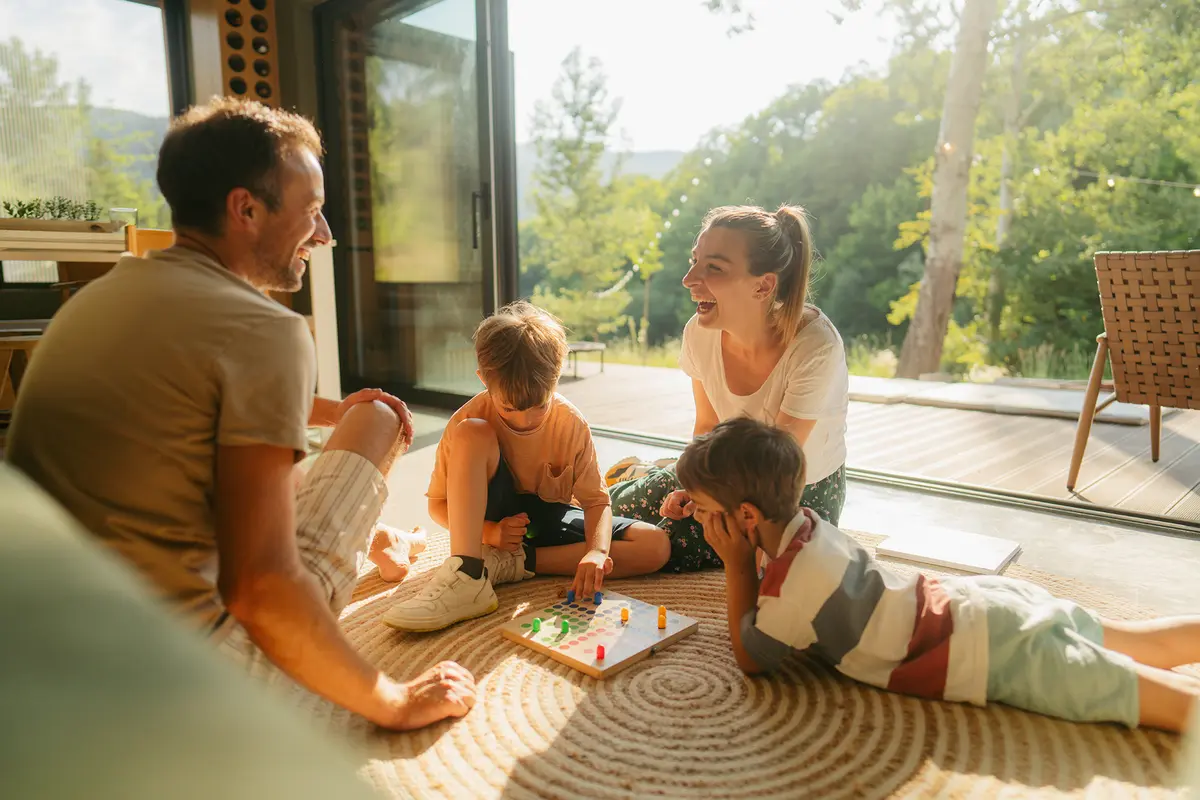
The communal aspect of play deserves special attention, too. Engaging in interactive, lighthearted activities provides something a family or group of friends can share. Because of its interactiveness, bonding occurs much more easily through play than through staring at a screen together (or, more likely, separate screens).
What might all this look like practically? Here are a few ideas:
Spend time not merely watching your kids or grandkids, but actually playing with them
Return to a sport you played when you were younger, or pick up a new one
Block out time to just be present with someone you love, without any scheduled activities, and see what you come up with together
Try a new hobby or craft
Play or listen to music
Explore outdoors
Tell stories and laugh together
Play is the wild world of indulging in whimsical and unnecessary things, which turns out to be quite necessary for our well-being after all. Some degree of enjoying things for their own sake, of just embracing being alive through activities that bring delight, remains essential throughout our lives.