“I have always loved the desert,” wrote Antoine de Saint-Exupéry in “The Little Prince.” “One sits down on a desert sand dune, sees nothing, hears nothing. Yet through the silence something throbs, and gleams.”
We tend to think of silence as an absence, a lack. Yet in that supposed lack, we become more aware of presence–our own presence and the mysterious presence of the world. It speaks to us in silence, not tumult. By contrast, excessive noise and stimulation suffocates the simple and beautiful awareness of existence. It buries that throbbing, obscures that gleam.
Further, it has a measurably negative effect on our ability to learn, remember, and create. Noise can take us out of the “flow state” we encounter in stillness, a state in which we are able to collect our thoughts and open ourselves to the inspiration the world offers.
There are two kinds of noise that can damage our ability to think, focus, and discover: literal noise and overstimulation, in whatever form they take (auditory, visual, mental). When it comes to literal noise, research indicates that excessive amounts sabotage cognition and health on a number of fronts, including hearing ability, learning ability, and bodily stress levels.
What’s at Stake

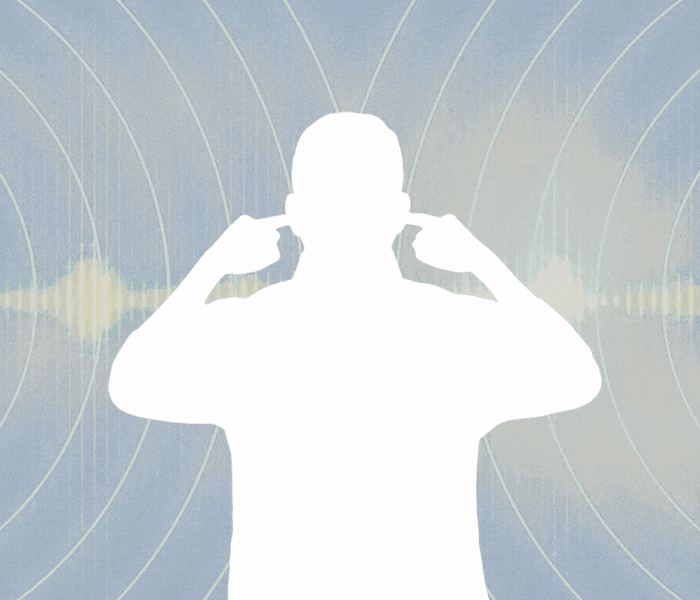
But it’s not just hearing damage we have to contend with. Sonic stimulation can also interfere with cognitive functions. For instance, studies have demonstrated that children find it harder to focus in loud classrooms and perform worse on reading tasks and remembering information. They perform worse academically because their brains have to work harder to sift through the background noise, identifying what is important and what isn’t.

Lynna Martinez-Khalilian, chief academic officer at Fusion Academy—a group that works with students who struggle in traditional classrooms—told The Epoch Times, “For some students—specifically those with ADHD, auditory processing differences, or sensory sensitivities—the effort required to filter background noise can consume cognitive resources that would otherwise be available for learning.”
Even when things grow quieter, it can be hard for children (and adults) who are used to a lot of noise to experience that calm—their brains become “noisier” in the sense that auditory nerves stay more active even when the environment is quiet.
Of course, not every student is the same, and some actually benefit from low-level noise.
Martinez-Khalilian observed: “Every student is different, and the right sound environment isn’t the same for every student. Moderate white noise has been shown to improve memory performance in children with ADHD while making it worse for their attentive classmates.”
Sweet Silence
Yet another reason to control the auditory environment and one’s response to it has to do with overall bodily health. Our ears serve as one of our alarm systems, and we often respond to noise by shifting into a fight-or-flight response. Noise can trigger a heightened level of anxiety and stress, and prolonged noise can set us on edge in a more permanent way. We may end up living our lives stretched taut, our nervous systems constantly turbocharging because of the perceived “threat” of surrounding noise, without even realizing it. And stress, of course, plays a major role in developing diseases, including high blood pressure and heart disease.
The Creativity Cost
“Certainly there are people, nay, very many, who will smile at [my predicament], because they are not sensitive to noise; it is precisely these people, however, who are not sensitive to argument, thought, poetry or art, in short, to any kind of intellectual impression: a fact to be assigned to the coarse quality and strong texture of their brain tissues.”
While Schopenhauer’s assertion that those unaffected by noise are also insensitive to deep thought is obviously unfair and self-serving, he’s not completely wrong about the connection between stillness—interior and exterior—and inspiration.
Leigh explains that creativity and inspiration spring out of the well-tilled soil of boredom. It is only when there’s space to be bored, to reflect, and to let the mind wander, that creativity has an opportunity to flourish. We see this play out particularly with children. In those distant pre-internet days, children had to endure a higher dose of boredom yet developed a higher capacity for original and speculative thinking—for example, turning piles of sticks into forts and towers of pebbles into cities. They had both the motivation (boredom) and the freedom (unstructured, undistracted time) to be creative. But today, with eyes and fingers pasted onto devices, boredom—and the worlds it opens up—has no time to surface.
This holds equally for adults. Because we are so used to receiving constant stimulation and dopamine hits from our devices, we remain stuck in “consumption mode” rather than “creativity mode.” We sink into a cycle of stimulation, crash, and numbness, which causes us to seek stimulation again. The noise never stops. The stillness never has time to settle over us.

Creative thinking comes alive when we activate what’s called the “default mode network” in our brains—the areas lit up during rest, reflection, and quiet, where we process and ponder. But when we become addicted to digital stimuli (or other unhealthy doses of dopamine), the default network mode doesn’t have a chance to activate. “When you’re bombarded by what are called supernormal stimuli—notifications, alerts—that are literally designed to keep you hooked, in that way your brain can’t slide into the default mode network,” Leigh stated. “It stays in survival mode. ... It’s in strain brain.”
She continued: “Supernormal stimuli don’t elevate you—they exploit you. They give you cheap, artificial dopamine hits that keep you wanting more. It’s like the chase but never catching the goal. ... In this way, your creativity is suffering.”
A Simple Solution
What to do about it? How to tame the tumult and summon the stillness? Leigh advised conscientiously breaking the loop of automatic, dopamine-seeking habits. “Choose awareness over autopilot,” she said.
Next, seek a dopamine detox, even if that begins with just spending a few minutes phone-free without demanding instant gratification and stimulation.
Finally, develop purposeful alignment rituals—simple routines that help you get grounded and settle into the present moment with the soft grace of stillness easing over your body. Leigh’s own ritual involves sitting down in silence every morning, preferably outside. This provides a dose of dopamine (at a healthy level), serotonin, and oxytocin.
This kind of quiet routine, inviting gentle joy into the start of the day, is much better than reaching instantly for the phone, which will cause an unhealthy saturation of dopamine, leading to the exhausting stimulation-crash-numbness-stimulation cycle described earlier. It’s a bit like starting your day with a donut—you set yourself up for blood sugar spikes and crashes all day long.