Up to 50 percent of the soldiers in the Continental Army during the American Revolutionary War were Irish, even though people of Irish heritage constituted only 10 percent of the overall U.S. population. This statistic points to one of the factors involved in the colonists’ incredible and unlikely victory over the juggernaut of British imperial forces. The colonists had the Irish fighting spirit on their side.
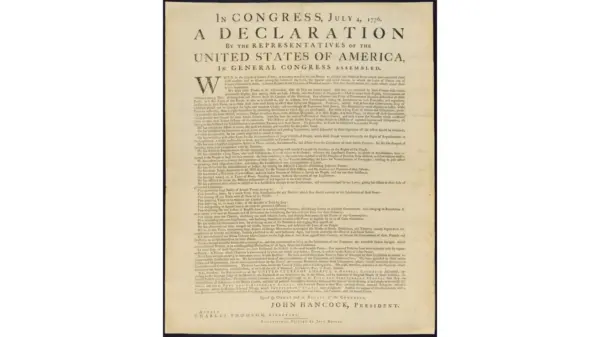
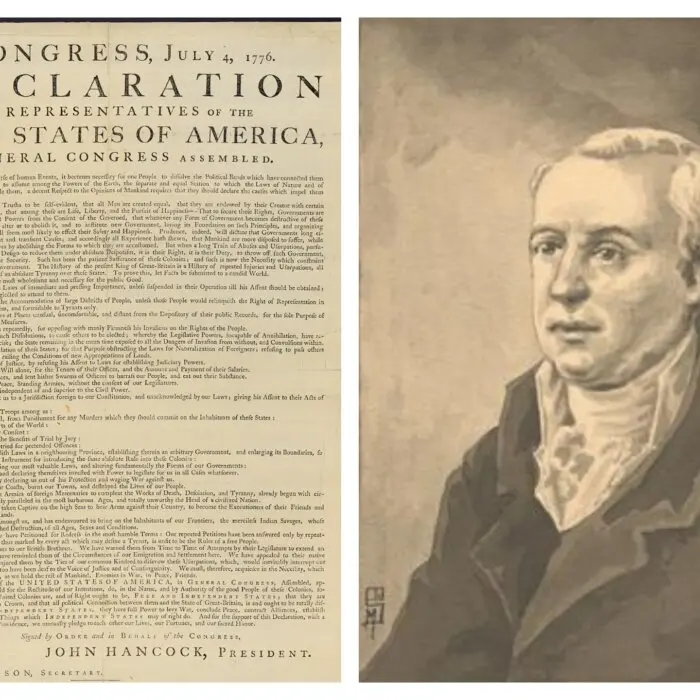
Printed on July 4, 1776, by Irish-born John Dunlap, the Dunlap Broadside was the very first public copy of the Declaration of Independence. Public Domain
Centuries of Conflict
As historian Phillip Thomas Tucker explains in “How the Irish Won the American Revolution: The Forgotten Heroes of America’s War of Independence,”“For more than two centuries, what has been most forgotten about America’s stirring creation story were the crucial and disproportionate contributions that the Irish people, especially the more numerous Scotch-Irish (compared to Irish Catholics) from Northern Ireland, played in the winning of the American Revolution. Largely because of Ireland’s dark legacy of early subjugation by England and difficult economic times that caused a mass exodus of immigrants to colonial America, the Irish people became not marginal, but the leading players in America’s struggle for liberty and creation.”
Of course, when we stop to consider it, it isn’t hard to understand why the Irish would have, by and large, thrown their support behind the revolution. The Irish feud with the English runs as deep as blood. After all, Ireland is sometimes referred to as England’s “first colony.”
The English first invaded Ireland in 1171 under King Henry II, inaugurating 800 years of British oppression on the island. This oppression included decimating the Irish ecosystem by stripping it of trees (to be used to build British ships), confiscating local lands, enslaving local peoples and sending them to other colonies, and, eventually, strict anti-Catholic laws. During and after the Reformation, Irish Catholic priests were executed, Mass was outlawed, and a series of Penal Laws were enacted, disenfranchising the Irish and leading to generational poverty among Irish Catholics.
That isn’t the kind of thing a people forget quickly.
Thus, in 1775, on the other side of the Atlantic, the Irish saw an opportunity to strike back at their British overlords and help another colony avoid the fate that Ireland had suffered. As Tucker observes, “The revolutionary tradition of rising up against abusive centralized authority was already deeply embedded in the hearts and minds of the average Irish immigrant who never needed to read Age of Enlightenment philosophers ... to become fiery revolutionaries.”
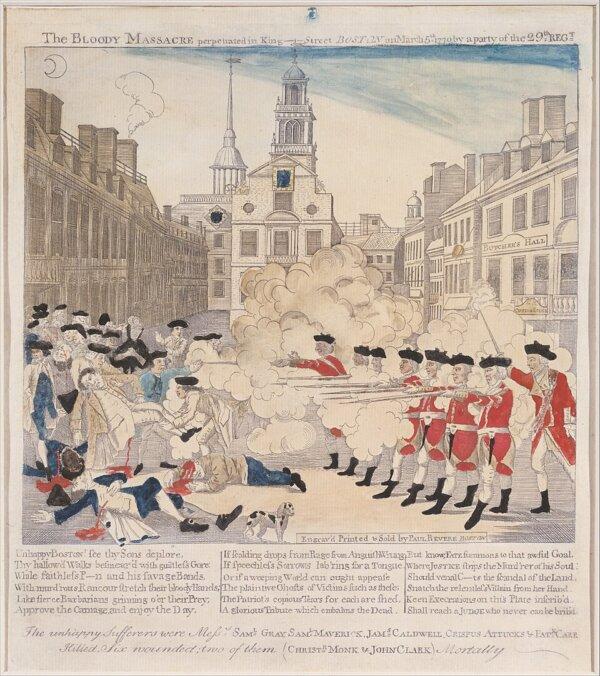
"The Boston Massacre," 1770, engraving by Paul Revere. Irish-born Patrick Carr became one of the first victims killed by British troops in the conflict. Public Domain
Some 250,000 Presbyterian Scots-Irish—who had also suffered religious persecution in Ireland—had immigrated to the American Colonies in the decades leading up to the Revolutionary War. Many Irish Catholics came to America as well. And both types of Irish were spoiling for a fight.
The Irish were there from the beginning of the uprising. One of the victims of the Boston Massacre of 1770 was an Irish-born man named Patrick Carr. The conspirators of the Boston Tea Party met at an inn owned by an Irishman, and some of the individuals who dumped the tea spoke with an Irish brogue.
As the struggle intensified, Irish Americans stepped boldly into the center of the broiling conflict between the Colonies and the Crown. And this was despite the fact that many of them remained on the outskirts of colonial society, often lacking land, money, education, and prospects. Nevertheless, they served as infantry, officers, spies, publishers, and even signers of the Declaration of Independence. In addition to their love of freedom and hatred of the English, many Irish troops were motivated by the prospect of receiving land as payment for service.
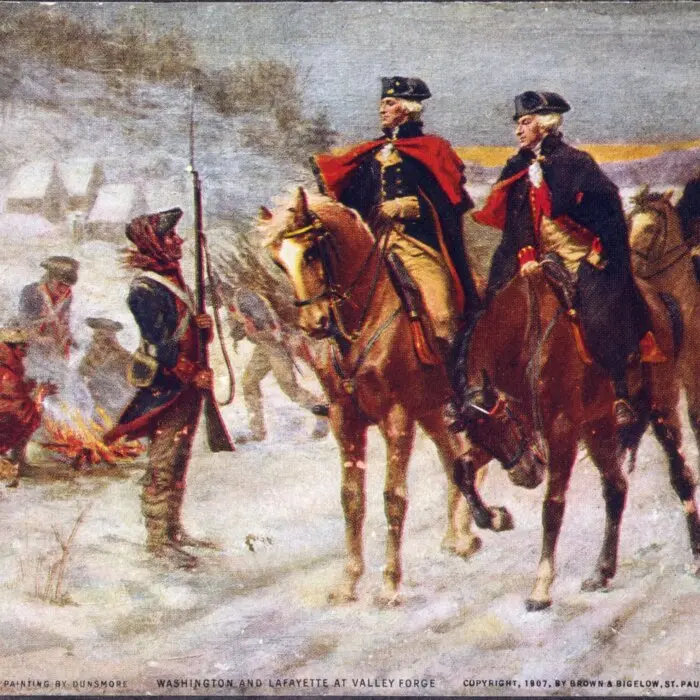
While it should be noted that not all the Irish in America supported the revolution, Tucker observes, “The Irish and Scotch-Irish actually fought in more disproportionate numbers compared to colonists of British descent and served as the longest-lasting and most sturdy core foundation of General George Washington’s Continental Army.”
Irishmen studded the Continental officer corps with talent and bravery: Stephen Moylan commanded a cavalry regiment, John Fitzgerald and James McHenry served as aides-de-camp for Washington. At the same time, nine of his generals were born in Ireland. James McHenry went on to become the third secretary of war under President Washington in the early American government.
On the Frontlines
One of the most notable Irish American commanders made waves (literally) at sea: The indefatigable John Barry (1745–1803) played such a pivotal role in American naval operations that he has been called “the Father of the American Navy.”Barry, who had experience as a merchant seaman, was tapped to outfit the first Continental Navy warships, and then received a commission in the newly formed navy and command of the brig Lexington. He secured one of the first American naval victories when he captured the British ship Edward. He went on to capture several more ships, fend off bribes from the British to defect, and sustain injuries in the line of duty.
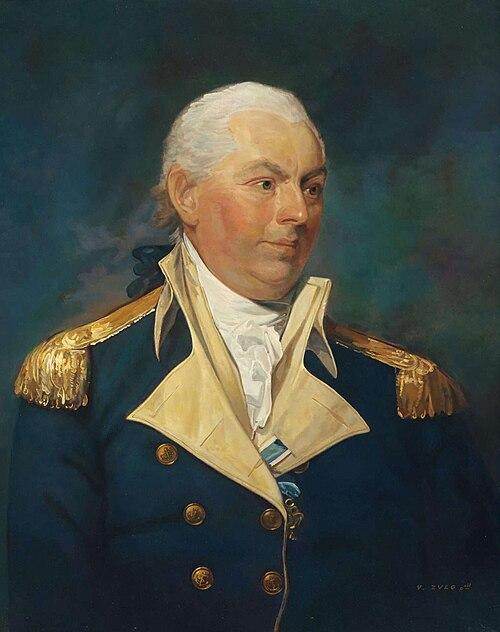
Irish-born John Barry commanded early Continental Navy warships against British forces and helped lay the foundation for the U.S. Navy. Public Domain
The American troops also counted some Irish defectors and spies among their ranks. One prominent example is Hercules Mulligan, born in 1740 in Coleraine, Ireland. Mulligan emigrated to New York City at age 6. He graduated from King’s College, married the niece of the Admiral of the British Royal Navy, and developed a friendship with Alexander Hamilton.
Shortly before the war, Mulligan opened a tailor shop in New York frequented by the elite, including high-ranking British officers. Despite his friendliness even toward his British customers, Mulligan harbored strong revolutionary sentiments and was among the first colonists to join the Sons of Liberty.
Hamilton suggested that Mulligan become a spy for the Continental Army, using his proximity to British military figures, afforded by his business, as a means of gathering information. Mulligan agreed, and he deftly led his British military clientele to unspool threads of information as they spoke with him.
He also used his powers of deduction; for instance, he could often figure out the British Army’s plans by asking officers when they needed their uniforms back from the tailor. All this information was relayed to Washington through the services of the slave Cato. On one occasion, this information literally saved Washington’s life. Mulligan had learned of a plot to capture the American general and managed to warn him in time.
A Shared Legacy of Freedom
Apart from direct military involvement, many Irish featured prominently in our nation’s founding. As the printer of the original broadsides of the Declaration of Independence and the United States Constitution, John Dunlap quite literally left his mark on our history. He was born in County Tyrone, Ireland, in 1747. In 1757, he was sent to Philadelphia to apprentice under his uncle William Dunlap, who was a printer and bookseller. John eventually inherited the business and supported himself by printing sermons as well as pamphlets and the weekly “Pennsylvania Packet,” which became a successful periodical. In 1776, he was appointed official printer for the government, which placed him in the position to print the first copy of the Declaration of Independence.Tucker argues that the Irish contribution to the war effort has been obscured by time and, maybe, prejudice. The Irish of the time held a very low social status, well below that of the Anglo yeoman farmer-soldier we most typically envision filling out Washington’s ranks. These were not the foremost figures in colonial society, yet theybore a substantial share of the costs of achieving American freedom. Their role has also been somewhat forgotten due to the lack of records of this diasporic people, but it was no less crucial for that. As Tucker put it, “In overall percentage terms, the average Irishman, the most ordinary common man and the lowest-class member of white colonial society, was in fact America’s patriot second to none.”
The relationship between Ireland and the United States worked both ways, too. The success of the American patriots inspired many in Ireland in casting off British rule. This led Irish radicals to launch the Irish Rebellion of 1798, which was unsuccessful, but which laid the groundwork for eventual Irish independence. As Patrick Ford wrote in the New York-based publication “The Irish World” 100 years after the American Revolution, “The Cause of America in 1776 is the cause of Ireland in 1876.”
The two nations were thus linked in their aspirations and their fortunes. In some sense, the Irish and the Americans owe their freedom to one another.
What arts and culture topics would you like us to cover? Please email ideas or feedback to [email protected]