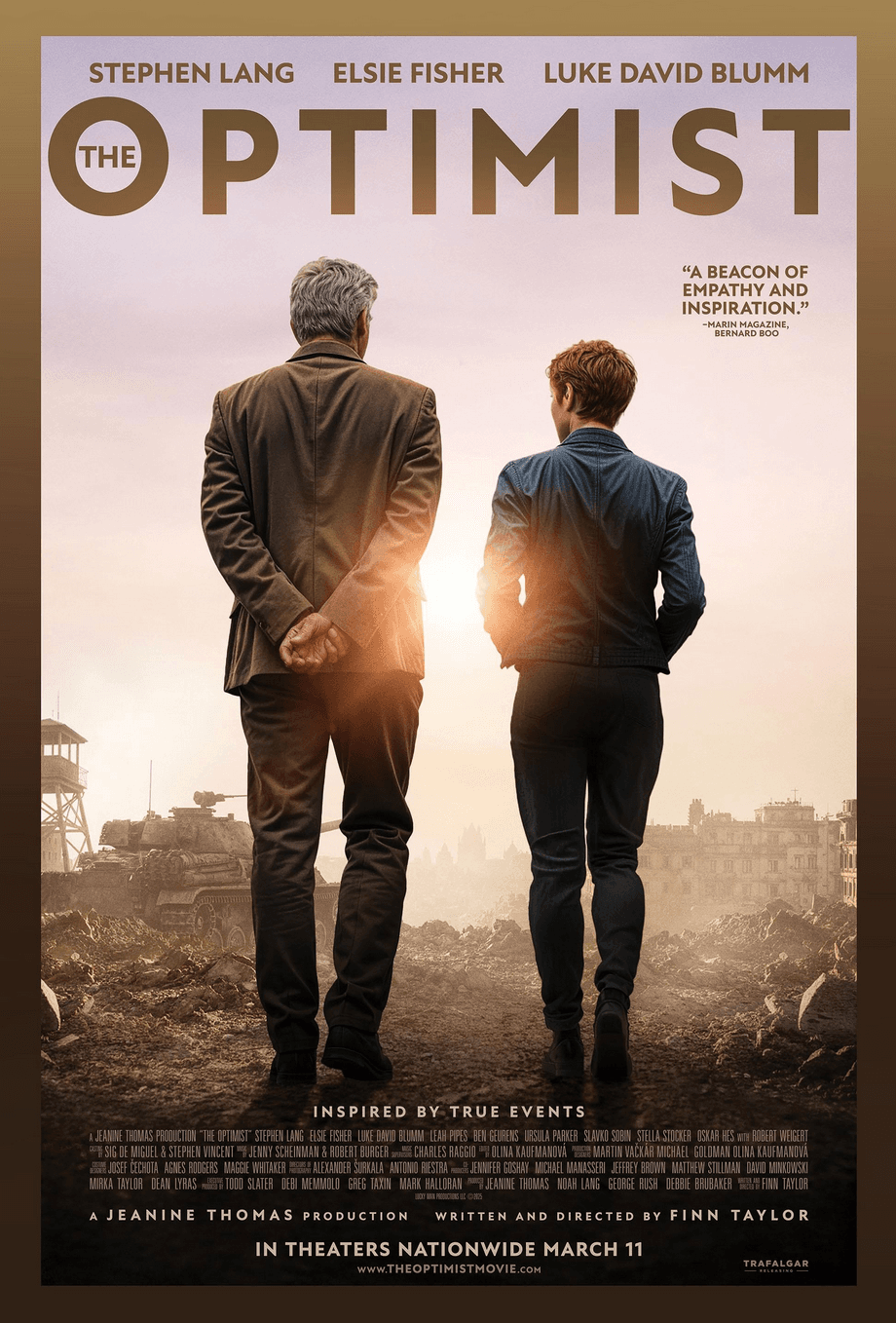
NR | 1h 42m | Holocaust, Drama | 2026
First, we’re shown the converging destinies of the two main characters—old man Herbert (Stephen Lang) and young woman Abby (Elsie Fisher). They cross paths in a hospital but don’t yet run into each other.
Herbert, after getting the news that he’s terminal and should get his affairs in order, returns to the children’s apparel shop he’s run for decades in Northern California. He hangs up a half-price-off sign. Abby has been seen in sessions at Redwoods Recovery with her therapist Ruth (Robin Weigert), who is having trouble getting through to her.
Set a Thief to Catch a Thief

Ruth receives a phone call from a mutual friend, who asks her to see Herbert. He spent his adult life refusing to speak about his boyhood at the Auschwitz death camp. Ruth argues that she doesn’t take those kinds of cases anymore but then has an inspiration—why not get two recalcitrant patients to coax their respective stories out of each other?


Ruth disguises the ploy by asking Abby to be the technician who films Herbert’s story for posterity. At the first recording session, after taking note of the patched-up incision Abby’s got at the base of her throat, Herbert suggests “If you tell me about your scar, I’ll tell you about mine,” referring to the acid-burn-removal of the Nazi camp tattoo on his forearm.
The Terrible Tales
Flashback to young Herbert (Luke David Blumm), in Prague, as the Nazis were incrementally encroaching and removing freedoms. Hebert’s father is the eternal optimist for whom the movie is named—he’s got his head firmly buried in the sand, claiming blithely that Czechoslovakia will never fall to the Nazis. Soon, however, his wife is stitching yellow stars of David on all their clothing and it’s too late to make a run for it.As Herbert and Abby start to comfortably confide in one another, sharing a burden they thought they would have to carry alone, Abby’s story begins to take shape in the form of child trafficking, lost friends, and survived suicide pacts.
“The Optimist” doesn’t diminish the seriousness of its subject. While the scenes set at Auschwitz are far less emotionally harrowing than “Schindler’s List,” audiences may run across aspects of the camps that they haven’t seen before. These sum up the depravity that drove German-American philosopher Hannah Arendt to coin the phrase “the banality of evil.” It’s not easy to stomach the business-like, factory-like, sheep-shearing-like extermination of an ethnic group and religious group by another culture.
Like the real-life Oskar Schindler in “Schindler’s List,” the spotlight eventually goes to real-life Holocaust survivor Herbert Heller, who made telling his story to younger generations his mission in his later years. Generational healing is the gift of this movie, and one shouldn’t look this gift horse in the mouth.
In the end, and in stark and ironic contrast with the infamous Auschwitz sign “Arbeit Macht Frei” (Work Creates Freedom), here, putting in the work to tell the truth about Auschwitz is what creates freedom.