New York state’s Hudson River Valley is one of the United States’ most picturesque areas, with dramatic vistas of hills, mountains, crags, and water features. In the 19th century, its natural beauty inspired an artistic movement known as the Hudson River School. Practitioners painted landscapes, creating the first significant works in this genre in American art history.
The British-born Thomas Cole (1801–1848), considered the school’s “founder,” inspired contemporaneous artists as well as successive generations to take up their brushes to capture America’s unique landscape. He encouraged the elevation of this genre through the incorporation of biblical, historical, and literary subjects and symbolism.

Carrying the Torch
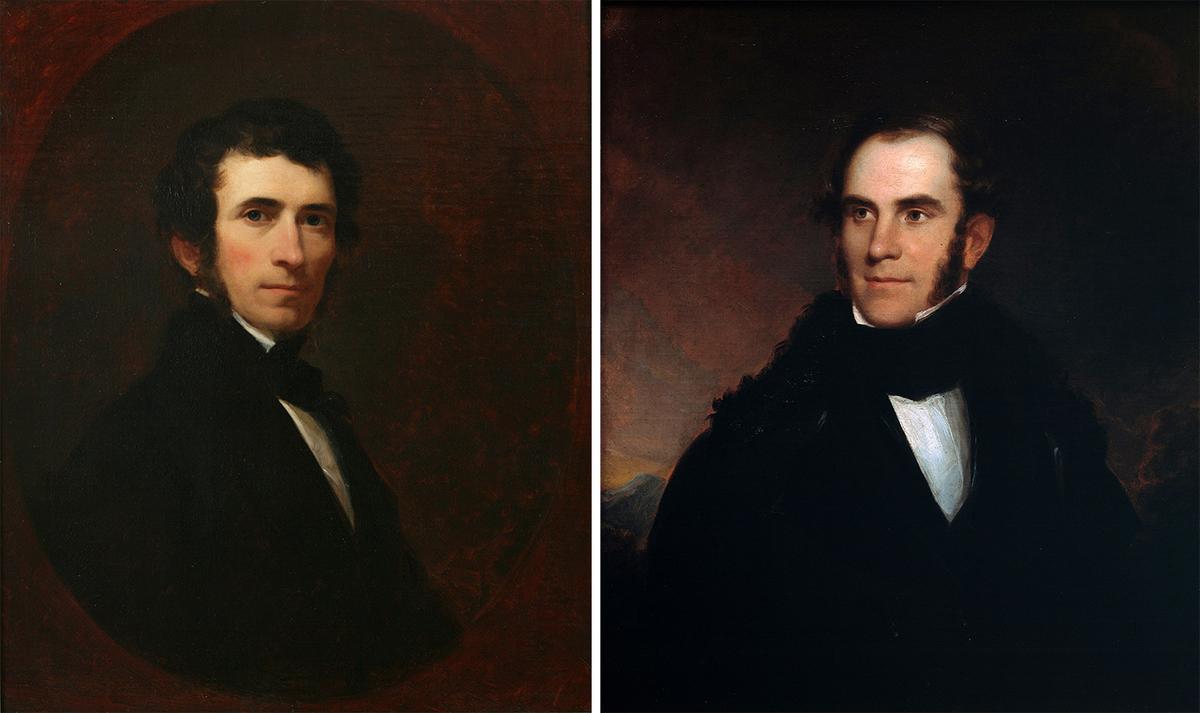
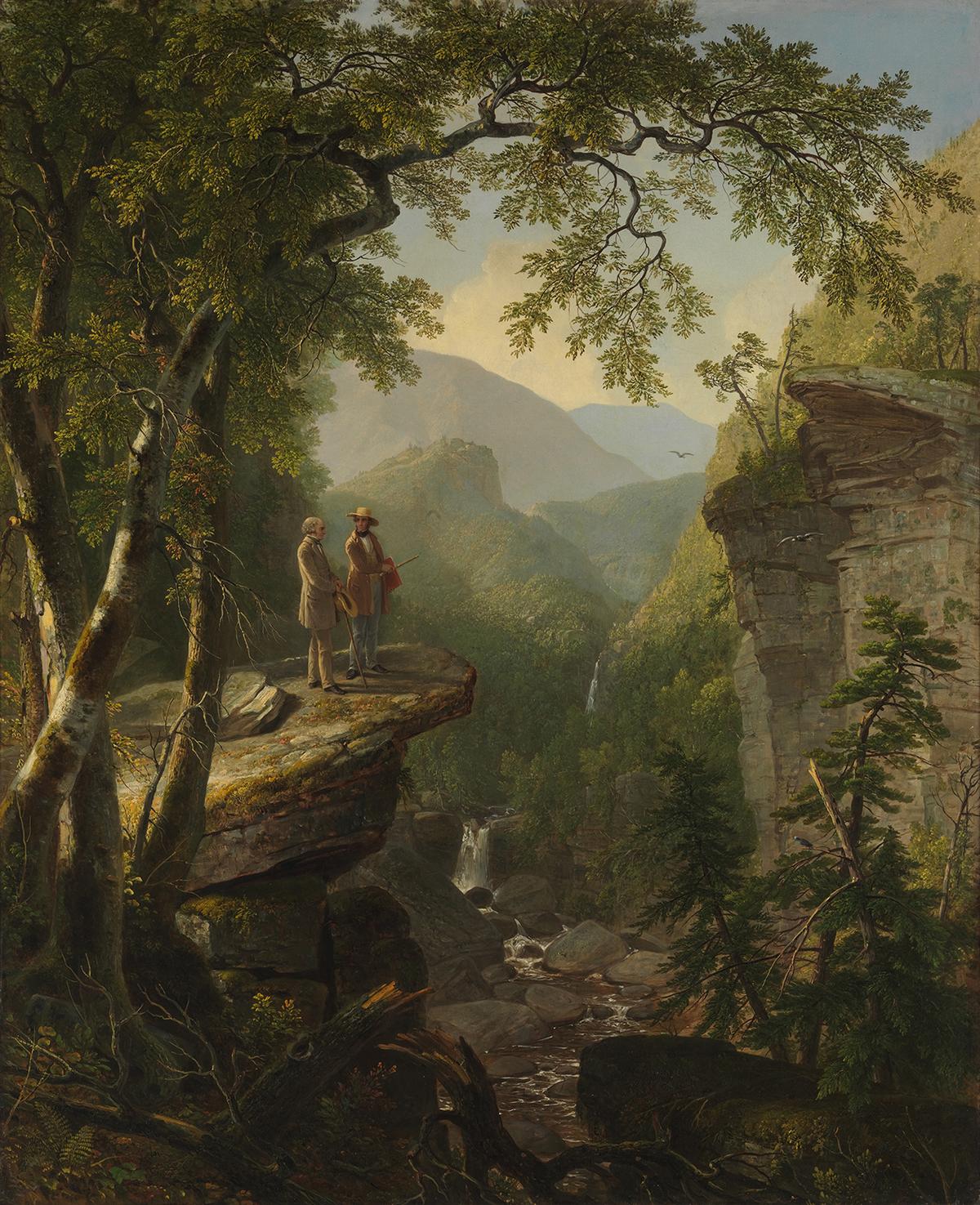
Durand (1796–1886) had been a successful engraver and portraitist before being encouraged by Cole to pursue landscape painting. Durand’s masterpiece, and one of the quintessential Hudson River School artworks, is the 1849 oil painting “Kindred Spirits.” It encapsulates the principles of the art movement. It is also a tribute to the deceased Cole and their mutual friend William Cullen Bryant (1794–1878), the acclaimed nature poet and newspaper editor.
The three men had collaborated on published artistic and literary projects, and they also went on wilderness trips together along the East Coast, including to the Catskills. After Cole’s death, the friendship between Durand and Bryant continued. In 1850, Durand painted a canvas inspired by Bryant’s most famous poem, which had launched his literary career, titled “Thanatopsis.”
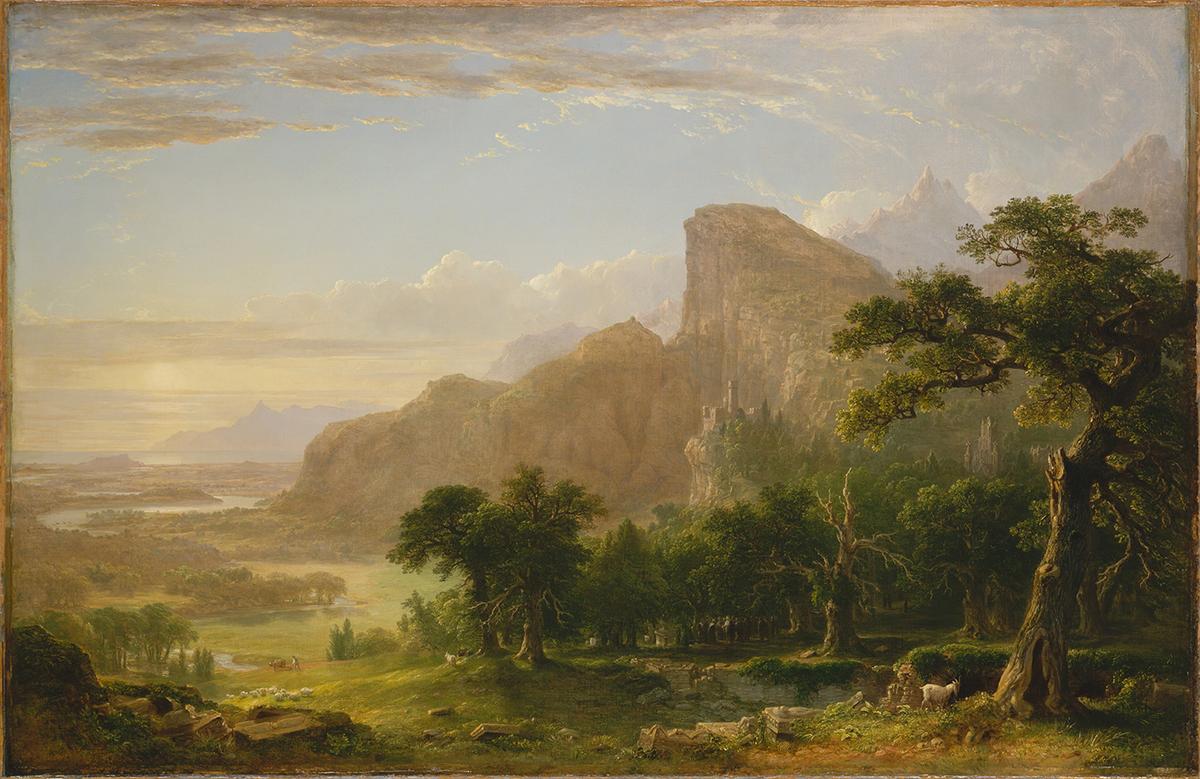
Durand’s Eulogistic Painting
The impetus for Durand to paint “Kindred Spirits” was a commission by the prominent New York City art collector and merchant Jonathan Sturges. The directive was to depict Cole and Bryant like “kindred spirits,” as described in “Sonnet to Solitude” by the English poet John Keats.O Solitude! if I must with thee dwell, Let it not be among the jumbled heap Of murky buildings: climb with me the steep,— Nature’s observatory—whence the dell, In flowery slopes, its river’s crystal swell, May seem a span; let me thy vigils keep ‘Mongst boughs pavilioned, where the deer’s swift leap Startles the wild bee from the foxglove bell. But though I'll gladly trace these scenes with thee, Yet the sweet converse of an innocent mind, Whose words are images of thoughts refined, Is my soul’s pleasure; and it sure must be Almost the highest bliss of human-kind, When to thy haunts two kindred spirits flee.
Incorporating Cole’s Style

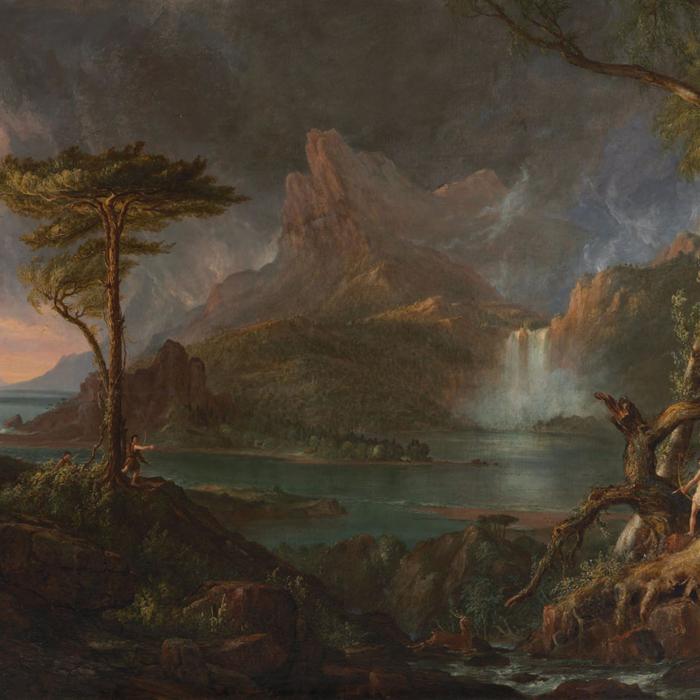
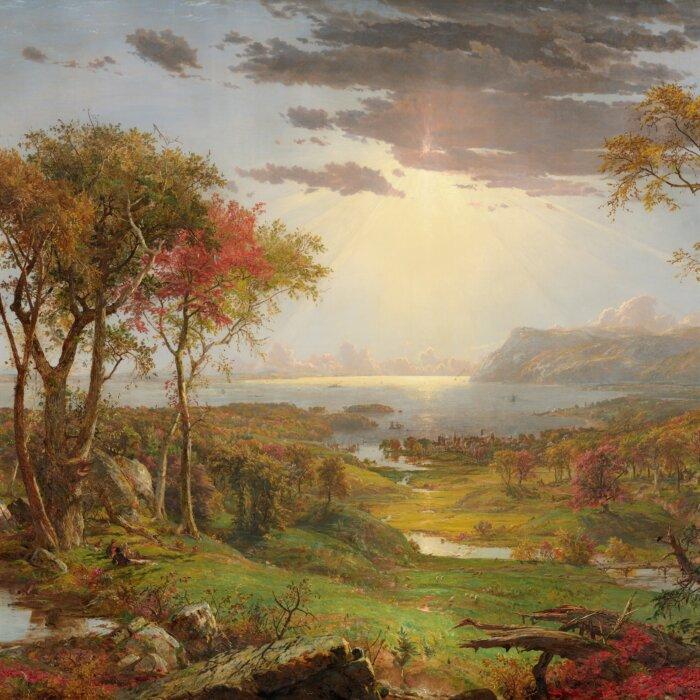
The setting of “Kindred Spirits” combines the Hudson River School’s birthplace, Kaaterskill Clove—one of the gorges of the Catskill Mountains—and Kaaterskill Falls, New York state’s highest cascading waterfall that was popular with the public and artists alike. Durand’s inclusion of both features is not geographically correct. Taking liberties with naturalism was not Durand’s typical style, as he advocated for highly detailed botanical realism. In the painting, he incorporates Cole’s grand idealization of landscape.
In addition, Durand references Cole’s painting “Expulsion from the Garden of Eden” by his positioning of the figures, his inclusion of a stream through a rock bed, and his placement of cliffs.

Before “Kindred Spirits,” Durand’s landscapes were horizontal and panoramic. Yet in this painting, he explores a circular composition, fashioning tree trunks, branches (also known as boughs, the term used in Keats’s poem), and other environmental elements to create this configuration on a vertical canvas. The blasted tree, visible in the foreground, was a symbol used by Cole. In this artwork, it signifies perhaps how Cole’s life was cut short. Durand’s presentation of Bryant with his hat in hand may be interpreted as the poet paying his respects to his deceased friend. The flying eagle visible in the background could denote that Cole’s spirit has left his body.
Sturges gave “Kindred Spirits” to Bryant to mark his appreciation for the poet having given Cole’s eulogy at the memorial service held at the New York Drawing Association (later named the National Academy of Design). The institution had been co-founded by a group of artists that included Cole and Durand. Bryant’s daughter, Julia, donated the painting to the New York Public Library in early 1904, and the artwork stayed in the library’s collection for a little more than 100 years.
In 2005, the library announced that it was putting the painting up for sale to fund a permanent endowment. This decision was met with heated controversy, as critics hailed the painting as a treasure that should remain on view to the public and stay in New York, given its embodiment of the state’s cultural history. The plan went ahead, and the painting was sold in May of that year at Sotheby’s in a sealed-bid sale. It was purchased by Walmart heiress Alice Walton for about $35 million, breaking the then-record for the auction price of an American painting.
“Kindred Spirits” left New York state for Bentonville, Arkansas, a city nestled in the stunning region of the Ozark Mountains and the hometown of Walmart. Its final destination was not Walton’s private residence, but a museum. This was Walton’s gift to the community and the public at large: a world-class museum designed by esteemed architect Moshe Safdie, with free admission and a comprehensive collection of Colonial through contemporary art.
Crystal Bridges Museum of American Art opened in 2011 with “Kindred Spirits” as its centerpiece. The museum is a special place to view and contemplate the divine in nature. There is no better crystallization of this connection in art than Durand’s definitive Hudson River School masterpiece.