A historic civilization centered in present-day Tuscany flourished between the 9th and 2nd centuries B.C. Its advanced culture was highly skilled in the arts, hydraulic engineering, urban planning, and winemaking. Gladiatorial games evolved from its funerary ritual combat events, and even “Roman” numerals descended from its numerical system. The people of this major Mediterranean power were the Etruscans.
Living in ancient Etruria, a region between the Arno and Tiber Rivers, they were eventually conquered and absorbed into the Roman Empire, becoming citizens in 89 B.C. While it was overshadowed historically by the ancient Greeks and Romans, Etruscan society had a resounding impact on Western civilization.
The most tangible surviving Etruscan materials are their exquisitely crafted art. Etruria was rich in metals, and the Etruscans became master bronzesmiths. They remain renowned for their lavish gold jewelry featuring complex techniques, including filigree and granulation. In addition to exporting and importing wares with trading partners such as Egypt, the Near East, and mainland Greece, the Etruscans incorporated foreign artistic elements to create their own unique aesthetic.
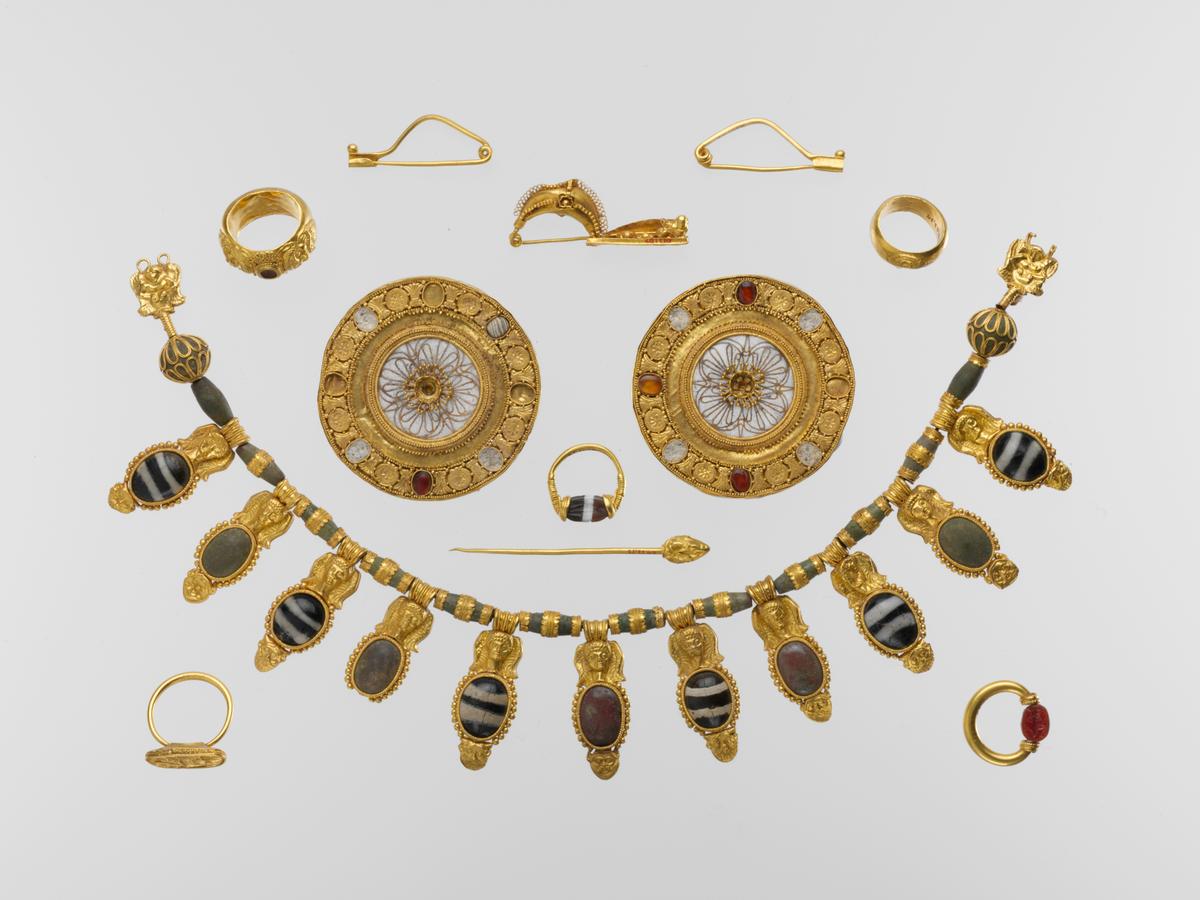
The Etruscans were devoutly religious with a strong belief in the afterlife. They built elaborate tombs for their elite, decorated them with beautiful wall paintings, and buried the dead with luxurious gold and metal objects. In life, they loved music and banqueting, and their funerary art reflected their prosperity.
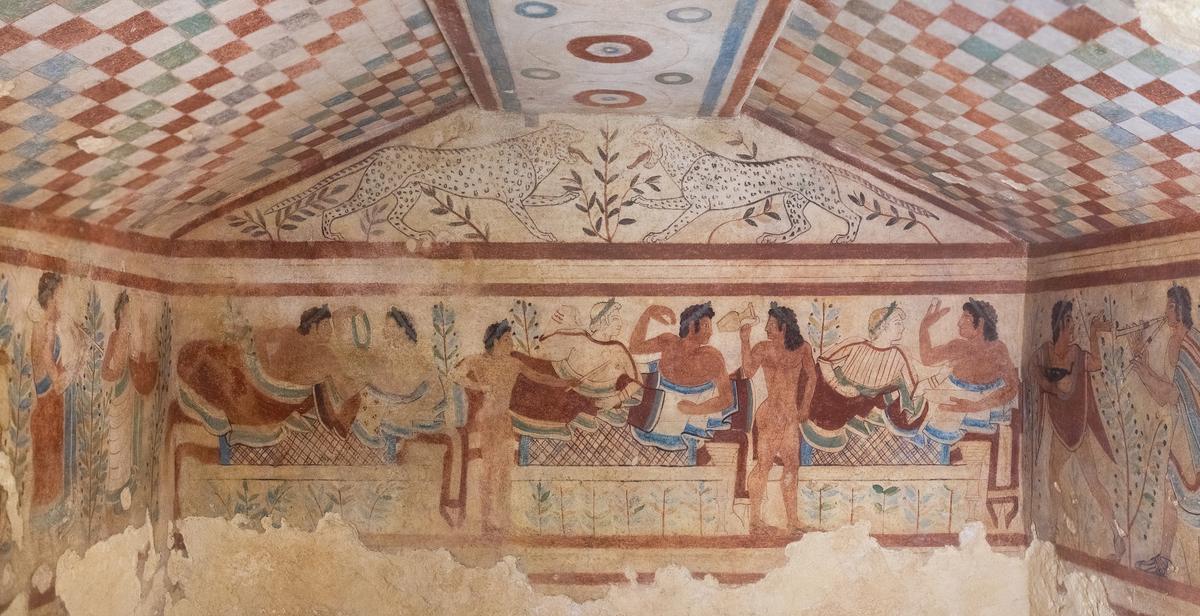
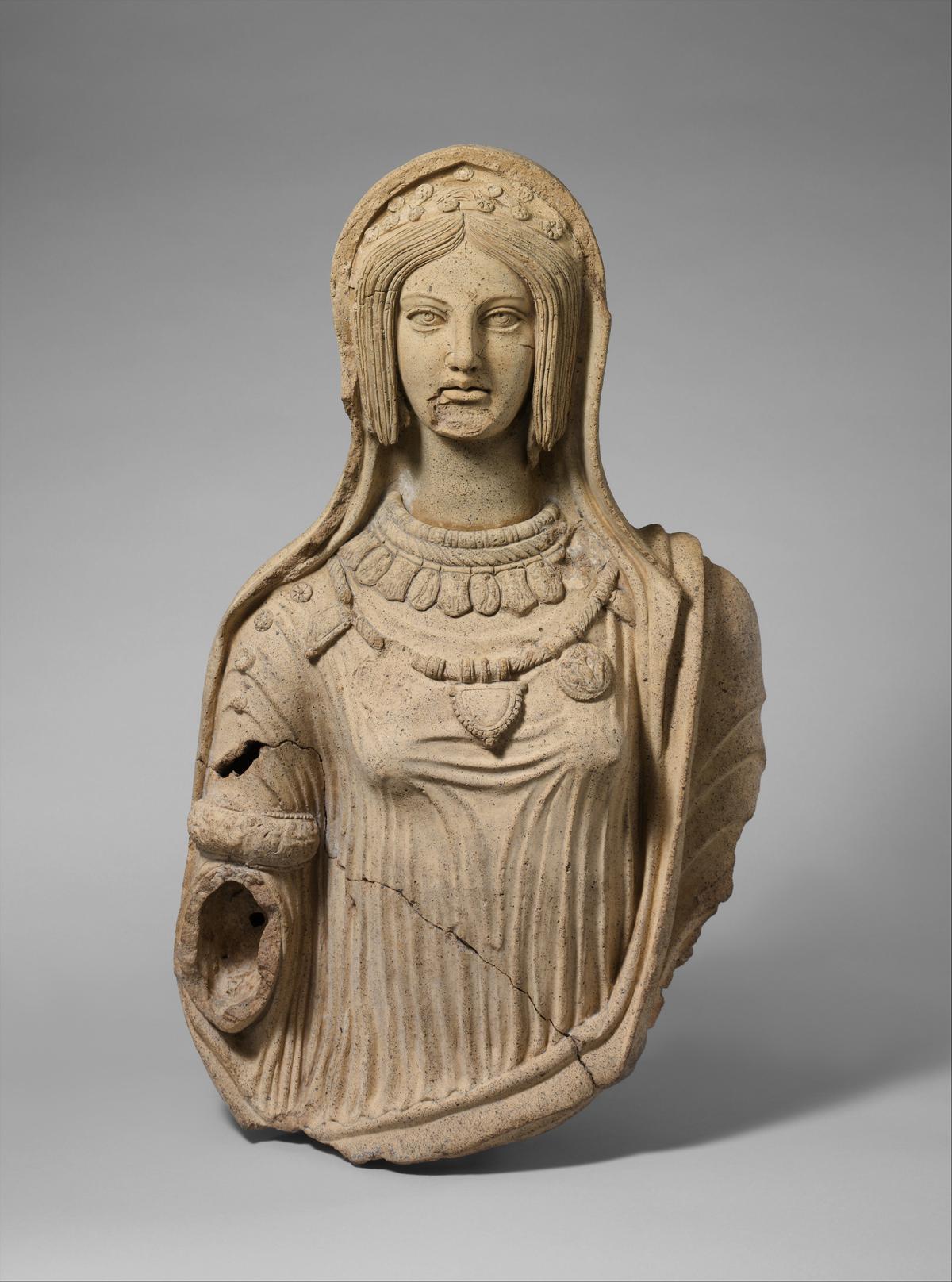
The position of women in Etruscan society was unique in the ancient Western world. They were the most independent and among the most literate of their era. Women were respected, could inherit family property, and participate in activities of public life, such as banquets and religious rituals. After death, Etruscan women also had elaborate burials.
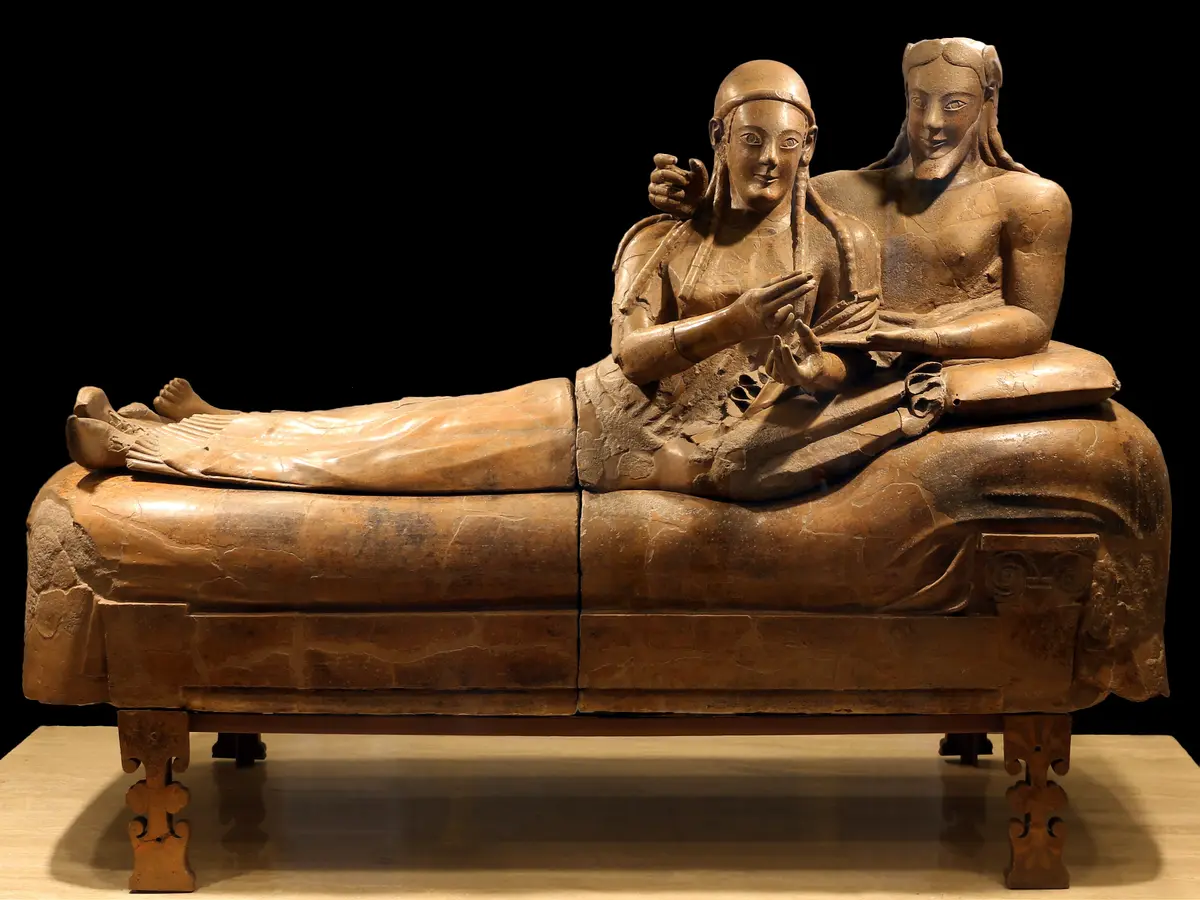
‘Sarcophagus of the Spouses’
The Etruscans valued affection between spouses. Tender depictions of embracing husbands and wives are found in Etruscan art, including funerary sculptures. The most famous example of this, and, indeed, one of Etruscan art’s greatest masterpieces, is the “Sarcophagus of the Spouses” at Museo Nazionale Etrusco (ETRU), Rome. This polychrome terracotta sculpture from 530 B.C. to 520 B.C. was discovered in 1881. Found in 400 fragments, it had been placed in a necropolis in Cerveteri, Italy. Known as Banditaccia, it contains thousands of Etruscan tombs arranged in a city-like plan.
Originally painted with vivid colors, this cinerary urn is a vessel for cremated ashes. Modeled as a freestanding, three-dimensional sculpture, the figures are a couple reclining partially on a “kline” (banqueting couch). Supported by their bent arms, they are raised to a feasting position. Although they no longer hold any objects, art historians believe that the female figure may have been depicted anointing herself with an unguent from a small vase, a ritual that had funerary significance. The man may have held a cup for wine.
The woman is fashionably attired, wearing a headdress called a “tutulus” and eastern-influenced shoes with pointed toes bent upwards known as “calcei repandi.”
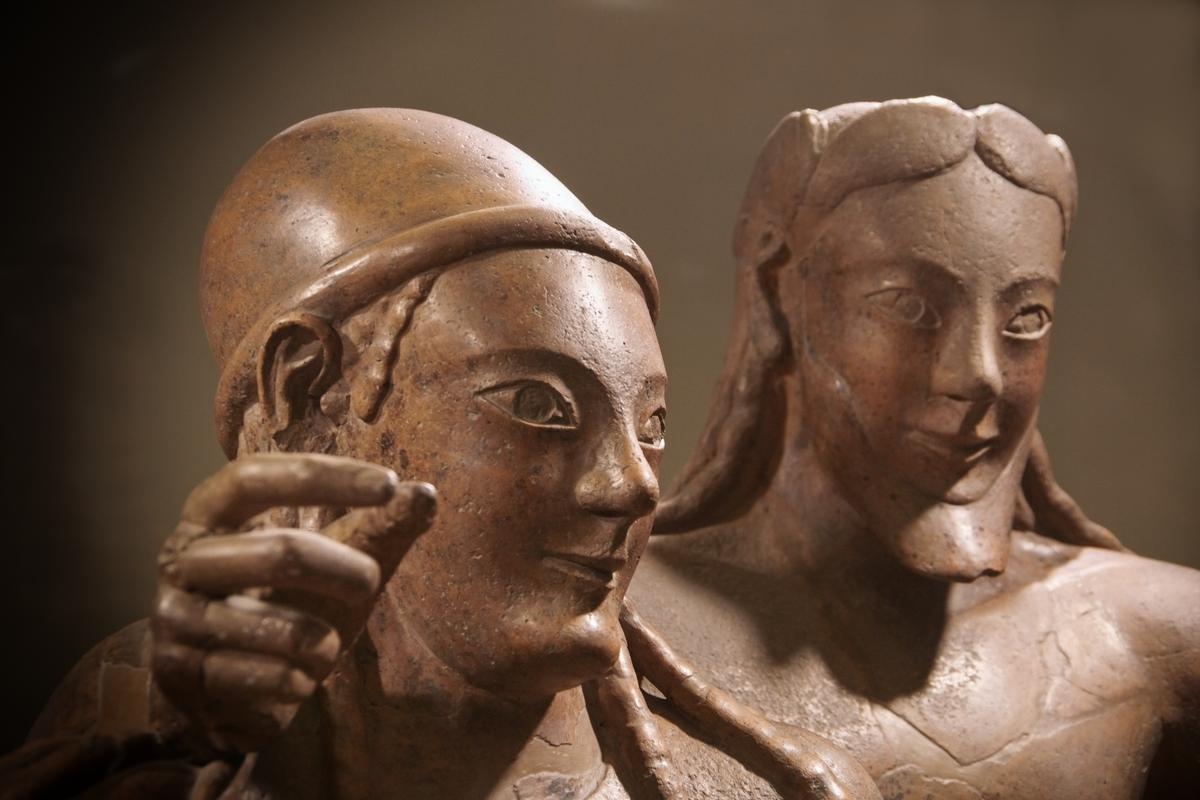
Banqueting was a practice the Etruscans acquired from the Greeks. However, this sculpture’s placement of a woman next to a man in an equal position would not have been conventional in Greek art or society. Indeed, in “Sarcophagus of the Spouses,” the woman, whose form is framed by the man’s arms and torso, is the figure who commands the scene.
The most captivating details are the figures’ smiles. Known as an “archaic smile,” this shallow, enigmatic formation of the mouth derives from ancient Greek art. While it does not reproduce a realistic human smile, it accentuates facial expressions.
Last spring, ETRU began a much-needed restoration of the “Sarcophagus of the Spouses” in full view of the public. It will be a long process; the first part focuses on the couple’s legs.
The important history of the Etruscans is currently reaching a greater audience. A major exhibition—“The Etruscans: From the Heart of Ancient Italy”—is on view at San Francisco’s Legion of Honor Museum through Sept. 20, 2026. This show, which presents the latest Etruscan scholarship, will travel to the San Antonio Museum of Art from Oct. 31, 2026 to March 14, 2027.
More is being learnt about the Etruscans, even though their written histories and literature do not exist. Much of their world remains intriguingly mysterious. The understandable universal theme of love, however, could not be better exemplified than by the emotionally moving “Sarcophagus of the Spouses.” Its depiction of an embrace that extends into the afterlife has withstood the test of time.