‘Winslow Homer: Painter, Etcher’ on Exhibit at the Portland Museum of Art

On view through Oct. 18, 2026, it the first major exhibition to spotlight the the artist’s etching practice.
‘Winslow Homer: Painter, Etcher’ on Exhibit at the Portland Museum of Art
A detail of "Undertow," 1886, by Winslow Homer. Oil on canvas. Clark Art Institute, Williamstown, Massachusetts. The Clark
|Updated:
0:00

“Winslow Homer: Painter, Etcher” at Maine’s Portland Museum of Art (PMA) is the first major exhibition to spotlight the artist’s etching practice. On view through Oct. 18, 2026, it examines this pivotal 19th-century American artist’s important exploration of the medium.

The exhibit positions this understudied and rarely seen body of work in dialogue with Homer’s oil paintings and watercolors, which almost always served as the basis for his etchings. Homer made the etchings on display while living at his Prouts Neck studio in Scarborough, Maine, just south of Portland. This was Homer’s home from the summer of 1883 until his death, although he also traveled extensively around the world. The PMA is steward of the Winslow Homer Studio, and special tours will be available during the exhibition’s run.
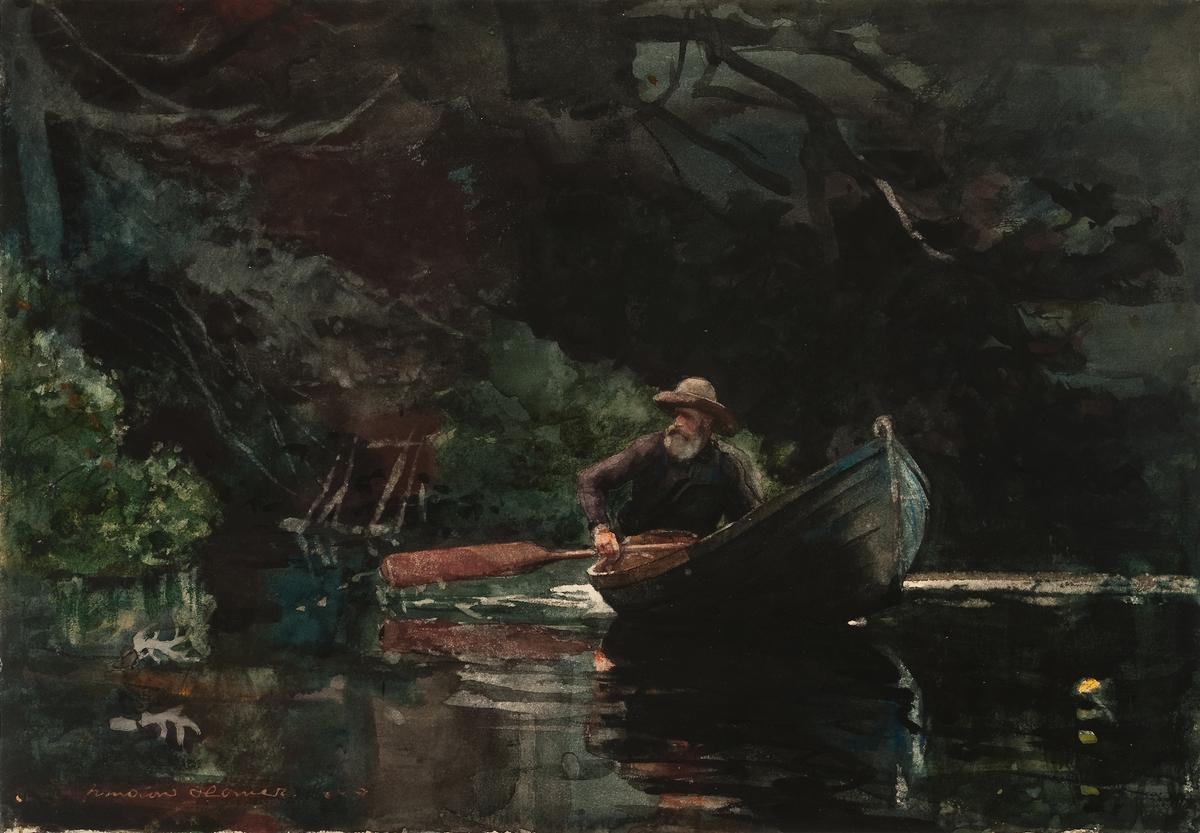
"The Guide," 1889, by Winslow Homer. Watercolor on ivory wove paper; 13 3/4 inches by 19 1/2 inches. Portland<br/>Museum of Art, Maine. (Courtesy of Meyersphoto.com)
"The Guide," 1889, by Winslow Homer. Watercolor on ivory wove paper; 13 3/4 inches by 19 1/2 inches. Portland
Museum of Art, Maine.
Courtesy of Meyersphoto.com

Winslow Homer (1836–1910) was born in Boston. He apprenticed in a lithography shop before moving to New York and working as a designer of wood engraving illustrations, most famously for the periodical “Harper’s Weekly.” While engaged as an artist-correspondent during the Civil War, he took up oil painting. His focus remained on this medium after the war.
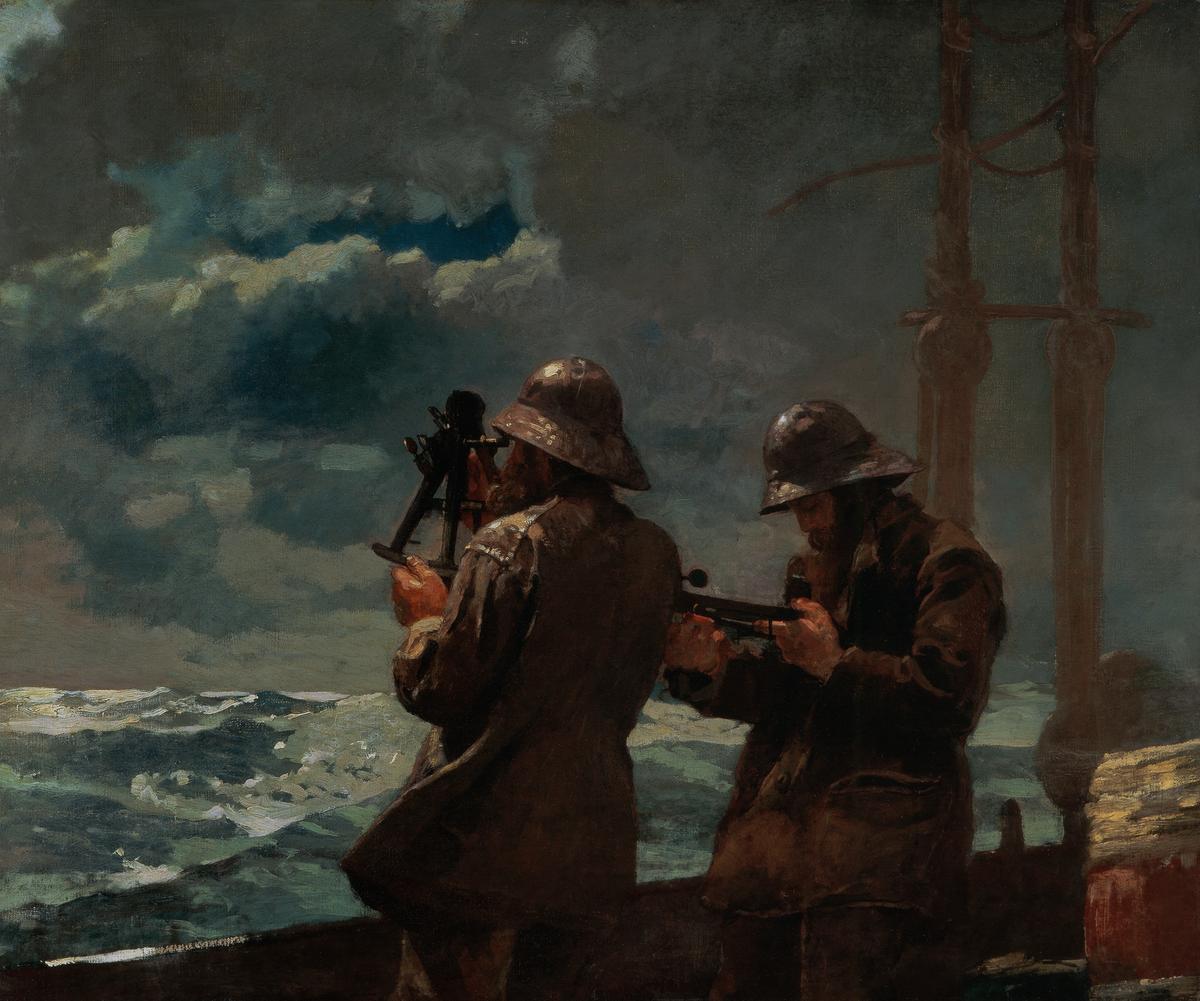
"Eight Bells," 1886, by Winslow Homer. Oil on canvas; 25 3/16 inches by 30 3/16 inches. Addison Gallery of American Art, Phillips Academy, Andover, Massachusetts. (Courtesy of PMA)
"Eight Bells," 1886, by Winslow Homer. Oil on canvas; 25 3/16 inches by 30 3/16 inches. Addison Gallery of American Art, Phillips Academy, Andover, Massachusetts. Courtesy of PMA
However, between 1884 and 1889, Homer produced a small but important body of etchings, many of which were based on his already critically acclaimed compositions. Homer considered these etchings among his finest artistic endeavors. They were undertaken in collaboration with the Brooklyn-based printer George Wistar Hodge Ritchie (1855–1929). Ritchie would send prepared plates to Homer’s Maine home, where the artist would incise the preliminary designs and then send them back to New York for final printing. Homer’s etchings, watercolors, and paintings, reflect his mastery of line, light, form, and composition.

Allure of the Sea

A constant in Homer’s oeuvre is a fascination with the sea and both the dangers and delights it affords. His dynamic works featuring this subject cemented his reputation as one of the greatest marine painters. One of his all-time masterpieces is “The Life Line.” Displayed in the exhibit, it is on loan from the Philadelphia Museum of Art. This 1884 painting was a great success upon its debut. Contemporary critics cited its technical virtuosity and culmination of the artist’s close observation.
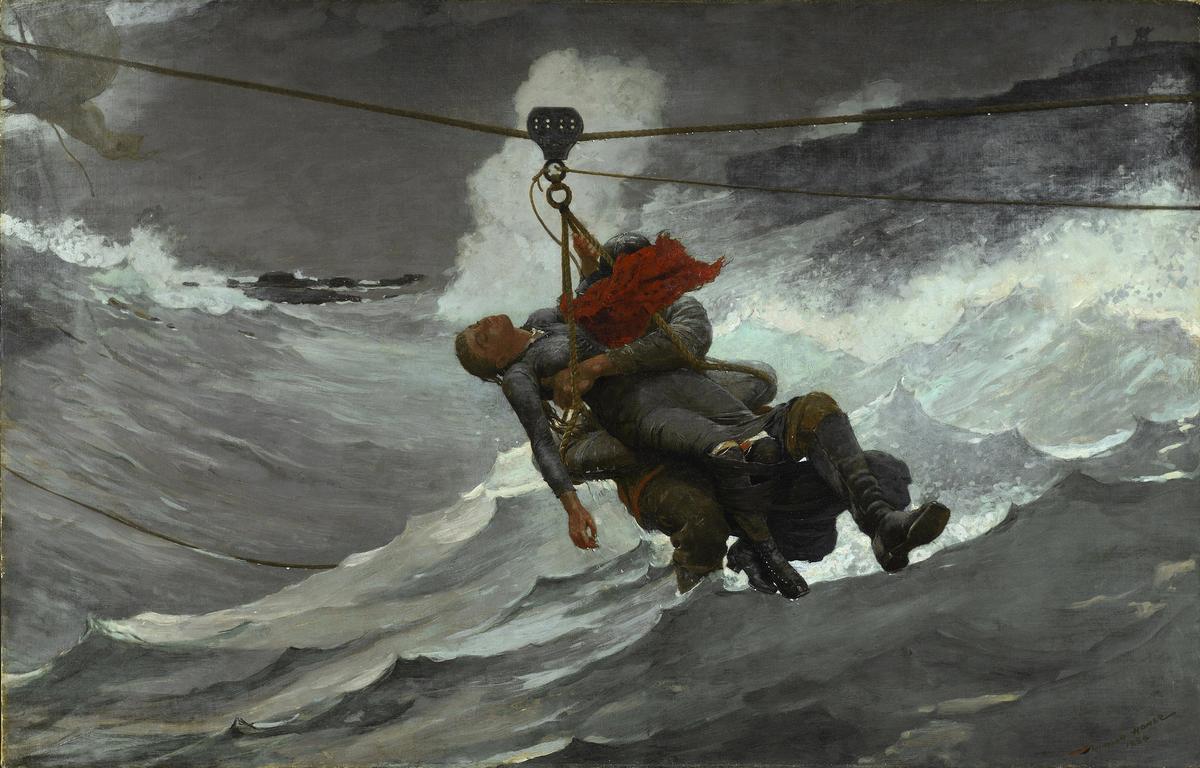
"The Life Line," 1884, by Winslow Homer. Oil on canvas; 28 5/8 inches by 44 3/4 inches. Philadelphia Museum of Art. (Courtesy of PMA)
"The Life Line," 1884, by Winslow Homer. Oil on canvas; 28 5/8 inches by 44 3/4 inches. Philadelphia Museum of Art. Courtesy of PMA

The work depicts a rescue at sea that utilizes what was then a recent innovation, a breeches buoy. The figural group at center consists of a semiconscious, near-drowned female passenger gripped tightly by a male savior whose face is obscured by her windblown shawl. This perilous rescue is set amidst ferocious waves.

Shortly after completing the oil, Homer worked on an etching version of the composition (the orientation is naturally reversed in the printmaking process). An example is on loan from the Terra Foundation for American Art. Five years later, Homer produced a second, larger etched variation of the composition entitled “Saved.” A copy owned by the PMA is included here, too.
(Left) "The Life Line [proof]," 1884–1887, by Winslow Homer. Etching; 18 5/8 inches by 24 3/4 inches. Terra Foundation for American Art, Chicago. (Copyright Terra Foundation for American Art, Chicago) (Right) "Saved," 1889, by Winslow Homer. Etching; 25 1/2 inches by 35 3/8 inches. Portland Museum of Art, Maine. (Luc Demers)
(Left) "The Life Line [proof]," 1884–1887, by Winslow Homer. Etching; 18 5/8 inches by 24 3/4 inches. Terra Foundation for American Art, Chicago. (Copyright Terra Foundation for American Art, Chicago) (Right) "Saved," 1889, by Winslow Homer. Etching; 25 1/2 inches by 35 3/8 inches. Portland Museum of Art, Maine. Luc Demers

Watercolor Sketches

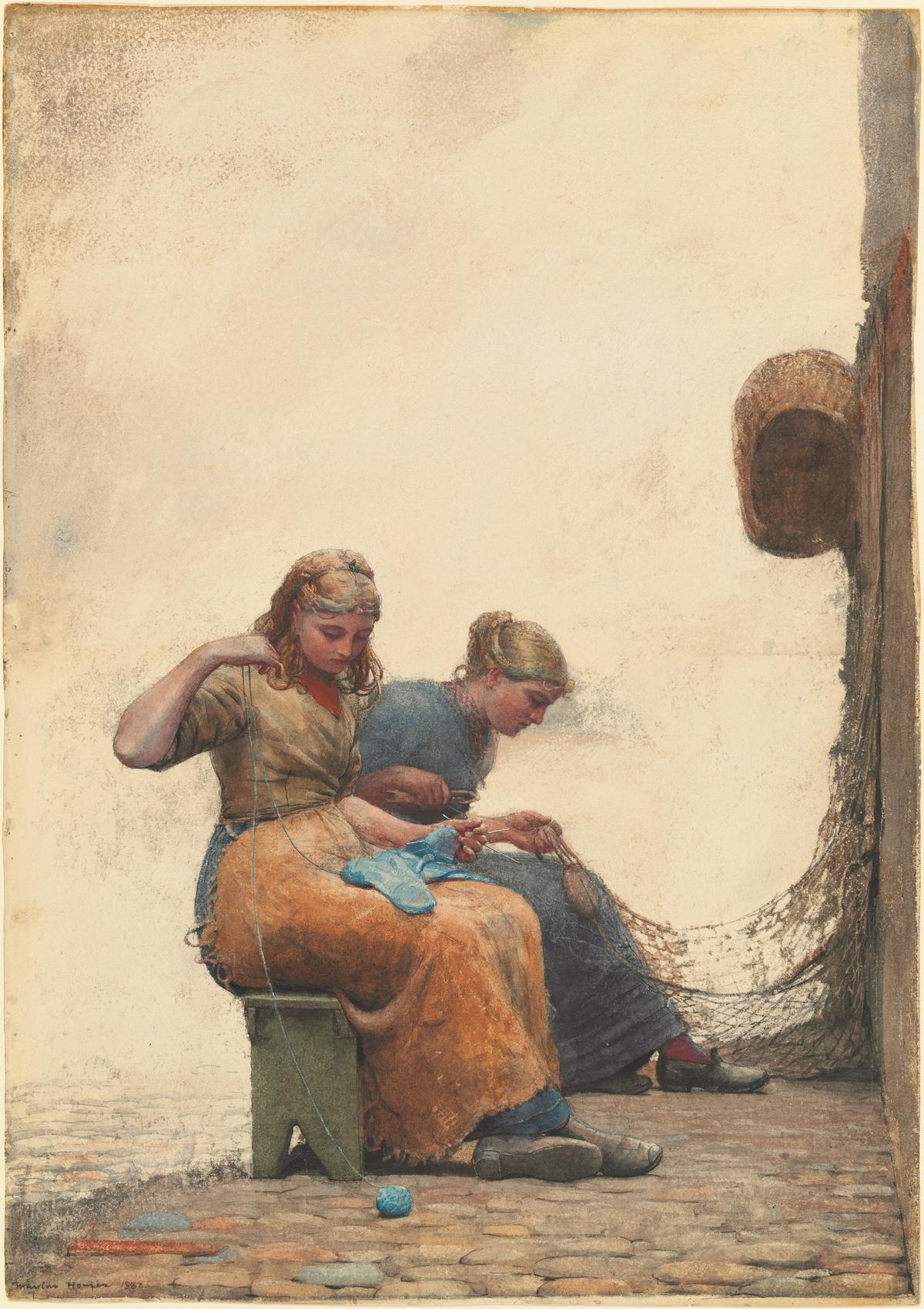
"Mending the Nets," 1882, by Winslow Homer. Transparent and opaque watercolor over graphite on wove paper; 27 3/8 inches by 19 1/4 inches. National Gallery of Art, Washington. (Courtesy of PMA)
"Mending the Nets," 1882, by Winslow Homer. Transparent and opaque watercolor over graphite on wove paper; 27 3/8 inches by 19 1/4 inches. National Gallery of Art, Washington. Courtesy of PMA

Watercolor was Homer’s favored medium while traveling, since it was easy to transport the required materials and it dried quickly. He is renowned for his brilliant palette and fluid brushstrokes when working in watercolor. From 1881 to 1882, he lived in Cullercoats, a small fishing village on the North Sea coast of England. This was a fundamental period for the evolution of his art; it solidified his interest in the sea. He portrayed the lives of workers in the community in watercolor, focusing on the strength of its women in the face of the sea and economic hardships.
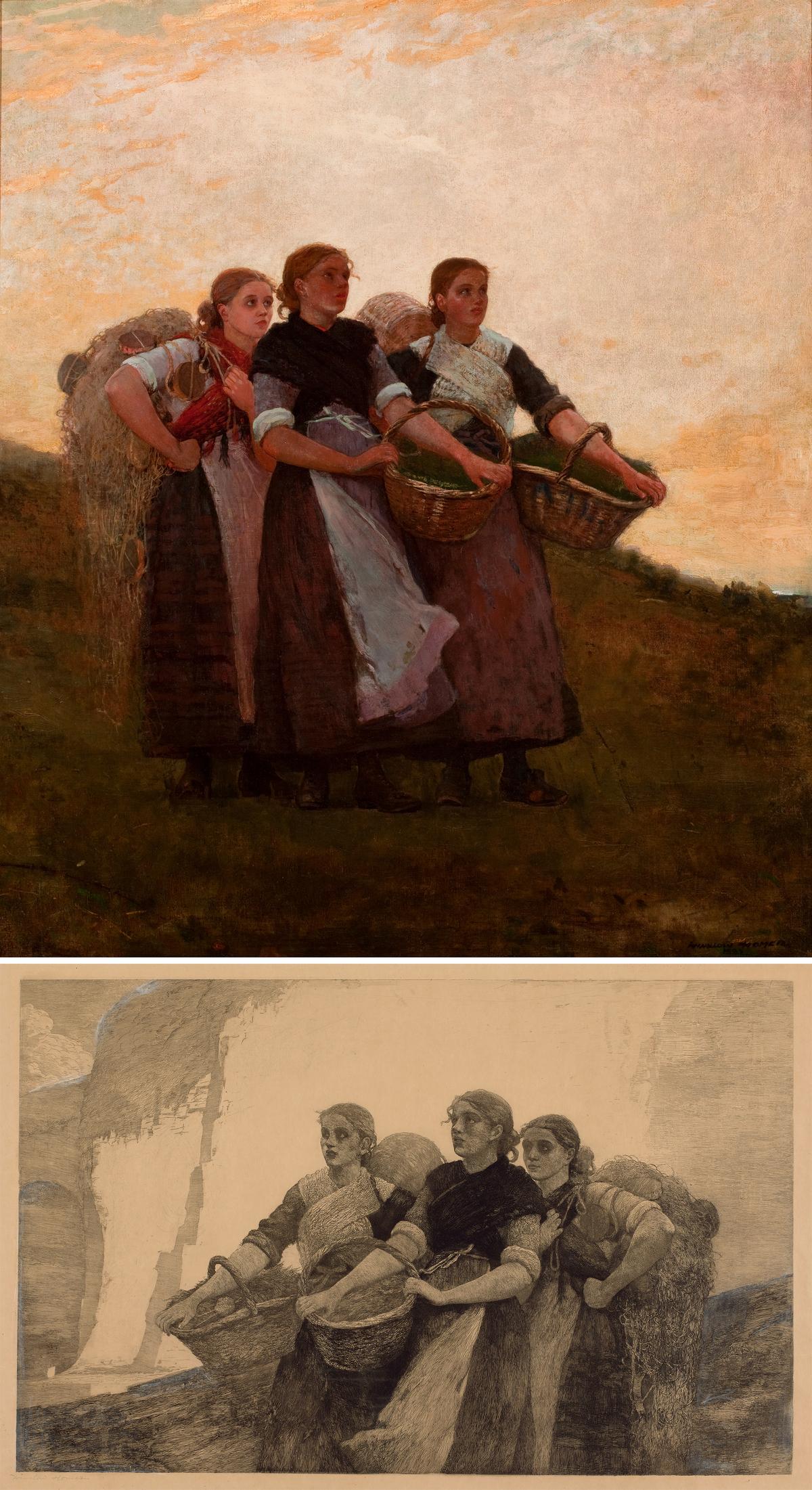
(Top) "Hark! The Lark," 1882, by Winslow Homer. Oil on canvas; 36 3/8 inches by 31 3/8 inches. Milwaukee Art Museum. (Courtesy John R. Glembin) (Bottom) "A Voice From the Cliffs," 1888, by Winslow Homer. Etching and aquatint heightened with white on paper; 19 1/8 inches by 30 inches. Bowdoin College Museum of Art, Brunswick, Maine. (Courtesy of PMA)
(Top) "Hark! The Lark," 1882, by Winslow Homer. Oil on canvas; 36 3/8 inches by 31 3/8 inches. Milwaukee Art Museum. (Courtesy John R. Glembin) (Bottom) "A Voice From the Cliffs," 1888, by Winslow Homer. Etching and aquatint heightened with white on paper; 19 1/8 inches by 30 inches. Bowdoin College Museum of Art, Brunswick, Maine. Courtesy of PMA

The 1881 watercolor “Perils of the Sea,” owned by the Clark Art Institute, situates two anxious women bundled up against a storm in the foreground. In the background, a group is gathered at the Volunteer Life Brigade’s Watch House. Assessing the rough waves, they wait for the storm to calm before sending out boats to search for missing seamen. The turbulent sea and dark sky emphasize the fear and vulnerability of the situation, a way of life for the villagers whose livelihood depended on the sea. Seven years after he painted this watercolor, Homer made an etching after it.
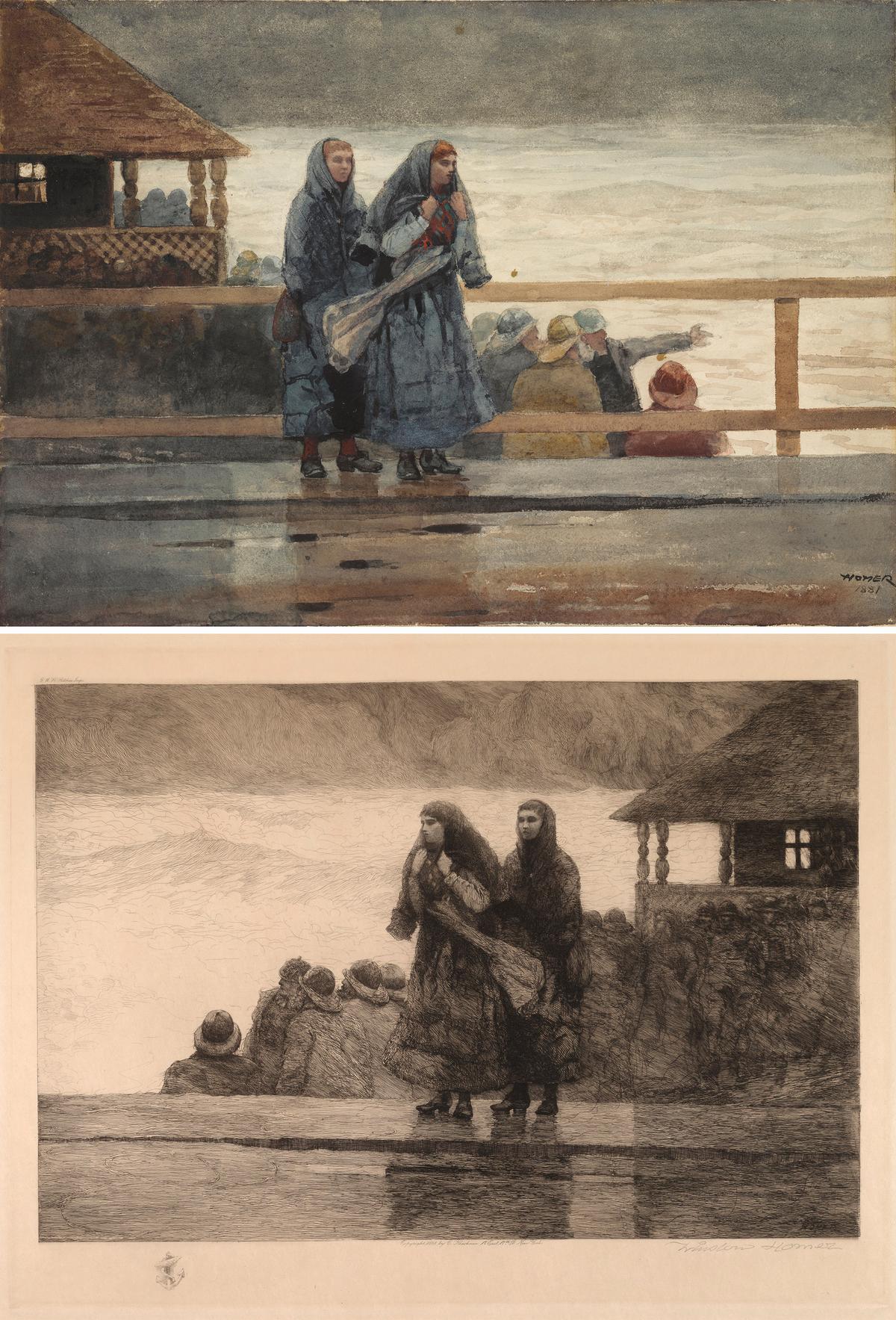
(Top) "Perils of the Sea," 1881, by Winslow Homer. Watercolor over graphite on cream wove paper, sheet; 14 5/8 inches by 20 15/16 inches. Clark Art Institute, Williamstown, Massachusetts. (Courtesy of PMA) (Bottom) "Perils of the Sea," 1888, by Winslow Homer. Etching; 13 11/16 inches by 20 1/4 inches. Portland Museum of Art, Maine. (Petegorsky/Gipe Photo)
(Top) "Perils of the Sea," 1881, by Winslow Homer. Watercolor over graphite on cream wove paper, sheet; 14 5/8 inches by 20 15/16 inches. Clark Art Institute, Williamstown, Massachusetts. (Courtesy of PMA) (Bottom) "Perils of the Sea," 1888, by Winslow Homer. Etching; 13 11/16 inches by 20 1/4 inches. Portland Museum of Art, Maine. Petegorsky/Gipe Photo

Another suspenseful pairing in the exhibit is the 1886 painting “Undertow” and an etching study lent by the Clark. Allegedly, this scene was inspired by a real rescue event Homer saw near Atlantic City, New Jersey in 1883. In Homer’s rendering, two women in waterlogged bathing dresses are in peril from an undertow as muscular rescuers try to pull them to shore.
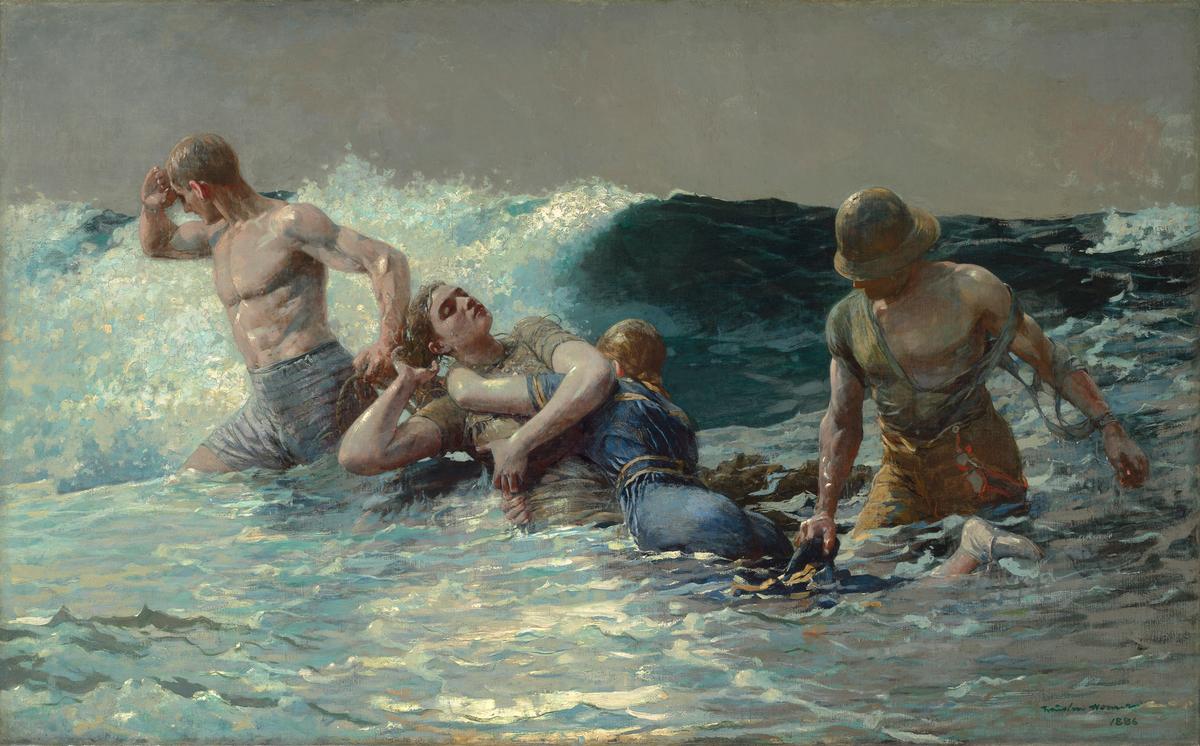
"Undertow," 1886, by Winslow Homer. Oil on canvas; 29 13/16 inches by 47 5/8 inches. Clark Art Institute, Williamstown, Massachusetts. (The Clark)
"Undertow," 1886, by Winslow Homer. Oil on canvas; 29 13/16 inches by 47 5/8 inches. Clark Art Institute, Williamstown, Massachusetts. The Clark
Ancient Greek marble statues served as models for the figures. Although their forms appear three-dimensional and strong, Homer evokes people’s frailty in the face of nature’s supremacy. This timeless and universal struggle between humankind and nature was one of the key themes Homer examined throughout his career.

The Outdoorsman

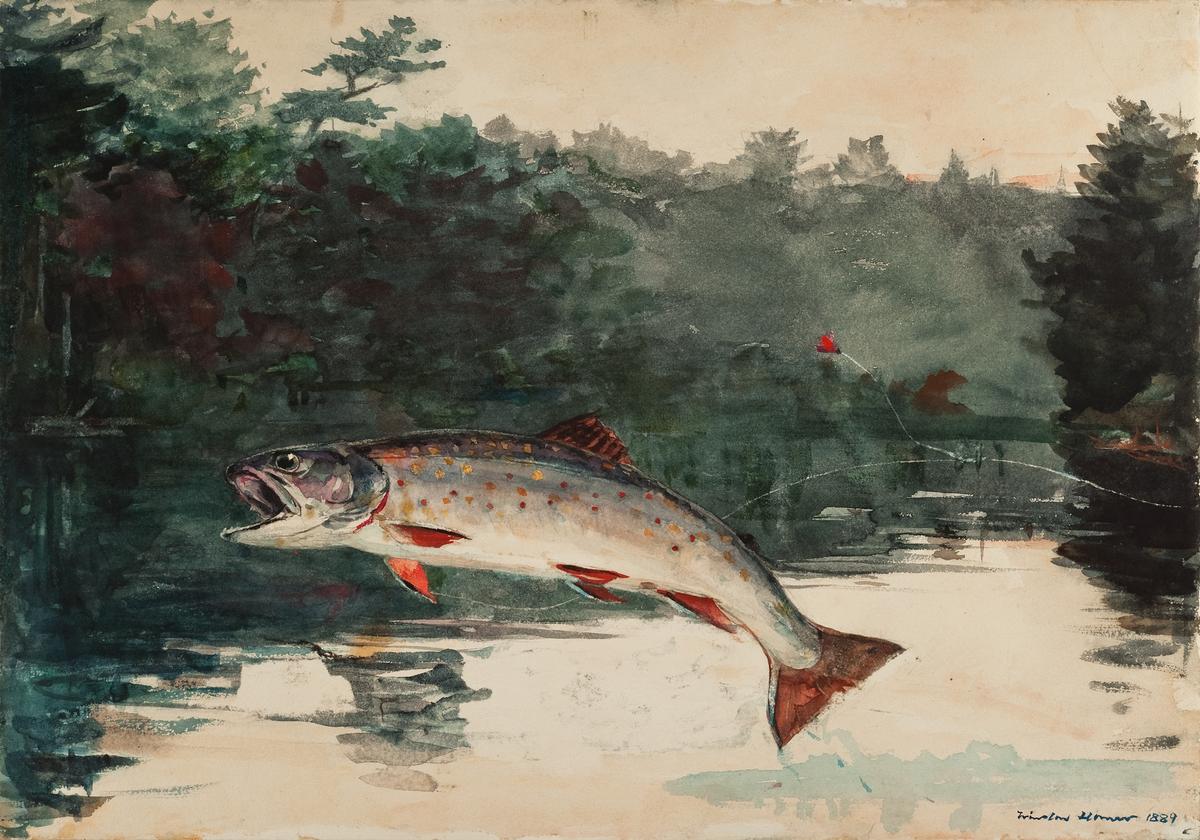
"Leaping Trout," 1889, by Winslow Homer. Watercolor on paper; 14 1/16 inches by 20 1/16 inches. Portland Museum of Art, Maine. (Courtesy Meyersphoto.com)
"Leaping Trout," 1889, by Winslow Homer. Watercolor on paper; 14 1/16 inches by 20 1/16 inches. Portland Museum of Art, Maine. Courtesy Meyersphoto.com

Nature played an integral role in both Homer’s professional and personal life. In addition to incorporating nature into his art, he was a keen outdoorsman who hunted and fished. Homer’s watercolors of this topic were often painted on trips to the Adirondack Mountains.

An example lent from the Art Institute of Chicago, the 1889 “Netting the Fish,” is a rare Homer grisaille, or monochrome, watercolor. It is also atypical for its portrayal of a gentleman sportsman, as opposed to Homer’s more common inclusion of rustic guides. This work was undertaken as a study in values for the etching “Fly Fishing, Saranac Lake,” an example of which from Bowdoin College Museum of Art is also exhibited.
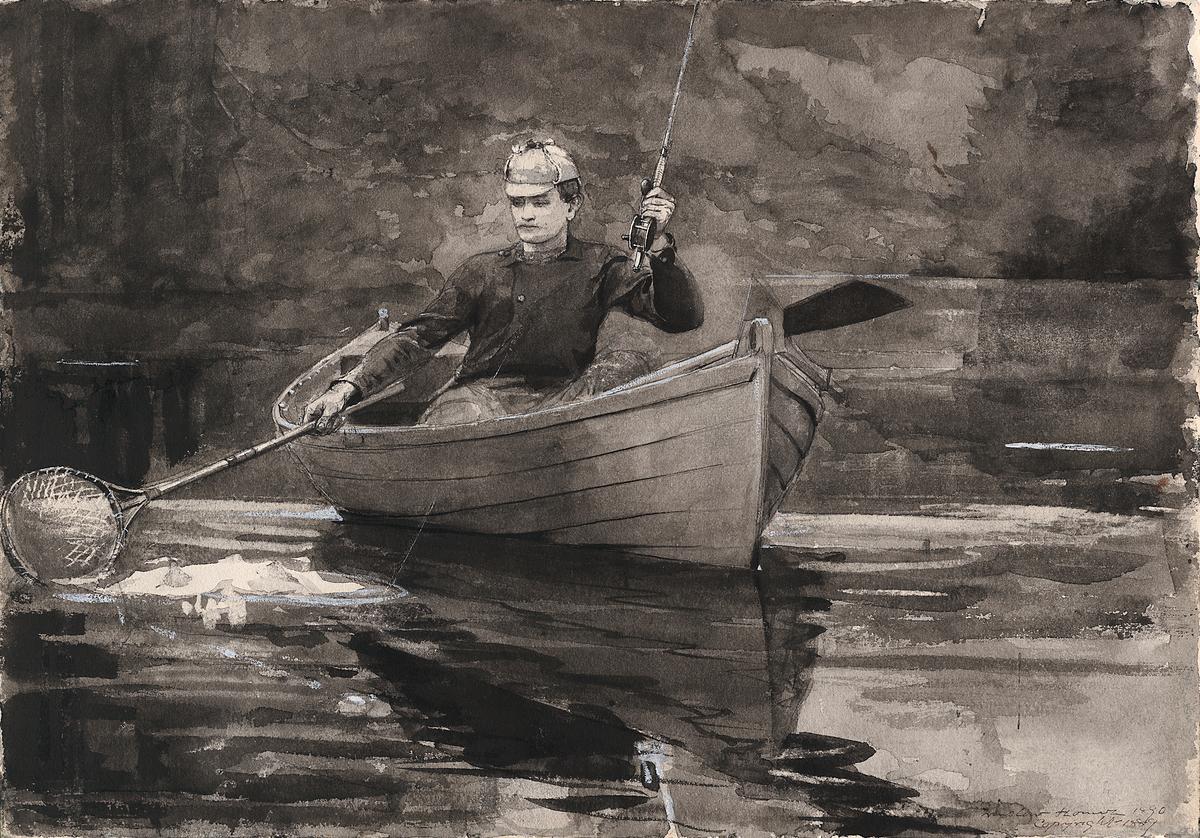
"Netting the Fish," 1889, by Winslow Homer. Transparent watercolor, heightened with opaque white watercolor, with rewetting, blotting, and scraping, over graphite, on moderately thick, cream wove paper, 13 15/16 x 20 inches. The Art Institute of Chicago. (Courtesy The Art Institute of Chicago)
"Netting the Fish," 1889, by Winslow Homer. Transparent watercolor, heightened with opaque white watercolor, with rewetting, blotting, and scraping, over graphite, on moderately thick, cream wove paper, 13 15/16 x 20 inches. The Art Institute of Chicago. Courtesy The Art Institute of Chicago

Homer’s probe of the depths of the relationship between humans and the natural world led to landmark achievements of pictorial poetry in oil, watercolor, and printmaking. It is fascinating to examine in-depth how he reworked images across media. The experience of viewing “Winslow Homer: Painter, Etcher” is heightened by PMA’s proximity to where Homer conceived the very etchings on view. PMA is committed to advancing Homer scholarship and the public’s engagement with his art. This exhibit carries the torch, furthering his legacy.
“Winslow Homer: Painter, Etcher” exhibition at the Portland Museum of Art  in Maine is on view through Oct. 18, 2026. To learn more, visit portlandmuseum.org.
What arts and culture topics would you like us to cover? Please email ideas or feedback to [email protected]
Google LogoMark Us Preferred on Google
Michelle Plastrik
Michelle Plastrik
Author
Michelle Plastrik is an art adviser living in New York City. She writes on a range of topics, including art history, the art market, museums, art fairs, and special exhibitions.