This copy is for your personal, non-commercial use only. Distribution and use of this material are governed by our Subscriber Agreement and by copyright law. For non-personal use or to order multiple copies, please contact The Epoch Times Reprints.
Amid the glitz and glamor of the French Riviera, Villa Kérylos is a rare bird—literally, “kérylos” means “sea swallow” or “halcyon,” signifying a good omen in Greek mythology.
This unique building in Beaulieu-sur-Mer, near Nice, was the product of a collaboration between patron Théodore Reinach (1860–1928) and his friend architect Emmanuel Pontremoli (1865–1956), who also worked on archeological sites. The polymath Reinach, born in France to a Jewish family, was an archaeologist, historian, jurist, mathematician, musicologist, and numismatist. He specialized in the study of ancient Greece. Built as a holiday home between 1902 and 1908, the white stucco villa is a poetic space that conjures a Hellenistic residence while incorporating Belle Époque comforts and techniques.
Villa Kérylos is a “Gesamtkunstwerk,” or total work of art. The architecture, gardens, and decorations evoke second-century-B.C. aristocratic homes on Delos. Interiors feature period-accurate frescoes, mosaics, textiles, tableware, and furniture, as well as a collection of antiquities and the prolific use of marbles, precious woods, and bronzes. Most of the furniture was designed by Reinach, modeled on historic examples, and made by cabinetmaker Louis-François Bettenfeld.
Upon Reinach’s death, the villa was bequeathed to the Institut de France with the understanding that his descendants could continue living there. During World War II, the Nazis confiscated the house, sent his son Julien, who was living in the villa, to Bergen-Belsen, and destroyed Reinach’s archives. The gardener moved the furnishings to a museum for safekeeping. Julien survived, but Reinach’s other son Léon, Reinach’s daughter-in-law, and their two children died at Auschwitz.
After the war, the villa was returned to the Reinach family, who continued to use it through the mid-1960s. In 1966, the French government classified it as a historic monument. It is now open to the public as a museum, offering a special immersive experience.
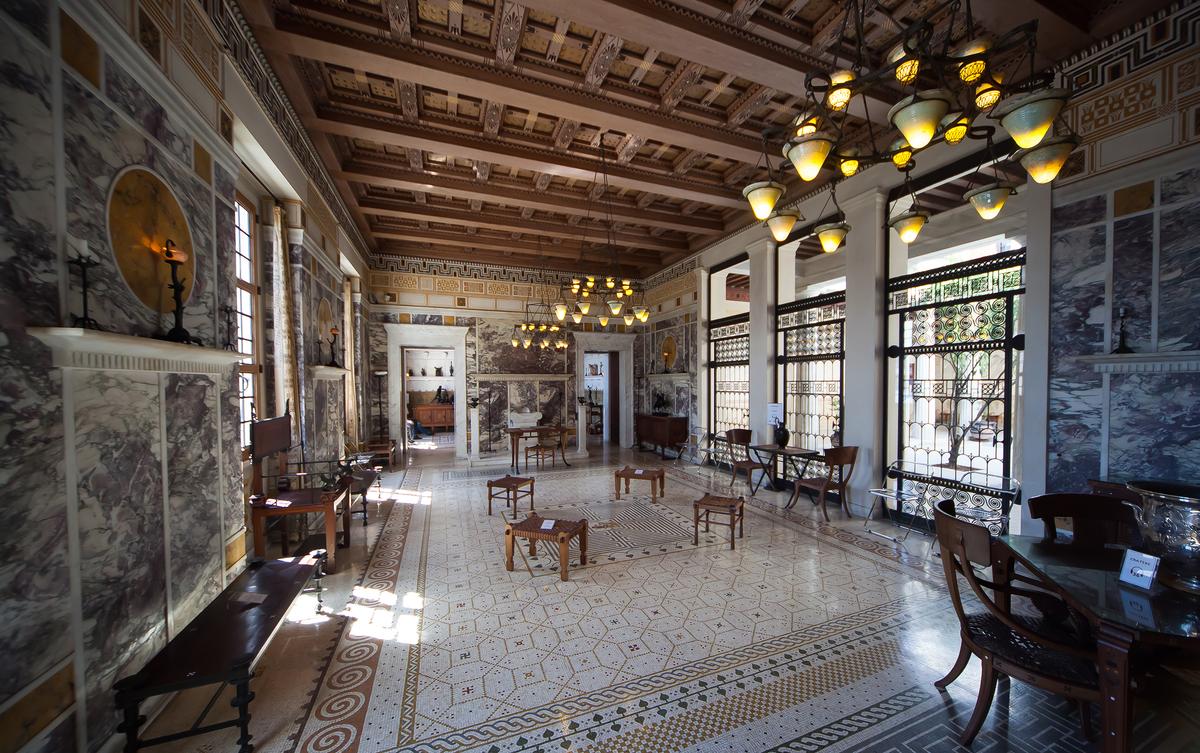
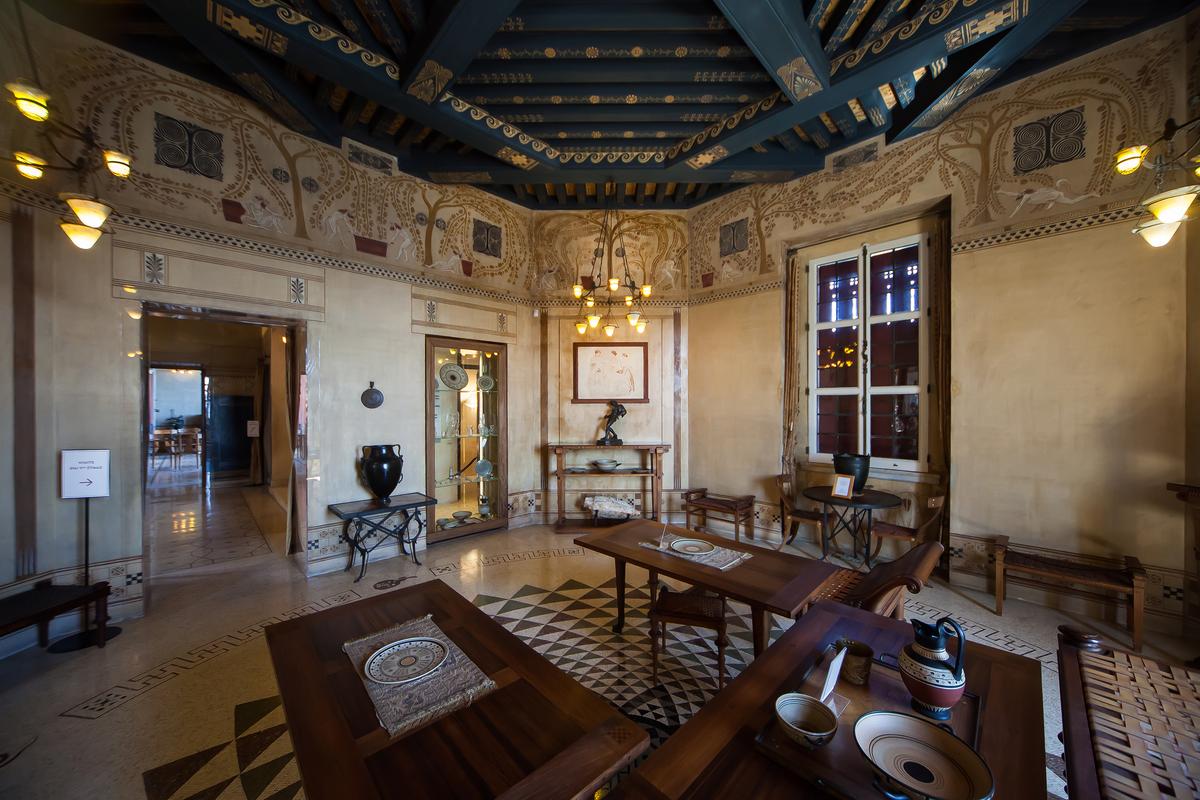
The walls of the impressive “andron,” or men’s reception room, are clad in Italian marble. At the salon's far end is a household altar made of Carrara marble that served as a place for offerings. The room’s mosaic illustrates the famous legend of Theseus slaying the Minotaur. A large, silver-plated krater (far right, front) on a table is a reproduction of a first-century-B.C. vase. Isogood_patrick/Shutterstock
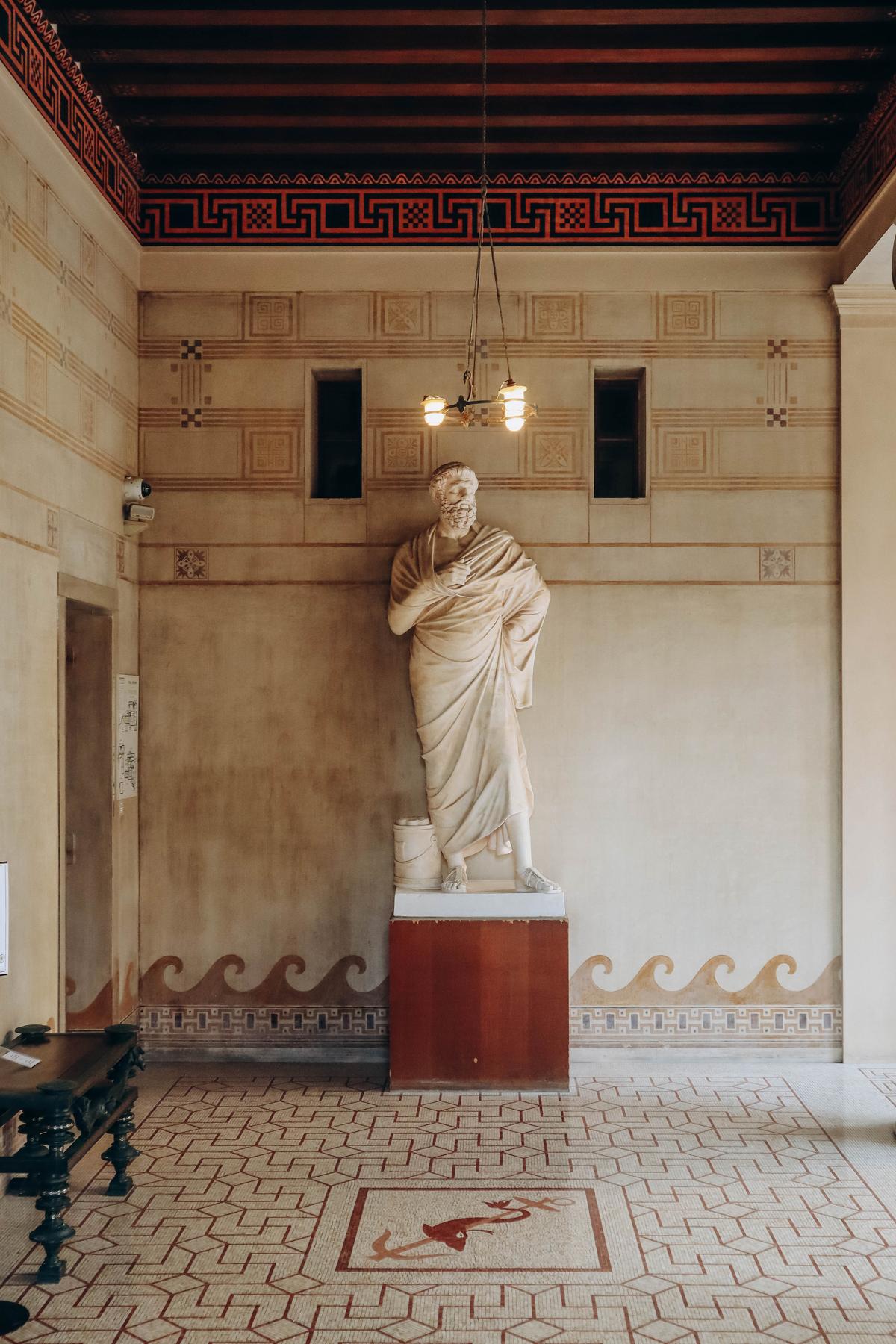
The entrance vestibule, like other areas of the home, is decorated from floor to ceiling. Its frescoes symbolize peace and war. At the far end of the vestibule, an imposing statue of Solon, a wise Athenian statesman, surveys the scene. Andrei Antipov/Shutterstock
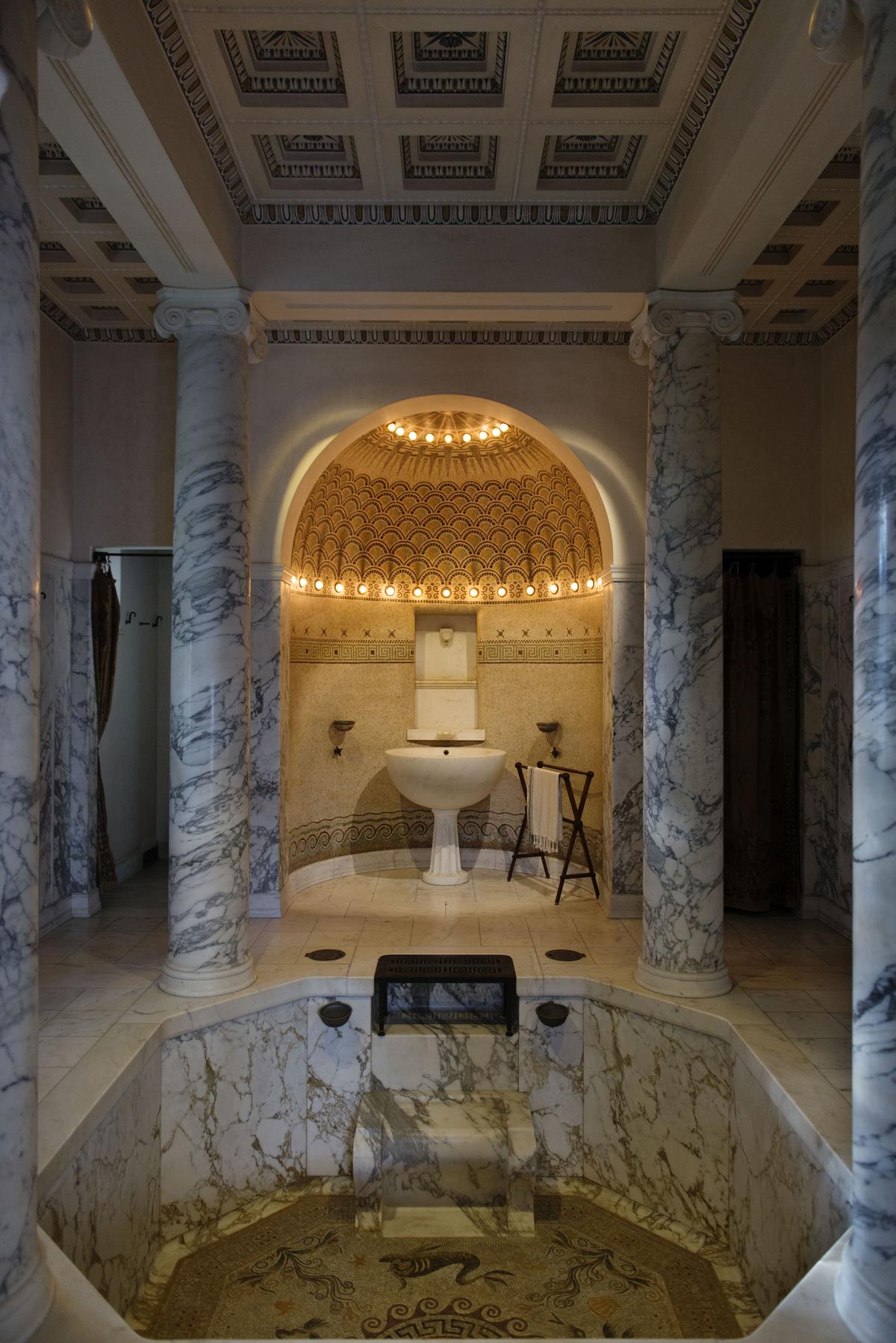
The villa was built with early 20th-century modern plumbing and heating. The ground-level “balaneion,” or bathroom, is dedicated to the naiads, female water nymphs. At its center is a luxurious sunken bath with a beautiful mosaic. The ancient Greeks valued bathing as an important ritual, and all of the villa’s bathrooms display the liberal use of marble and mosaics. Colombe Clier /Center of National Monuments
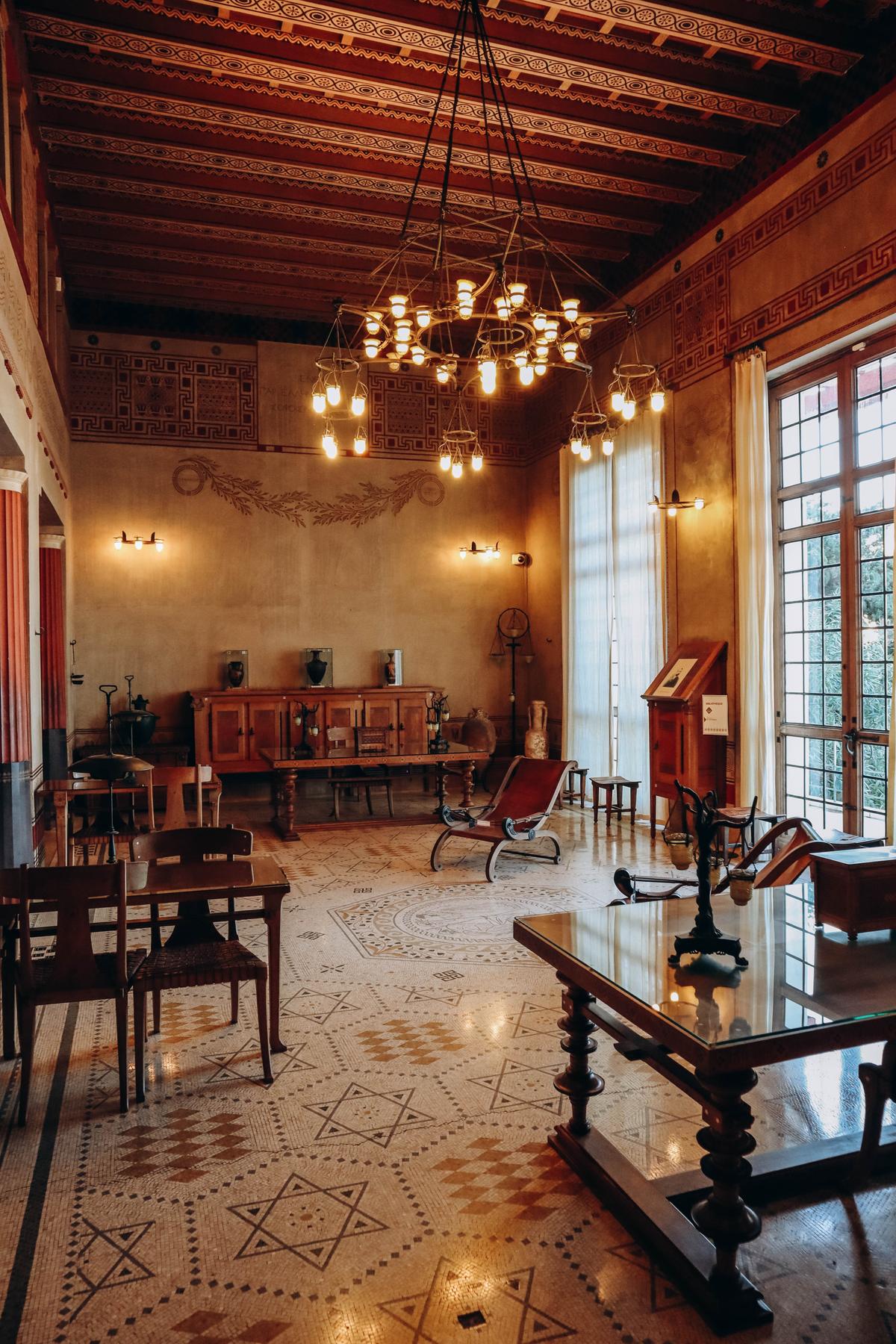
The library, one of the villa’s largest rooms, features books on art and archeology and a collection of objects in oak cabinetry. Emulating the practice of the ancient Greeks, Reinach used two lecterns (one pictured here) for reading and working while standing. The room’s central mosaic shows the Greek goddess Hera and the Titan Prometheus. The bronze lamps on the tables are replicas of lamps at the National Archaeological Museum of Naples, Italy. Andrei Antipov/Shutterstock
The ground-level state rooms are arrayed around an open-air courtyard with a peristyle, a colonnade surrounding a court. This was an essential element of ancient Greek houses, allowing light and air to circulate. Here, there are a dozen Doric Carrara marble columns and six wall frescos. The atmosphere is accented by Mediterranean plants, which also adorn the gardens. Waterborough/CC-BY-SA-4.0
Four black statues, portraying the god Apollo, the mythological youth Narcissus, and two satyrs, decorate the octagonal dining room. (The sculpture in this view is a satyr with a wineskin.) The room’s fresco depicts Sileni, male woodland spirits. The ancient Greeks ate meals while reclining on couches. This custom is facilitated at the villa by leather-woven beds set at the same height as the three-legged tables. Isogood_patrick/Shutterstock
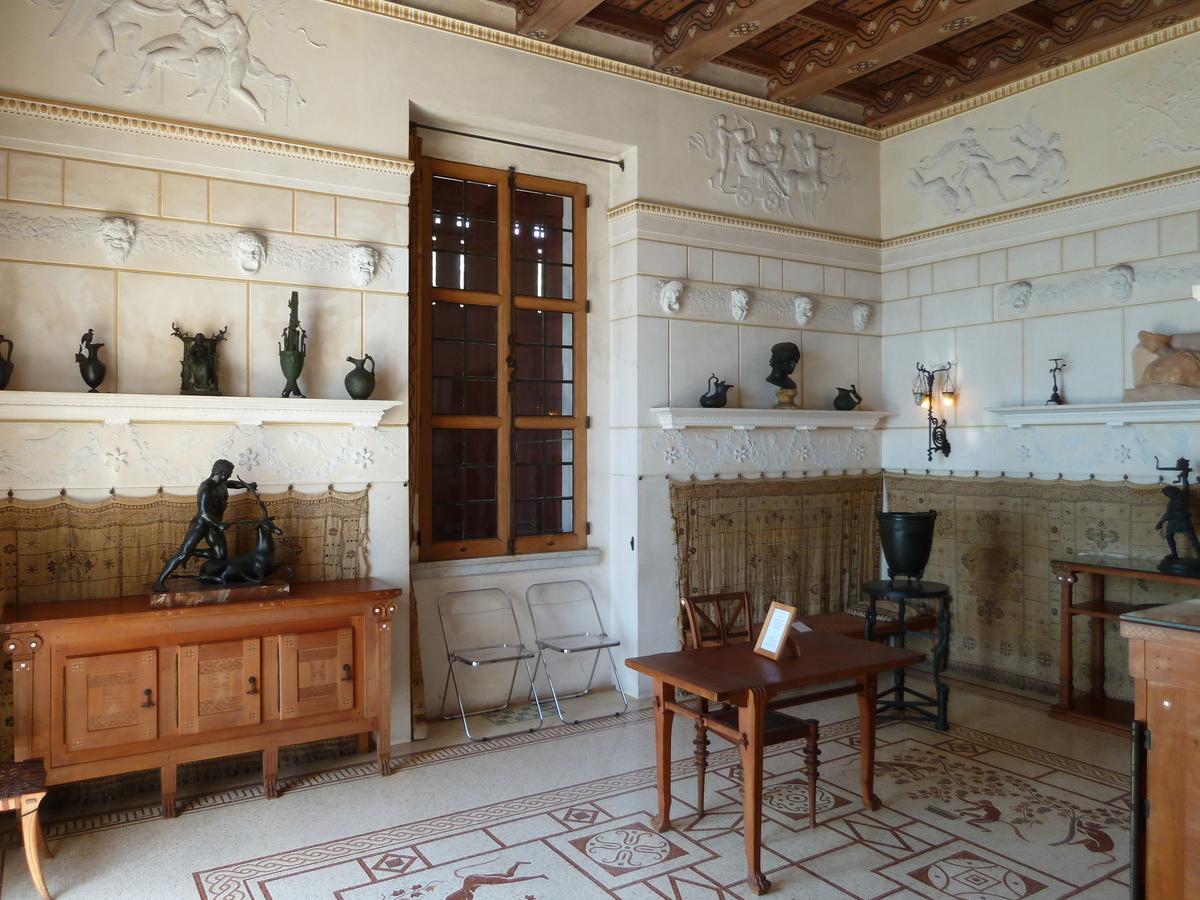
The “oikos” is a room dedicated to the arts. Its stucco frieze of bas-relief carvings showcases musical instruments and a range of exaggerated theater masks, a key component of ancient Greek performances. A lemonwood cabinet (peeking out from the bottom right)conceals a miniature folding piano. While not accurate for the period, it was a request from Reinach’s wife. Abxbay/ CC-BY-SA-3.0
What arts and culture topics would you like us to cover? Please email ideas or feedback to [email protected].
Michelle Plastrik is an art adviser living in New York City. She writes on a range of topics, including art history, the art market, museums, art fairs, and special exhibitions.