‘A Marvelous Journey: The Collection of Maurice Tempelsman’ at Sotheby’s New York

A varied collection of fine and decorative art as well as rare books will be auctioned at Sotheby’s New York on June 24, 2026.
‘A Marvelous Journey: The Collection of Maurice Tempelsman’ at Sotheby’s New York
"A Marvelous Journey: The Collection of Maurice Tempelsman" brings together fine art, gold boxes, and objects of vertu, antiquities, and objects assembled over a lifetime that had personal significance to the collector. Sotheby's
|Updated:
0:00
The Belgian-born Maurice Tempelsman (1929–2025) lived a remarkable life that encompassed intellectualism, entrepreneurship, philanthropy, and travel, as well as a refined aesthetic. When he was a child, he and his Jewish family fled Nazi-occupied Europe. Settling in America, Tempelsman went on to become chief executive of the country’s largest diamond company.

Multilingual and a lover of literature and music, he acquired a varied collection of fine and decorative art as well as rare books that is being auctioned at Sotheby’s New York on June 24, 2026. The exhibition is on view through June 23.

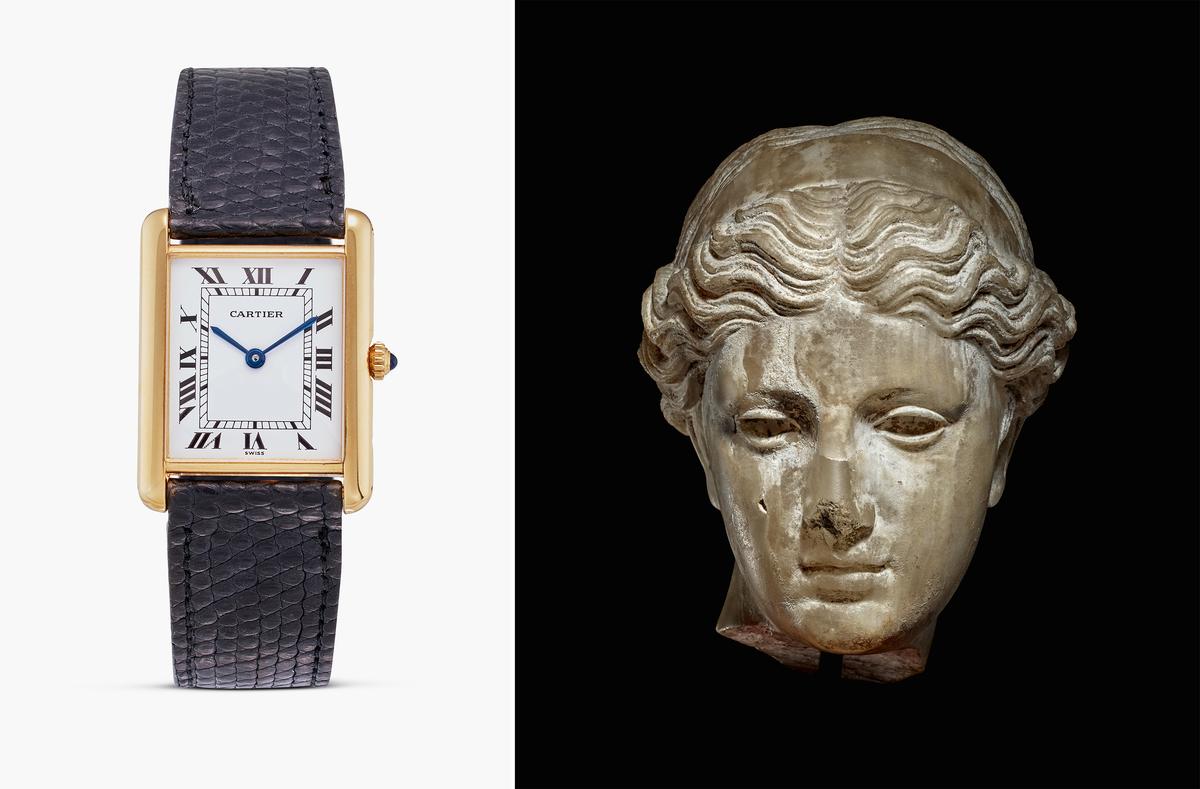
Professionally, Tempelsman was a civic leader, engaging frequently with prominent politicians in America, Africa, Latin America, and Europe. Personally, he was the final longtime companion of Jacqueline Kennedy Onassis. Keepsakes from their relationship in the sale include an engraved Cartier Tank Wristwatch Onassis gifted him, a portrait of her by celebrated American artist Aaron Shickler, a watercolor by her, and a Greek-style alabaster head that was displayed in the Kennedy White House and bequeathed to Templesman in Onassis’s will.
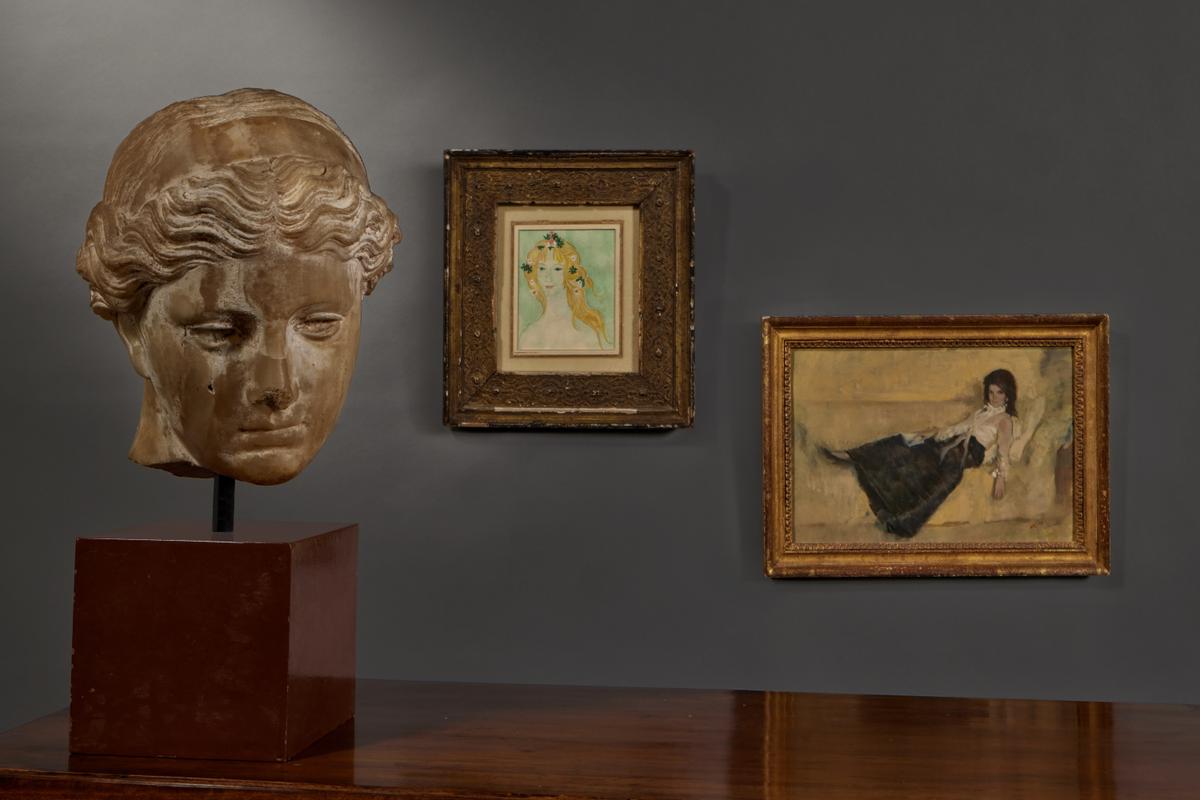
The portrait "Mrs. Onassis on Couch, Book in Lap," 1968, by Aaron Shikler is estimated to auction for $10,000 to $15,000. The exhibition will be on view through June 23, before the auction begins on June 24, 2026. (Sotheby's)
The portrait "Mrs. Onassis on Couch, Book in Lap," 1968, by Aaron Shikler is estimated to auction for $10,000 to $15,000. The exhibition will be on view through June 23, before the auction begins on June 24, 2026. Sotheby's
(Left) An 18k yellow gold Cartier wristwatch gifted to Maurice Tempelsman by Jackie Kennedy Onassis, circa 1985. (Right) Jacqueline Kennedy Onassis's "My Greek Alabaster Head of Goddess," in the "Taste of the Antique," 8 1/2 inches. (Sotheby's)
(Left) An 18k yellow gold Cartier wristwatch gifted to Maurice Tempelsman by Jackie Kennedy Onassis, circa 1985. (Right) Jacqueline Kennedy Onassis's "My Greek Alabaster Head of Goddess," in the "Taste of the Antique," 8 1/2 inches. Sotheby's
“A Marvelous Journey: The Collection of Maurice Tempelsman” takes its name from the Greek writer C.P. Cavafy’s poem “Ithaka,” which Tempelsman read at Onassis’s funeral: “As you set out for Ithaka hope your road is a long one, full of adventure, full of discovery […] Ithaka gave you the marvelous journey. Without her you wouldn’t have set out.”
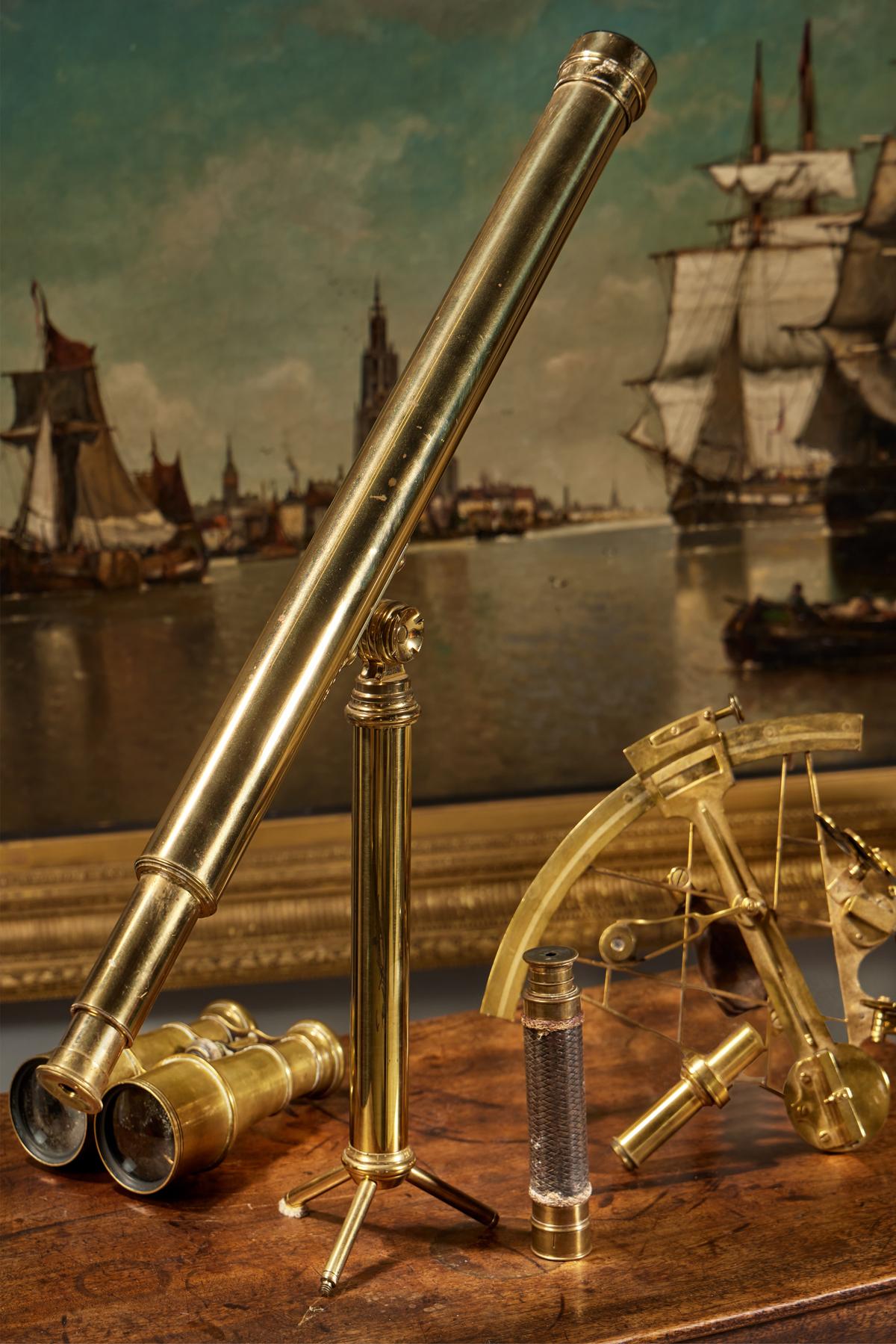
Maritime objects from the collection of Maurice Tempelsman, including a group of brass optical instruments and an English brass radius vernier sextant. (Sotheby's)
Maritime objects from the collection of Maurice Tempelsman, including a group of brass optical instruments and an English brass radius vernier sextant. Sotheby's

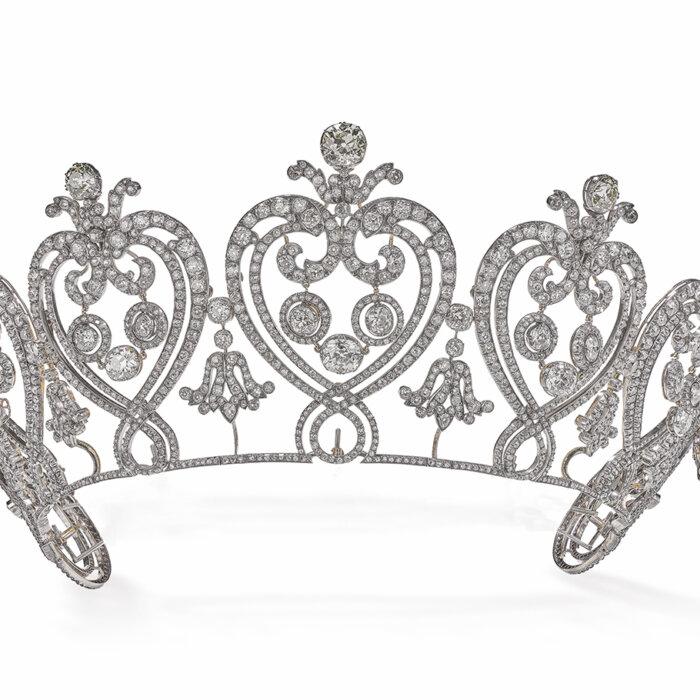
Among the additional thematic groupings in the sale are maritime objects and paintings (Tempelsman was passionate about the sea), antique jewelry, American, English, and French furniture, African and Oceanic art, illuminated manuscript leaves, and gold boxes.
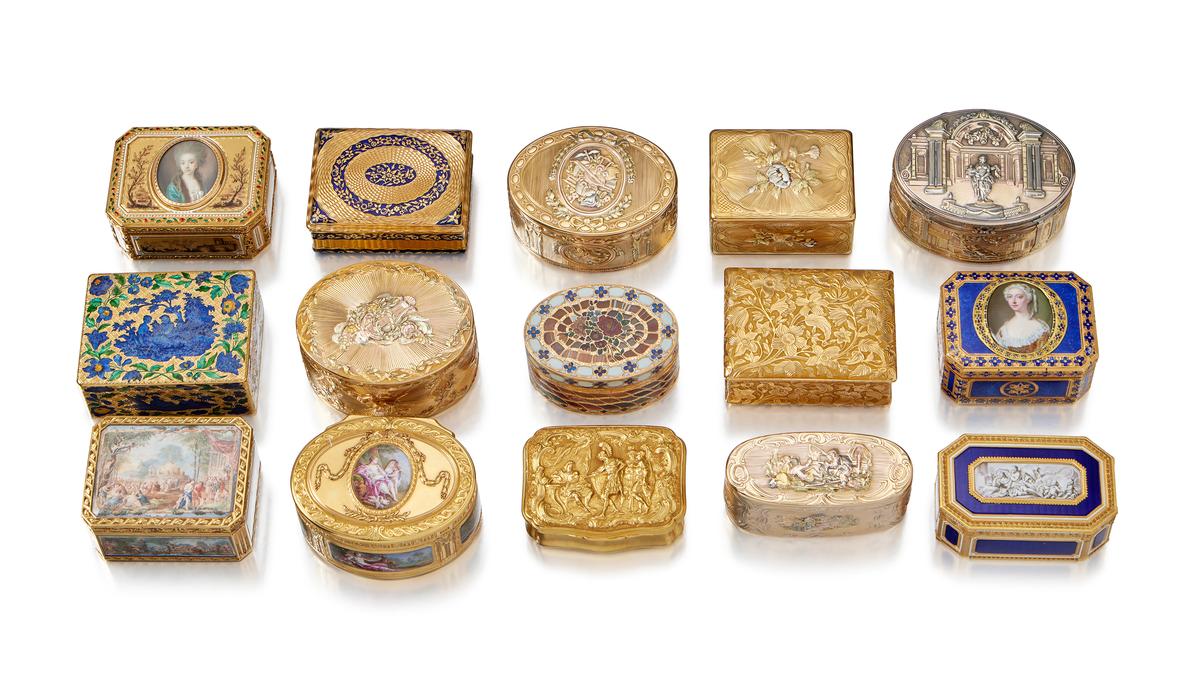
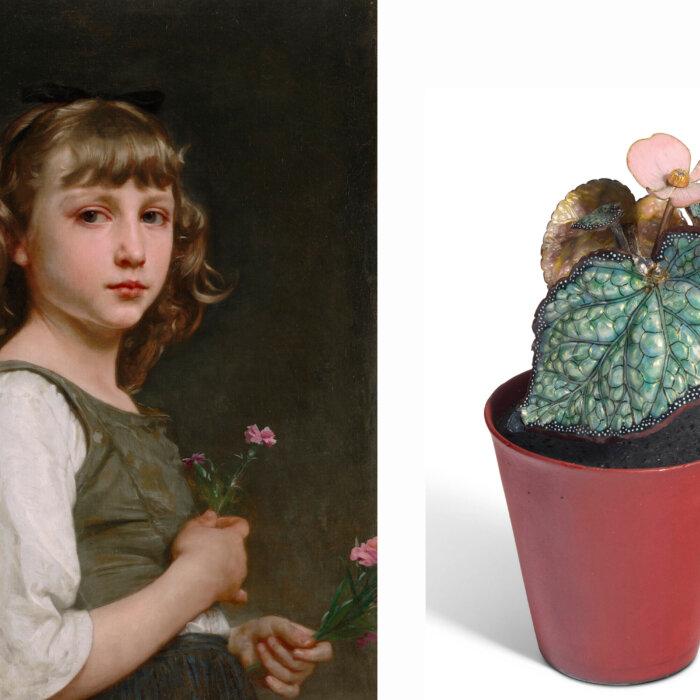
The auction features a collection of gold, decorative boxes from the collection of Maurice Tempelsman. (Sotheby's)
The auction features a collection of gold, decorative boxes from the collection of Maurice Tempelsman. Sotheby's

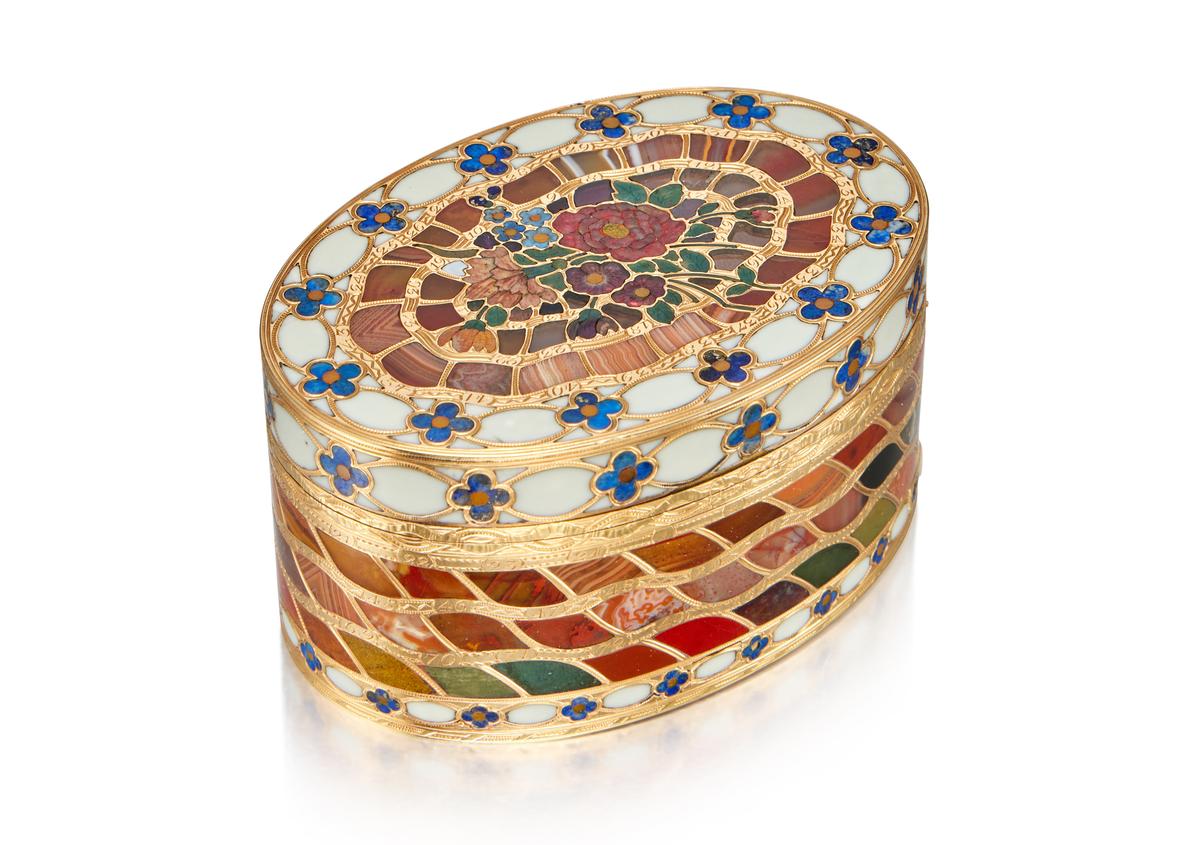
A magnificent and rare gold and hardstone ‘Steinkabinett’ Box, circa 1770, by Christian Gottlieb Stiehl, 2 7/8 inches. (Sotheby's)
A magnificent and rare gold and hardstone ‘Steinkabinett’ Box, circa 1770, by Christian Gottlieb Stiehl, 2 7/8 inches. Sotheby's
Stiehl (1708–1792)  held prestigious appointments to Augustus the Strong, King of Poland and Elector of Saxony (1670–1733) and his successor, Augustus III (1696–1763). Of the three master goldsmiths and lapidaries in Dresden during the Enlightenment period, Stiehl’s refined work is considered by some scholars to be the greatest, though his output was much smaller. Only 10 snuff boxes are currently attributed to him.

Besides the present lot, acquired by Tempelsman in the 1960s, four are in museum collections (the Palazzo Pitti in Florence, the Naturhistorisches Museum in Vienna, the Thyssen-Bornemisza Collection, and the Musée du Louvre) and five are in private collections.
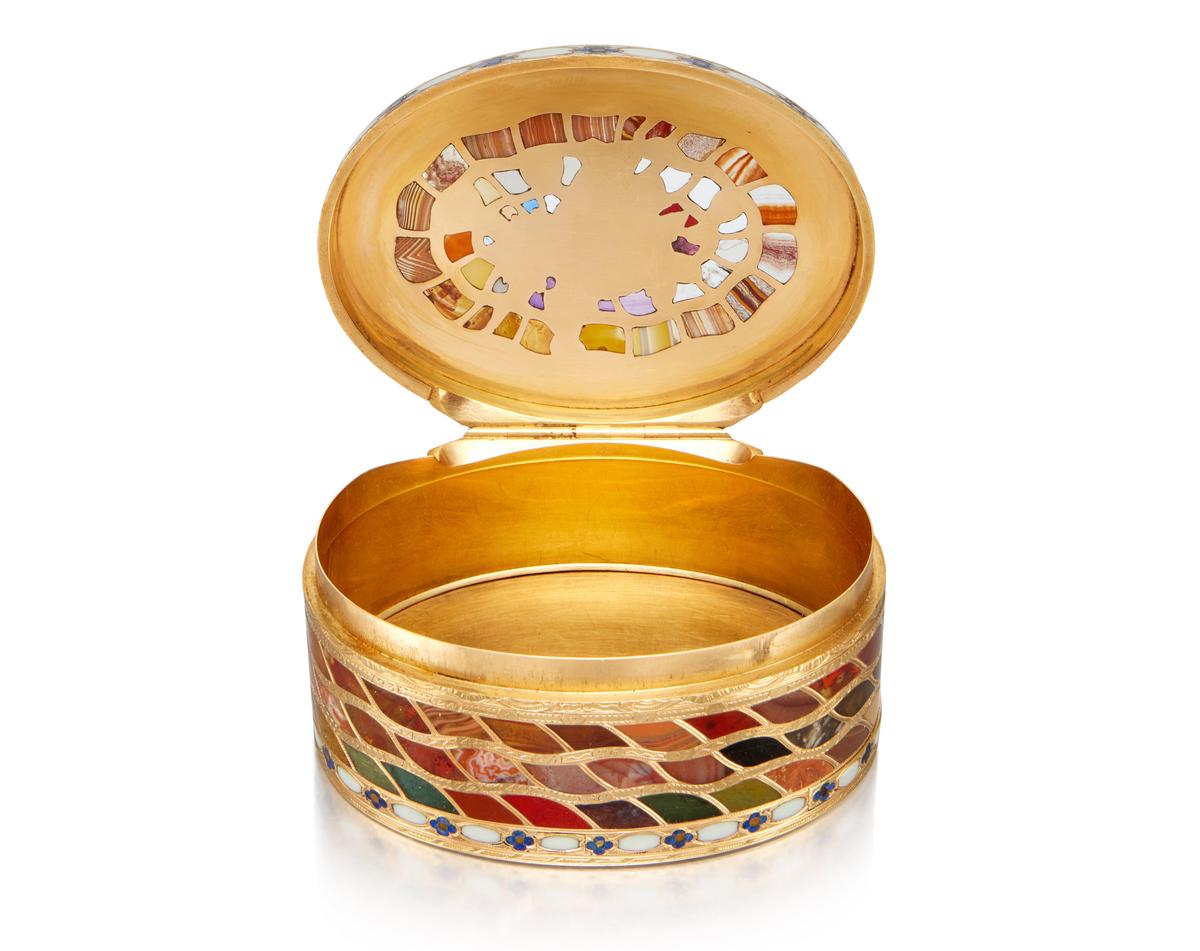
Inside the magnificent and rare gold and hardstone ‘Steinkabinett’ Box. When held to light, the luminous effect of the hardstone gives the impression of stained glass. (Sotheby's)
Inside the magnificent and rare gold and hardstone ‘Steinkabinett’ Box. When held to light, the luminous effect of the hardstone gives the impression of stained glass. Sotheby's

Luxuriously crafted Steinkabinetts epitomize the Enlightenment’s scientific interest in mineralogy. This example of “Galanteriewaren,” or small precious objects with a function, features agate, amethyst, bloodstone, jasper, lapis lazuli, nephrite, petrified wood, turquoise, and white opal, a gemstone that particularly fascinated the Electors of Saxony.

Stiehl, like other goldsmiths, had to obtain approval to personally mine stones for his work. He was granted permission to do so in Saxony in 1765. While other goldsmiths focused on utilizing scientifically varied specimens, Stiehl chose thinly-cut translucent hardstones for their harmony and beauty.

Knowledge of this box’s individual stone types and their specific place of origin come from a secret hidden within the box. A sliding compartment in the base, activated by pressing one of the opal inlays, reveals a small handwritten paper booklet titled “Catalogue de toutes Sortes de Pierres qui se trouvent en Saxe.”

This document is written in French, the official language of the Dresden court, and in old German script (Kurrent). It identifies every hardstone used on the lid, sides, and base, and assigns each a number. These numbers correspond to tiny, engraved numbers above each hardstone panel on the box itself. It is fortuitous that both box and booklet have survived intact together.
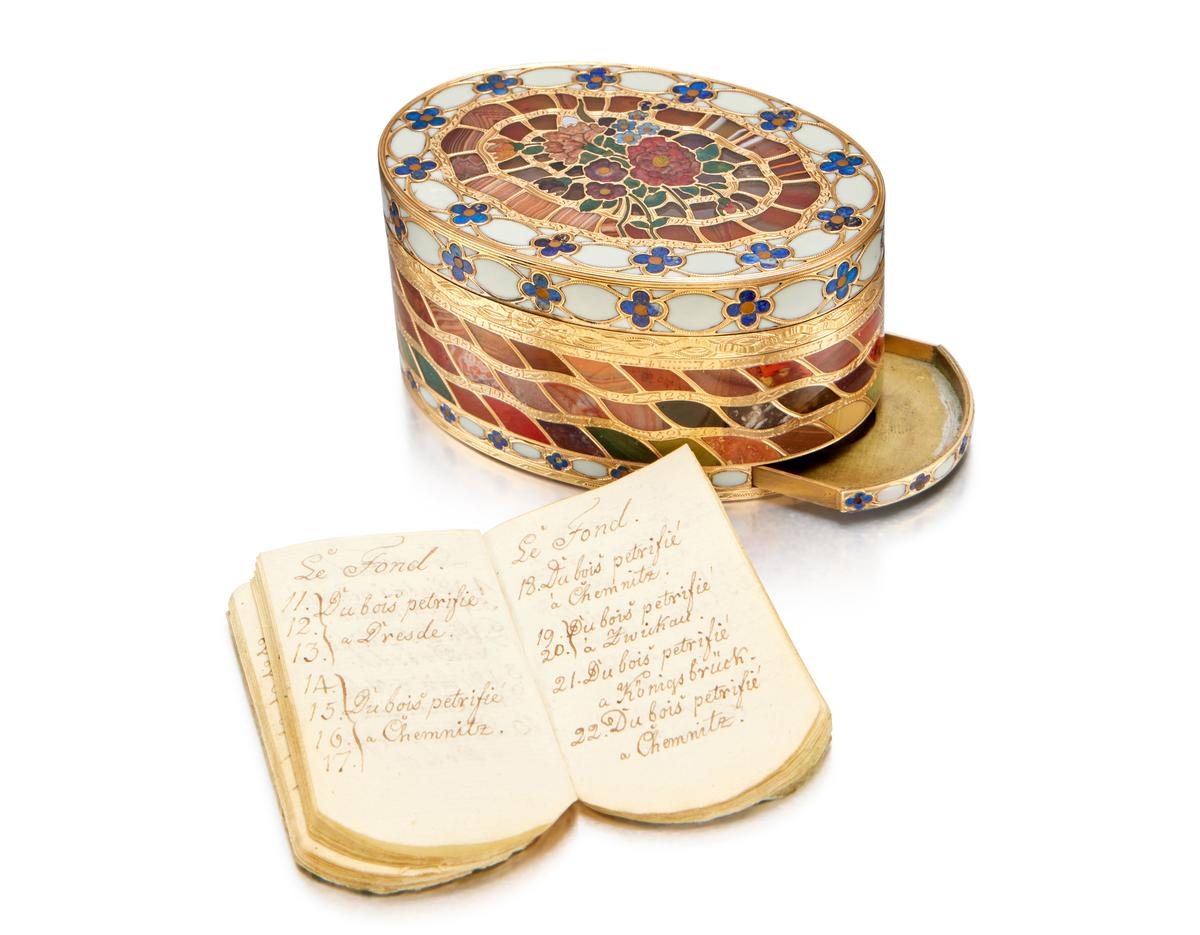
A sliding compartment in the box's base reveals a small handwritten paper booklet that details every hardstone used. (Sotheby's)
A sliding compartment in the box's base reveals a small handwritten paper booklet that details every hardstone used. Sotheby's
All the sides of this oval box have surfaces inlaid in perfect “Zellenmosaik.” Sotheby’s described this as “a technique of extreme precision in which finely polished hardstone specimens … are set à jour within gold cloisonné borders less than a millimeter wide, achieving both a near-seamless polished surface and, when held to light, the luminous effect of stained glass.”
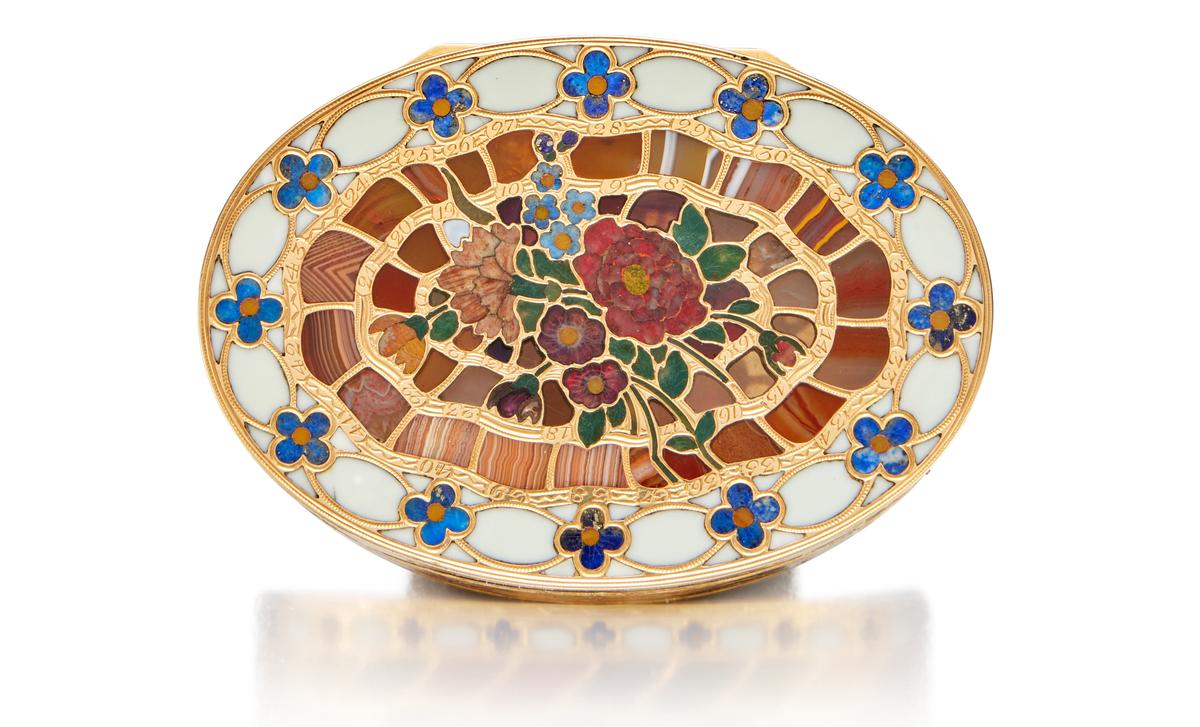
The lid features a peony, a red carnation, tulips, smaller blossoms, and forget-me-nots. (Sotheby's)
The lid features a peony, a red carnation, tulips, smaller blossoms, and forget-me-nots. Sotheby's

Stiehl is known for his floral designs, and the lid here displays a spray with a peony, a red carnation, tulips, smaller blossoms, and forget-me-nots. At the Saxon court, forget-me-nots had a rich symbolic history, denoting loyalty and faithfulness. There are 43 numbered irregularly shaped hardstone specimens on the lid, 72 lozenge-shaped ones on the sides, and another 72 on the base. The wavy bands of gold have reeded or stippled engraving, and sinuous gold work on the sides includes a motif of interlaced ribbons.
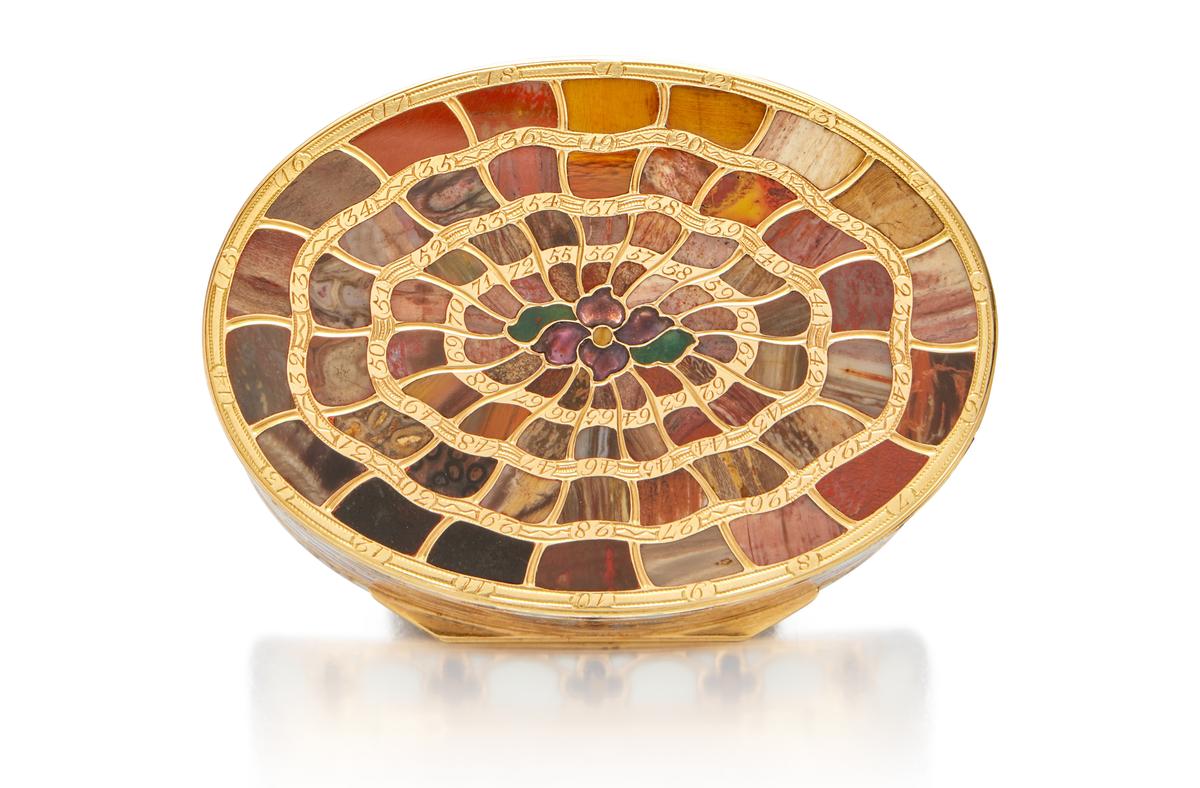
The base of the box features 72 hardstones. (Sotheby's)
The base of the box features 72 hardstones. Sotheby's

The rarity of Stiehl’s Steinkabinett is evocative of Tempelsman’s unique life. This intricate work of art celebrates the natural world, as Tempelsman’s career focused on the earth’s resource of diamonds. Its embodiment of scientific inquiry is akin to Tempelsman’s intellectual rigor, and its ode to beauty is echoed in the aesthetic thread found in Tempelsman’s collection.
What arts and culture topics would you like us to cover? Please email ideas or feedback to [email protected].
Google LogoMark Us Preferred on Google
Michelle Plastrik
Michelle Plastrik
Author
Michelle Plastrik is an art adviser living in New York City. She writes on a range of topics, including art history, the art market, museums, art fairs, and special exhibitions.