NR | 1h 35m | Drama | 1951
“Peking Express” is at once a critique of Chinese communism and an insistent, if idealistic, call for change. What’s the point of a People’s Republic, it asks, if that republic habitually suppresses its people?
American Dr. Michael Bachlin (Joseph Cotten) boards the Peking Express from the Shanghai railroad station on a secret mission to Peking (now Beijing). As a UN doctor, he’s rushing to perform surgery on a leader of the underground resistance who’s been defying Mao Zedong’s brutal communist takeover of China.
Drama on a Train
Other passengers are an equally intriguing bunch. Propagandist newspaperman Mr. Wong (Benson Fong) figures everyone ought to be communist, even missionary Father Joseph Murray (Edmund Gwenn). Father Murray hopes to spend his final years ministering to the faithful in Peking.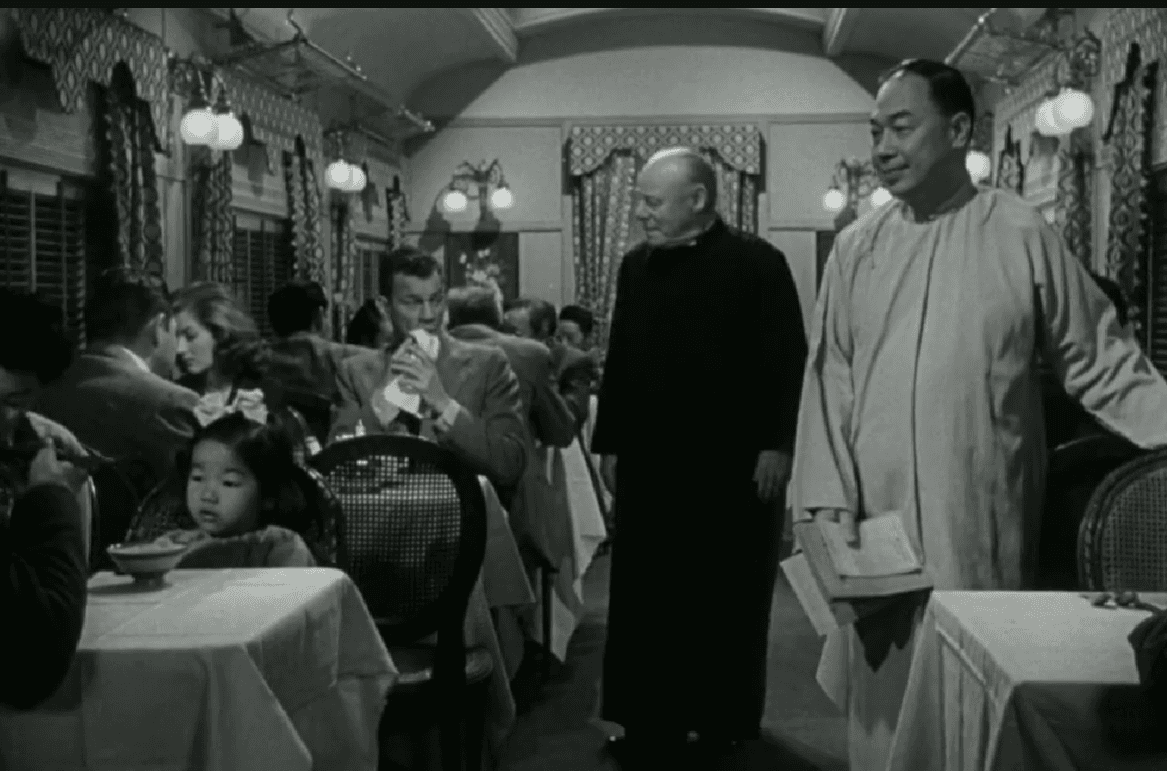
Enigmatic black-marketeer Mr. Kwon (Marvin Miller) masquerades as a merchant. He eventually hijacks the train and its passengers to free his son Ti Chen (Robert W. Lee), who has been arrested on suspicion of treason.
Kwon’s patriotic wife, Li Eiu (Soo Yong), who is also on board, accepts Kwon’s violence toward her. What she won’t tolerate is her son Chen being brainwashed by communists or ex-communist mercenaries like Kwon. Kwon once had Chen kill Eiu’s other son.


Now Kwon is trying to get rid of Eiu. She resents Chen’s being rescued merely to become Kwon’s fellow mercenary. Kwon has also stolen UN medical supplies intended for Chinese commoners. Now Kwon imagines that Bachlin and Grenier will, mercenary-like, pay any price to free themselves, overlooking both stolen supplies and their love for each other.
Hal B. Wallis’s production lacks the finesse that ought to be a given for a 1951 production, especially a remake of the 1932 production “Shanghai Express.” Dimitri Tiomkin’s score is earnest but often excessive, and at times more frenetic than the speed of the Peking Express. Still, director William Dieterle’s action-packed execution, his cast’s arresting performances, and Charles Lang’s nifty camerawork compensates for such shortcomings.
Missouri-born Miller was as American as it gets but excelled at playing Asian characters. Here, he wields his legendary baritone to bring a suave savagery to his Kwon. Fong’s portrayal of the indoctrinated Wong is appropriately robotic. Endearingly, Yong depicts a woman torn between patriotism and parenthood, making it seem as if the two are interchangeable, or even the same thing. Calvet, who exudes something of Rita Hayworth and Maureen O’Hara, is a convincingly conflicted enchantress.
Changing Track, Changing Tack
Chen represents vulnerable Chinese citizens who are lulled into receiving as truth, with facts filtered by a powerful party, and personified here by the unprincipled Kwon who pretends to be nothing but principled.Eiu serves as a kind of Mother China figure, pained at what the regime has done to her children. Even if one generation has been lost to communism’s corrosiveness, she hopes that another won’t be. Chen is the next generation; the brother he killed at Kwon’s behest is the present generation.
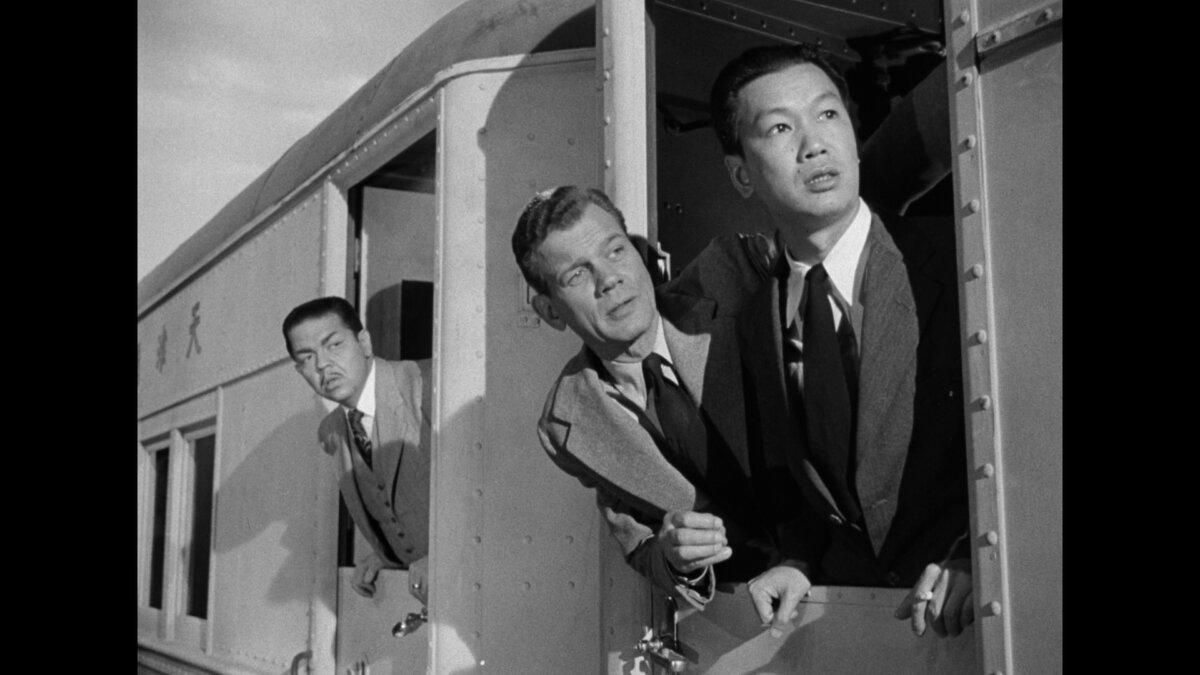
Dieterle’s over-the-shoulder shot allows Eiu to speak to both Chen and the audience. She’s facing the camera, personifying ancient China. Chen’s back is to the camera, a shadowy figure personifying China’s citizens, custodians of its present and its future. She sighs, recalling what the ancients once said: “The parent is yesterday, the son, tomorrow. And the flower lives on in the seed.” She pleads with Chen, “Live decently … for me … for your brother.”
Grenier serves as a conscience, too, but addresses the America personified by Bachlin. Arguing about their past, he wonders how she could ever have married a Russian communist. Prophetically, she recalls how, fresh from World War II victories, the West once believed the world was a wonderful, friendly place: “We didn’t know then what they really stood for. … I wasn’t the only one who thought that the communists were friends.”
As stated by a character in the film, Dieterle hints that such a thought is as naive as a peasant idly petting his cow in the middle of a railroad track while a train hurtles toward them.