This copy is for your personal, non-commercial use only. Distribution and use of this material are governed by our Subscriber Agreement and by copyright law. For non-personal use or to order multiple copies, please contact The Epoch Times Reprints.
The art of Parmigianino (1503–1540) is exquisitely elegant and innovative. Called “Raphael reborn,” he was the most influential Mannerist painter. Although he died at only 37, he had a prolific 20-year career. He is believed to have been the first Italian artist to make etchings, and this was key in the wide dissemination of his art throughout Italy and Europe.
Parmigianino painted religious scenes, frescos, and portraits. In portraits, he captured refined courtly sitters, and the 16th-century Venetian humanist Ludovico Dolce declared, “Parmigianino endowed his creations with a certain beauty which makes whoever looks at them fall in love with them.” Among his most esteemed pictures is the enigmatic “Schiava Turca.”
Parma’s Painter
Born Girolamo Francesco Maria Mazzola, his nickname derived from Parma, the Northern Italy city of his birth. His earliest artistic training came from his uncles. Art historians believe that he likely worked under Parma’s most celebrated Renaissance artist, Correggio. In any case, beginning in 1520, Correggio was the primary inspiration of his early career.
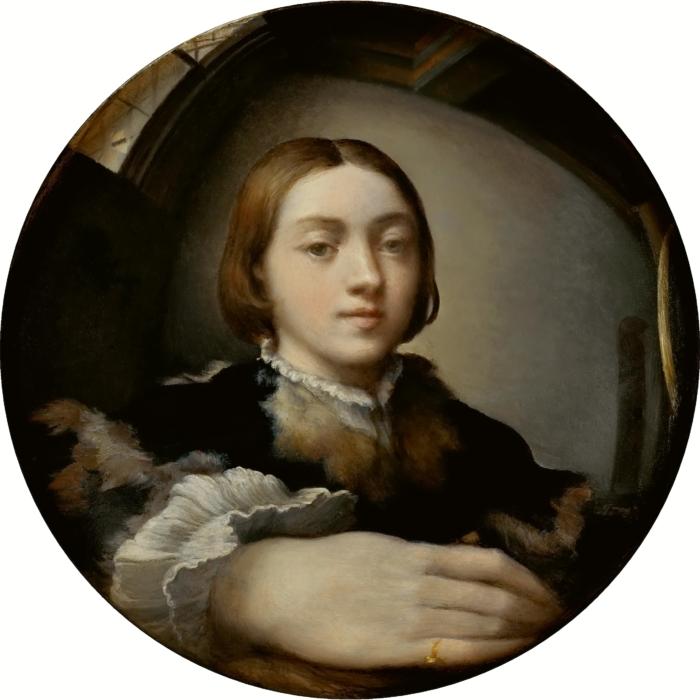
“Self-Portrait in a Convex Mirror” circa 1523–1524, by Parmigianino. Oil on poplar panel, 9 3/5 inches. Museum of Fine Arts, Vienna, Austria. Public Domain
Parmigianino’s masterpiece from this period is his “Self-Portrait in a Convex Mirror.” He traveled to Rome in 1524 to present the oil panel to Pope Clement VII. While living in the city, Parmigianino was exposed to works by Michelangelo and Raphael. This led to changes in his own style, and his art became grander. In 1527, Rome was sacked by an invading army, and the artist escaped to Bologna. He probably returned to Parma in 1531, where he remained until shortly before his death. Between Bologna and Parma, Parmigianino traveled briefly to Venice in 1530. “Schiava Turca” cannot be definitively dated, but most experts agree to assign the period of the early 1530s based on style. Thus, the work could have been painted in any of these cities.
The Tantalizing ‘Turk’
“Schiava Turca” ("Turkish Slave"), circa 1532, by Parmigianino. Oil on panel; 26 3/4 inches by 20 9/10 inches. Galleria Nazionale di Parma, Italy. Sailko/CC BY-SA 4.0
Almost two dozen Parmigianino portraits are known today, and among those only four are of women. “Schiava Turca” is owned by the Galleria Nazionale di Parma. The image of a woman with charming hazel eyes and enticing smile has become an icon of the artist’s native city. The title translates to “Turkish Slave,” but it is a misnomer. In 1704, the panel was assigned this name by a cataloguer at the Uffizi Galleries. He believed the sitter’s turban-like headdress and ostrich-feather fan denoted exoticism and that the gold chain in her right sleeve referenced enslavement. While her identity remains tantalizingly mysterious, the woman is actually wearing fashionable Italian courtly dress.
Her headdress is a gilt-thread balzo, a luxury feminine accessory traced to the Renaissance aristocrat Isabella d’Este, the most celebrated woman of her day. Popular at Northern Italian courts, a balzo is featured in another circa 1530 Parmigianino portrait whose sitter is believed to be Countess Gozzadini. The same type of accessory can be seen in paintings by other artists of the time, such as Lorenzo Lotto’s double portrait.
(Left) Portrait of Countess Gozzadini, circa 1530, by Parmigianino. Oil on poplar wood; 19 3/5 inches by 18 3/10 inches. Museum of Fine Arts, Vienna. (Right) "Family Portrait," 1523–1524, by Lorenzo Lotto. Oil on canvas; 37 4/5 inches by 45 3/5 inches. Hermitage Museum, Saint Petersburg, Russia. Public Domain
Balzi were often decorated with a central jewel or medallion. The enameled relief circular ornament in “Schiava Turca” shows a white winged horse, likely the mythological Pegasus. While some art historians have suggested that this insignia is a heraldic reference that could identify the sitter, this avenue has not led to satisfactory conclusions.
A detail of “Schiava Turca” ("Turkish Slave"), circa 1532, by Parmigianino. Sailko/CC BY-SA 4.0
Another scholarly supposition is that the sitter is not an actual woman but instead an image of ideal beauty conjured by Parmigianino. However, while idealization was common practice in Renaissance portraiture, the woman in “Schiava Turca” maintains a sense of individuality via her frank, engaging gaze. Parmigianino could have “beautified” her face and still have based her on a real person.
A New Interpretation
In 2014, Aimee Ng, then research associate at the Frick Collection and now chief curator, publicized a new interpretation of “Schiava Turca.” She believes that the sitter may have been a poetess. In Parmigianino’s day, Pegasus was emblematic of humanist poetry, as the creature was said to have brought forth the font of poetic inspiration sacred to Apollo and the Muses by striking the ground on the Grecian Mount Helicon with his hoof. A candidate for identification is the political ruler and poet Veronica Gambara (1485–1550): She was well connected to Northern Italian courts, visited and lived in cities that overlap with Parmigianino’s travels, and was close friends with the artist Correggio.
In this work, Parmigianino employs unconventional features in female portraiture, which draw from traditional male portraiture. This supports the conclusion that the woman in “Schiava Turca” was a unique character. Women were typically painted as still—their bodies are positioned in the same direction as their faces. This is true for the sitters in Parmigianino’s three other female portraits, whose faces are also impassive.
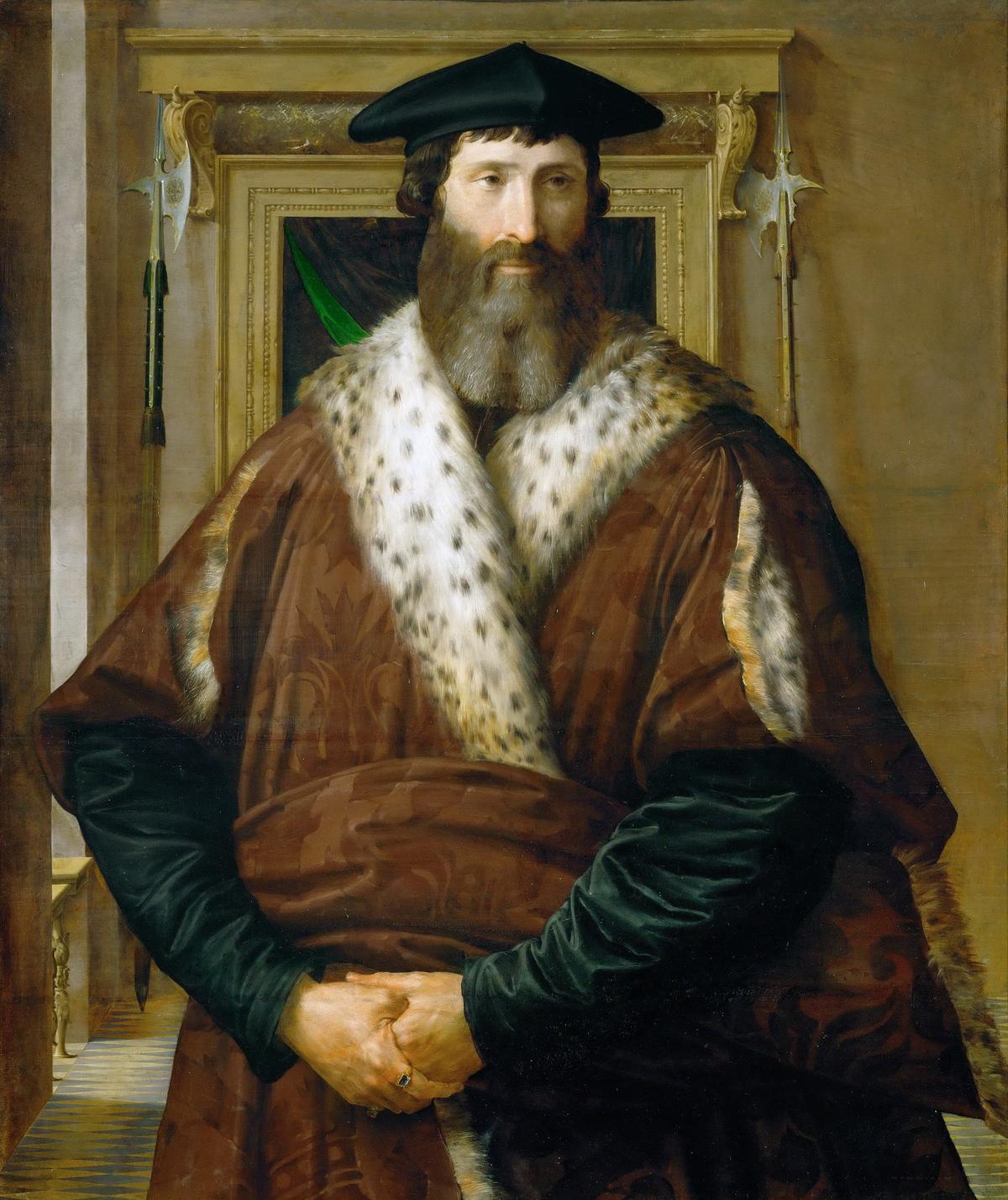
Instead of being static, men were depicted dynamically, often through a twisting pose. This torsion can be seen in works such as Parmigianino’s “Portrait of a Dignitary,” possibly of Malatesta Baglione, as well as in “Schiava Turca.”
"Portrait of a Dignitary," circa 1535, by Parmigianino. Oil on poplar wood; 46 1/4 inches by 38 1/2 inches. Museum of Fine Arts, Vienna. Public Domain
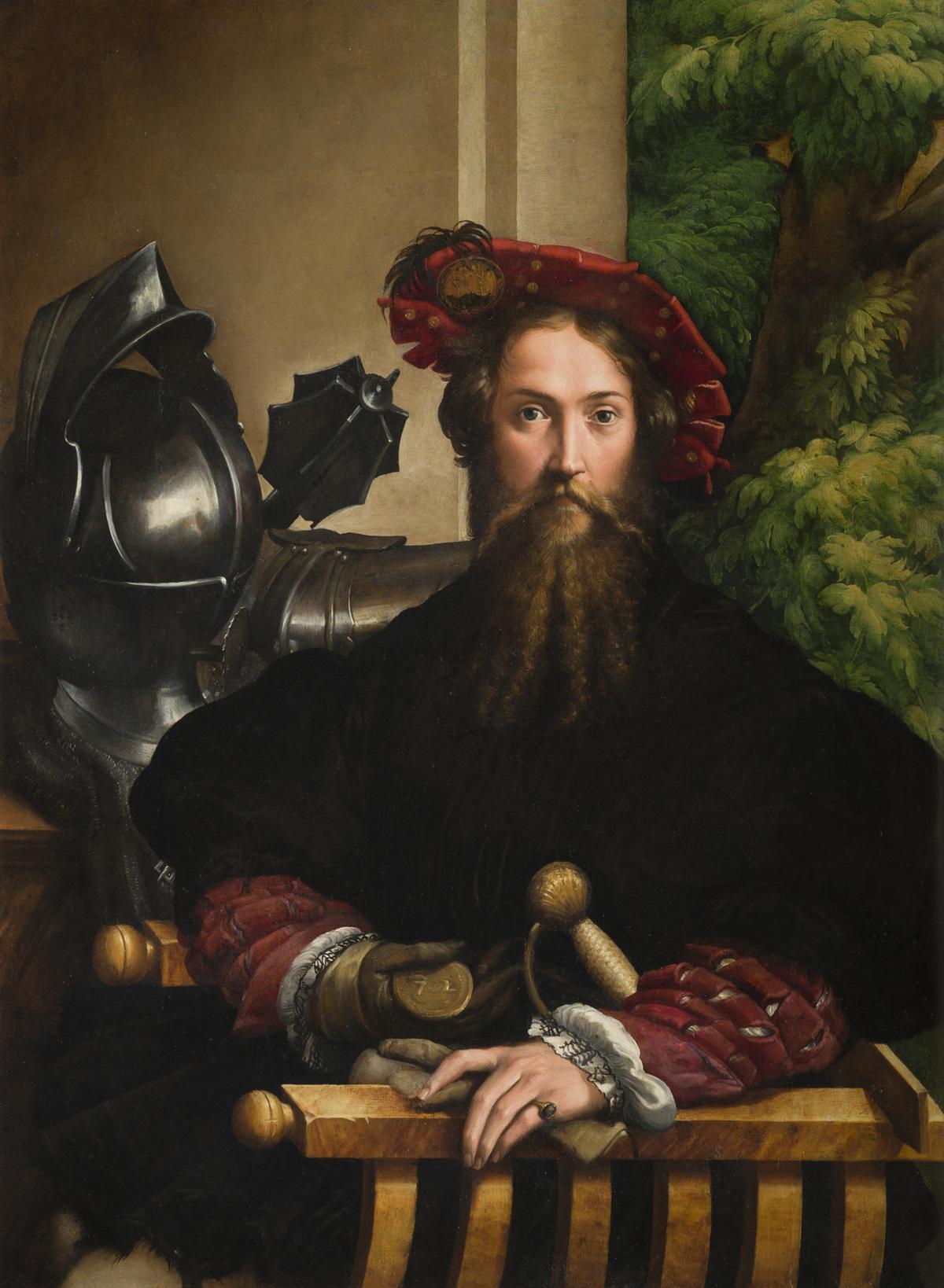
Ng believes that the woman’s balzo appears to be adorned with a hat badge, an item that derived from the military badge. It was considered a typical male accessory and displayed one’s personal emblem. In Parmigianino’s “Portrait of Galeazzo Sanvitale,” the male sitter wears an example with the image of the twin columns of Hercules.
"Portrait of Galeazzo Sanvitale," 1524, by Francesco Mazzola (Parmigianino). Oil on panel; 42 1/2 inches by by 31 1/2 inches. Courtesy of the Louvre
“Schiava Turca” is a remarkable painting. It showcases Parmigianino’s creative genius of rich colorization, withthe woman’s outfit of vivid golds and blues complimented by the picture’s yellow-green background. One marvels at the artist’s technical skill in conveying diverse textures, from metal threads and feathers to soft ringlets and plucked high arch eyebrows. What elevates this artwork is not just the woman’s striking accessories, but also the immediacy of her expression. One wants to know what she is thinking and whether she is a real person. It is this inscrutability that makes her endlessly fascinating.
What arts and culture topics would you like us to cover? Please email ideas or feedback to [email protected]
Michelle Plastrik is an art adviser living in New York City. She writes on a range of topics, including art history, the art market, museums, art fairs, and special exhibitions.