One of the Greatest Treasures of European Medieval Art in an American Museum

A chalice used for centuries in a French basilica is now a treasured piece at the National Gallery of Art.
One of the Greatest Treasures of European Medieval Art in an American Museum
The front and side view of the "Chalice of the Abbot Suger of Saint-Denis," 2nd–1st century B.C., from an Alexandrian artist with mounting added in France during the 12th century. National Gallery of Art, Washington. Public Domain
|Updated:
0:00
One of the most exquisite European medieval artworks in the United States is part of the collection of the National Gallery of Art (NGA). The “Chalice of the Abbot Suger of Saint-Denis” is an ancient Egyptian hard-stone cup from 2nd to 1st century B.C with 12th-century French mounts. The vessel’s 2,000-year-old history reveals tales of superb craftsmanship, visionary artistic patronage, revolution, theft, and preservation. 

Scholars believe that the high level of artisanal skill evident in the carved cup points to the Egyptian city of Alexandria as the site of its creation. In antiquity, Alexandria was famously a center for the working of hard stones. The vessel’s material is commonly called sardonyx: It is a form of agate with parallel bands of reddish-brown and white. The raw material may have originated in India, which was known in the ancient world for its natural resource of high-quality banded agates.

Goods such as this were transported to Egypt by Arab caravans. The “Chalice” was made shortly before the defeat of Cleopatra and the conquest of Egypt by the Roman Empire. The Roman elite had a taste for luxury goods, including hard-stone vessels such as the “Chalice,” which they used for banqueting or as libations to their gods.

Patron of Arts

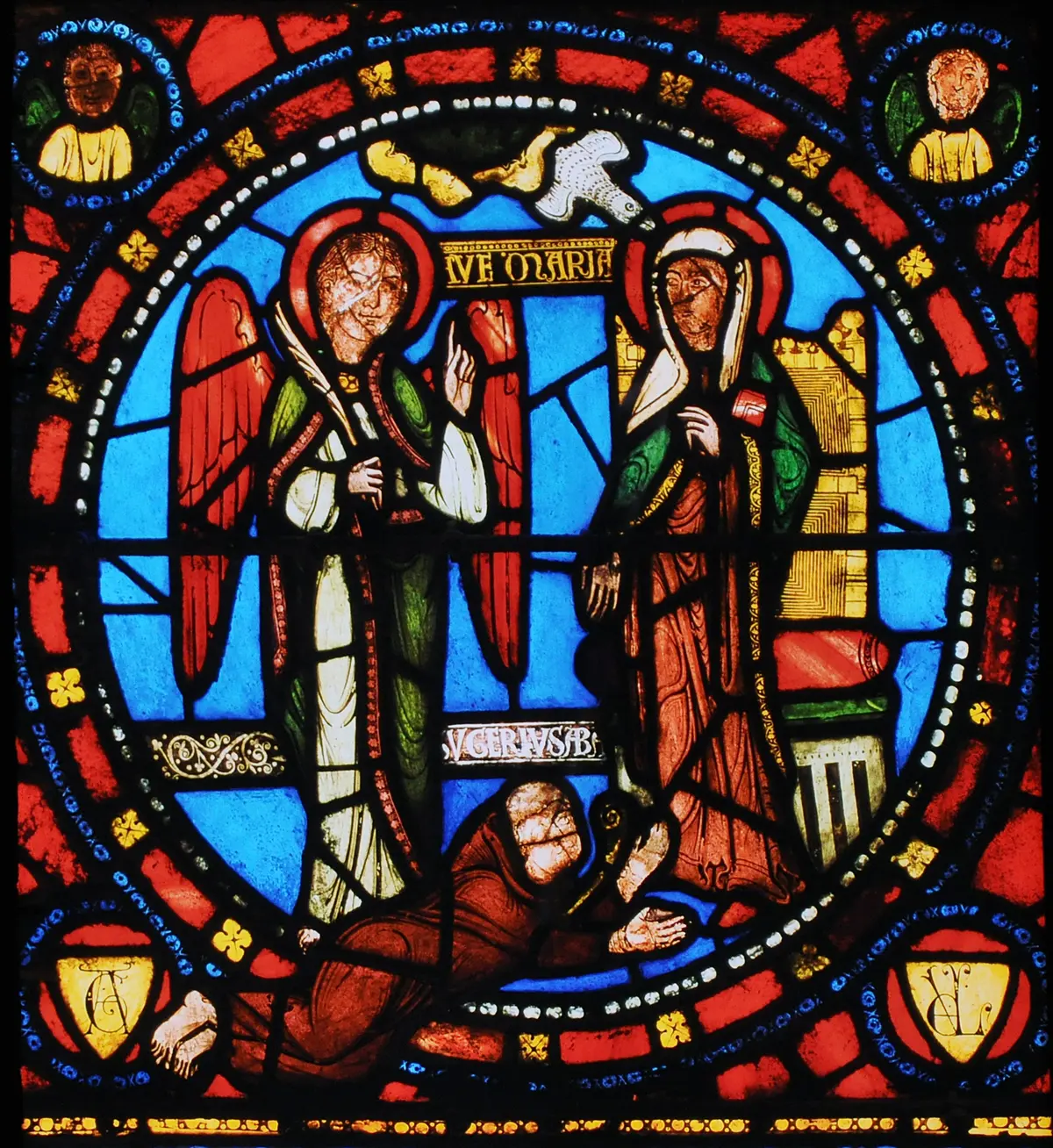
A representation of Abbot Suger prostrating at the feet of the Virgin in the 12th-century stained-glass window in the Basilica of Saint-Denis (Chapel of the Virgin), France. (Public Domain)
A representation of Abbot Suger prostrating at the feet of the Virgin in the 12th-century stained-glass window in the Basilica of Saint-Denis (Chapel of the Virgin), France. Public Domain

The first documented owner of the sardonyx cup is Abbot Suger (circa 1081–1151). Suger was elected abbot of the Royal Abbey Church of Saint-Denis in 1122. One of the most important patrons of the arts of his time, this powerful churchman was also an influential statesman as a key advisor to two French kings.

(Left) West façade of the Basilica of Saint-Denis in Saint-Denis, France. (Petr Kovalenkov/Shutterstock) (Right) The Rayonnant windows of clerestory and triforium. (<a href="https://commons.wikimedia.org/wiki/File:Saint-Denis_(93),_basilique_Saint-Denis,_abside_3-BF.jpg" target="_blank" rel="nofollow noopener">Pierre Poschadel</a>/  <a title="Category:CC-BY-SA-3.0" href="https://commons.wikimedia.org/wiki/Category:CC-BY-SA-3.0">CC-BY-SA-3.0</a>)
(Left) West façade of the Basilica of Saint-Denis in Saint-Denis, France. (Petr Kovalenkov/Shutterstock) (Right) The Rayonnant windows of clerestory and triforium. (Pierre Poschadel/  CC-BY-SA-3.0)

Suger is best remembered for his rebuilding of the early medieval Abbey of Saint-Denis. Saint Denis, the first bishop of Paris, was regarded as the patron saint of the French people as well as its monarchy. As a result, most French kings were buried in the abbey.

By the time Suger became abbot, the complex was in need of refurbishment. Suger oversaw the builders that fashioned the abbey from 1137 to 1144 into the first true manifestation of the Gothic style. This type of architecture, which prioritized light flooding through richly colored stained glass windows, would dominate Europe for centuries.


Art historians believe that merchants brought the sardonyx cup to Paris in the first half of the 12th century where it was purchased by Suger. Around 1137 to 1140, Suger had it set in gilded silver mounts adorned with jewels and golden filigree wire in coiling patterns. This transfiguration turned the hard-stone vessel into an ecclesiastical object, a Catholic chalice for the revitalized Abbey of Saint-Denis.
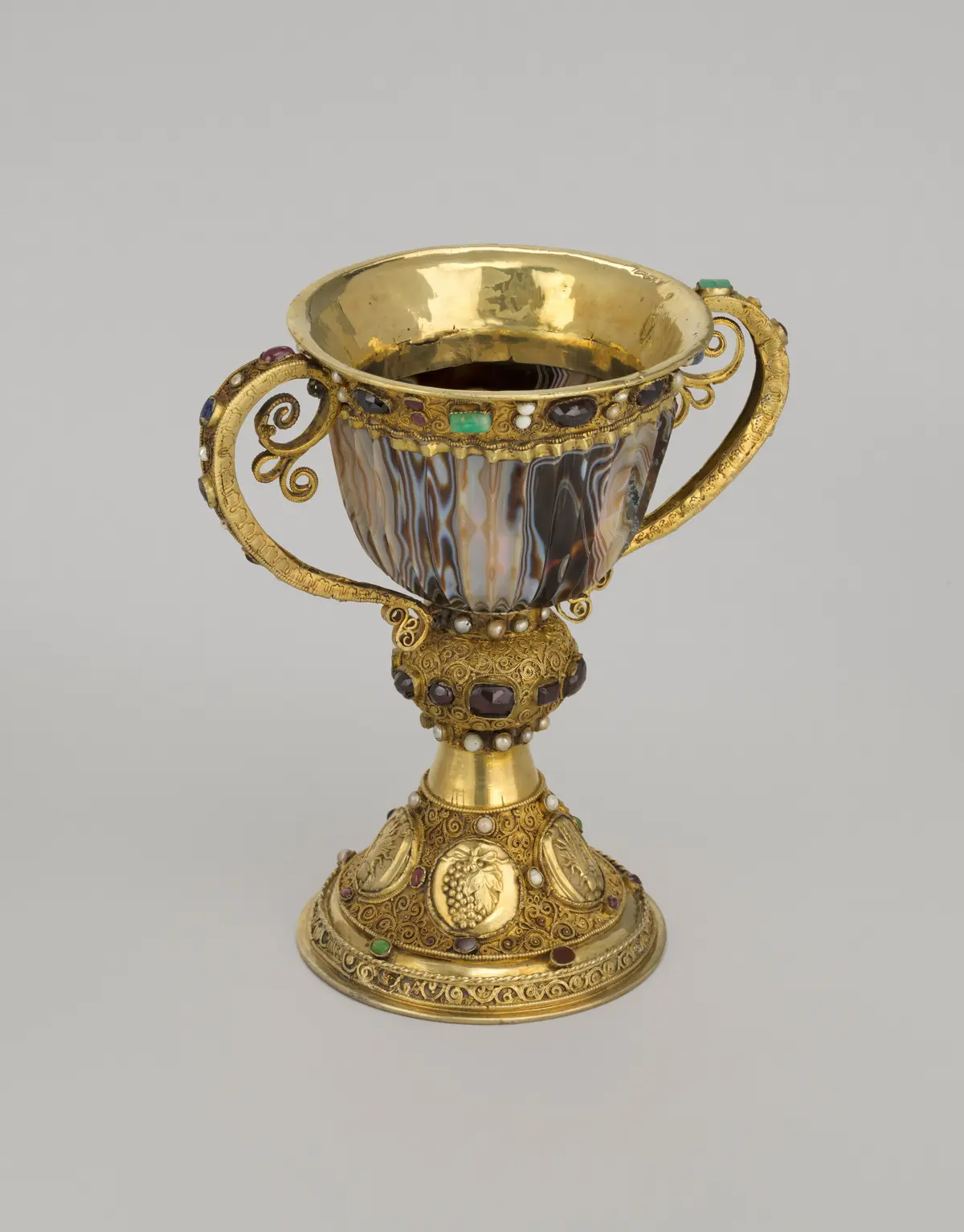
"Chalice of the Abbot Suger of Saint-Denis," 2nd–1st century B.C., from an Alexandrian artist with mounting added in France during the 12th century. A sardonyx cup with heavily gilded silver mounting, adorned with filigrees set with stones, pearls, glass insets, and opaque white glass pearls; 7 1/4 inches by 4 7/8 inches. National Gallery of Art, Washington. (Public Domain)
"Chalice of the Abbot Suger of Saint-Denis," 2nd–1st century B.C., from an Alexandrian artist with mounting added in France during the 12th century. A sardonyx cup with heavily gilded silver mounting, adorned with filigrees set with stones, pearls, glass insets, and opaque white glass pearls; 7 1/4 inches by 4 7/8 inches. National Gallery of Art, Washington. Public Domain
Suger’s belief that light is a divine essence and brings people closer to God, as exemplified in the building of Saint-Denis, is echoed in this 7-1/4-inch cup. Beautiful hard stones were also viewed as containing divine power. On the NGA’s audio tour, Alison Luchs, curator of early European sculpture, observes:

“When you look at this cup, you notice a wonderful sense of movement that pervades both the stone, the swirling, spiraling veining that winds its way over the surface and is broken up by the fluting and the spiral coils of wire that cover the surfaces of the goldsmith work.”

Its visual effect is enhanced by the high polish of the sardonyx.

Other precious items acquired by Suger for the abbey’s treasury that have survived are now part of the Louvre’s collection. The “Eleanor Vase” and “Sardonyx Ewer” are also composed of historic hard-stone vessels from other cultures with medieval metal mountings of exceptional quality. The shared characteristics of these three objects suggest that they were set in the same Parisian workshop.
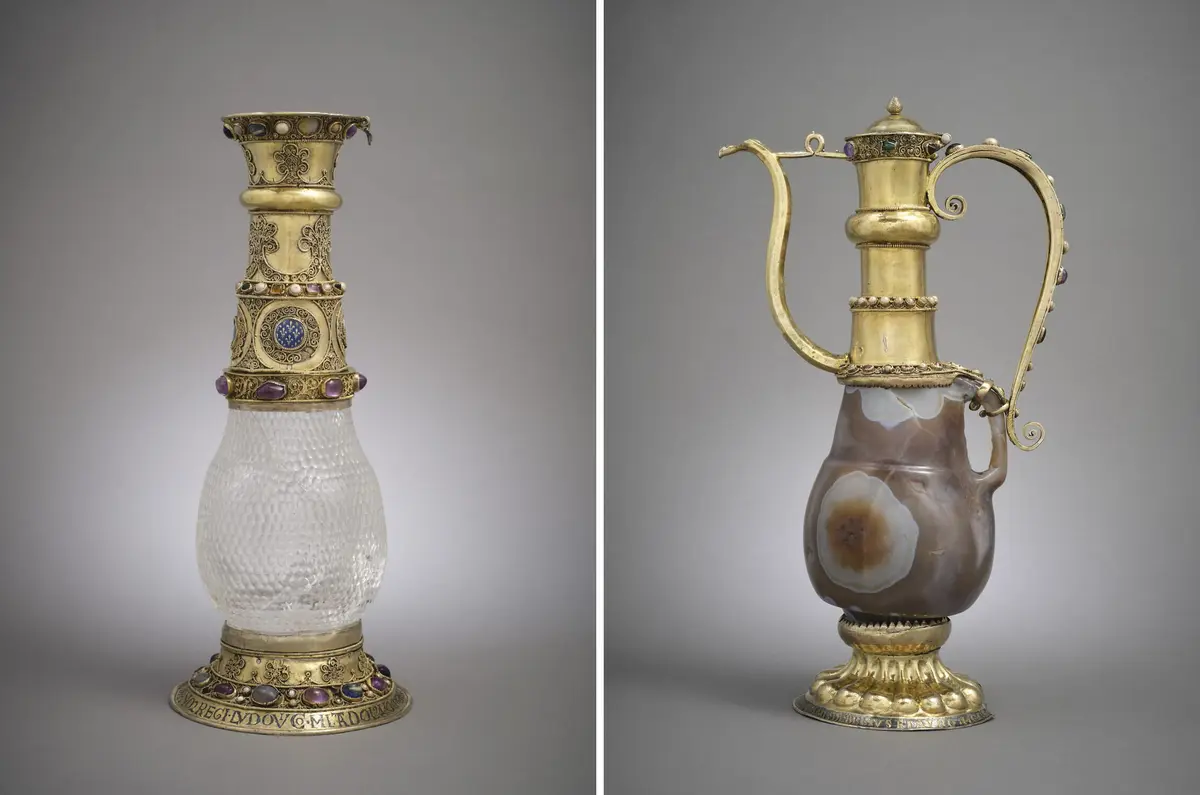
(Left) “Eleanor Vase,” 6th–7th century, from Persia. Gem and hard stone; 13 5/16 inches by 6 3/8 inches. (Right) “Sardonyx Ewer,” 6th century, from Persia. Gem and hard stone; 14 1/16 inches by 4 9/16 inches. Louvre Museum, Paris. (Thierry Ollivier/Louvre Museum)
(Left) “Eleanor Vase,” 6th–7th century, from Persia. Gem and hard stone; 13 5/16 inches by 6 3/8 inches. (Right) “Sardonyx Ewer,” 6th century, from Persia. Gem and hard stone; 14 1/16 inches by 4 9/16 inches. Louvre Museum, Paris. Thierry Ollivier/Louvre Museum

Rehoming the ‘Suger Chalice’

The “Chalice” is documented in both written inventories as well as works of art during its time at the abbey. An engraving from 1706 shows it grouped with other precious items from the Treasury of Saint-Denis. It remained in use at the abbey until 1791.

One of the engravings from the description of the Saint-Denis treasury by Michel Félibien, 1706. The “Chalice” is in the bottom row, second from the right. (<a title="User:Gérald Garitan" href="https://commons.wikimedia.org/wiki/File:Dom_F%C3%A9libien_1706_tr%C3%A9sor_de_St-Denis.jpg">Gérald Garitan</a>/ <a title="Category:CC-BY-SA-3.0" href="https://commons.wikimedia.org/wiki/Category:CC-BY-SA-3.0">CC-BY-SA-3.0</a>)
One of the engravings from the description of the Saint-Denis treasury by Michel Félibien, 1706. The “Chalice” is in the bottom row, second from the right. Gérald GaritanCC-BY-SA-3.0

It was removed during the French Revolution as a law was passed ordering the nationalization of the monastic orders. The “Chalice” was sent to the Cabinet National des Médailles et Antiques and put on public display.

One February night in 1804, during the Napoleonic Wars, it was stolen from the Cabinet National, along with other objects. The “Chalice” was smuggled out of the country in a plaster bust of an ancient sculpture and deposited in England.

In July of 1804, the thief sold the cup to the famed English collector Charles Townley (1737–1805). It seems that it remained with the Townley family until around 1920, when it was purchased by a London dealer. Shortly thereafter, it traveled to a New York gallery and was soon acquired by the Philadelphia-based collector Joseph E. Widener, one of the NGA’s most prolific benefactors.
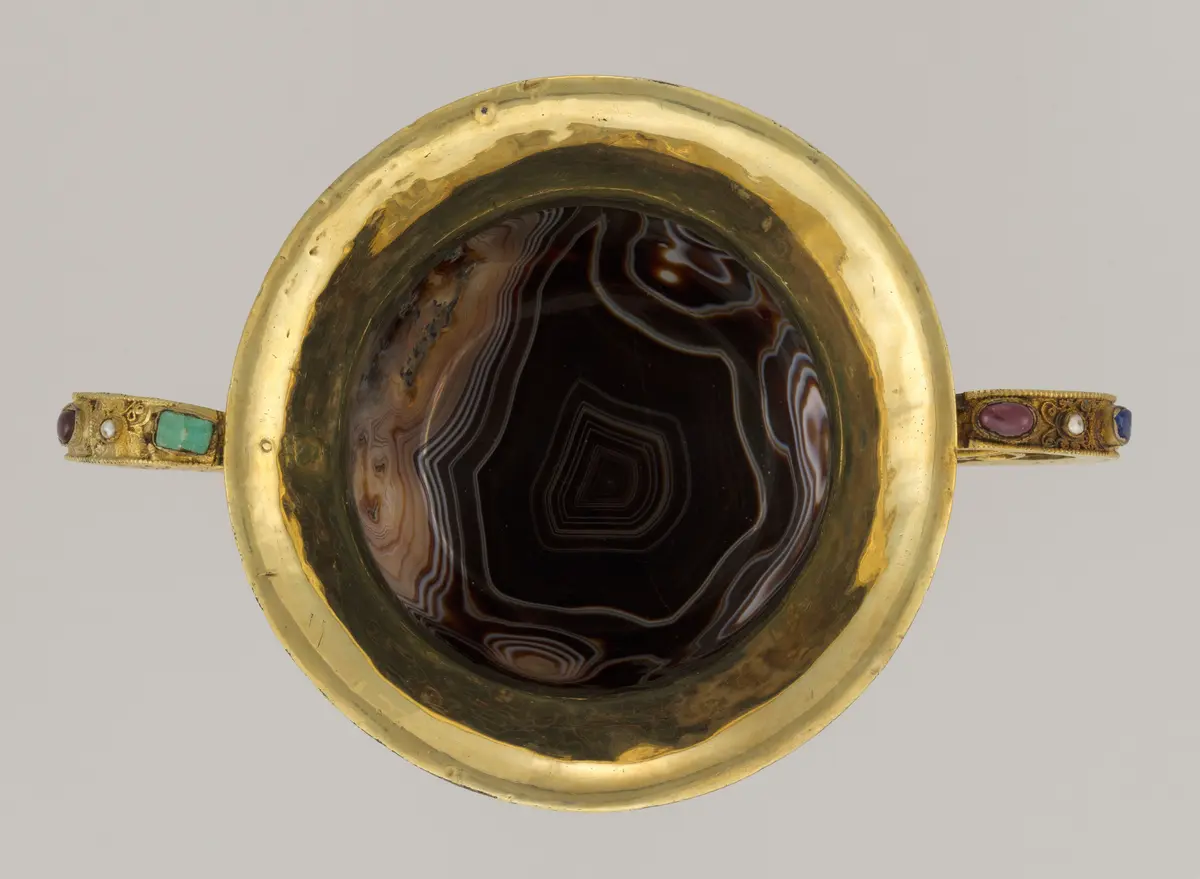
A view inside the "Chalice of the Abbot Suger of Saint-Denis," 2nd–1st century B.C. National Gallery of Art, Wahington. (Public Domain)
A view inside the "Chalice of the Abbot Suger of Saint-Denis," 2nd–1st century B.C. National Gallery of Art, Wahington. Public Domain
In 1942, the “Chalice” entered the NGA’s collection as a bequest from Widener. In a 2025 scholarly article for the NGA’s biennial journal Fracture, conservator Dylan Smith and research professor Therese Martin wrote an in-depth technical analysis of the “Chalice.” They conclude that “the ’Suger Chalice’ can be understood as a convergence of precious materials obtained through the artistic skill, technical knowledge, and physical labor of a global community.”

Although some modifications have been made to it over the centuries, including the replacement of some gems, medallions, and the handles, the “Chalice” is remarkably intact given its age and history. It is as precious and wondrous as when it was first created.

What arts and culture topics would you like us to cover? Please email ideas or feedback to [email protected].
Google LogoMark Us Preferred on Google
Michelle Plastrik
Michelle Plastrik
Author
Michelle Plastrik is an art adviser living in New York City. She writes on a range of topics, including art history, the art market, museums, art fairs, and special exhibitions.