This copy is for your personal, non-commercial use only. Distribution and use of this material are governed by our Subscriber Agreement and by copyright law. For non-personal use or to order multiple copies, please contact The Epoch Times Reprints.
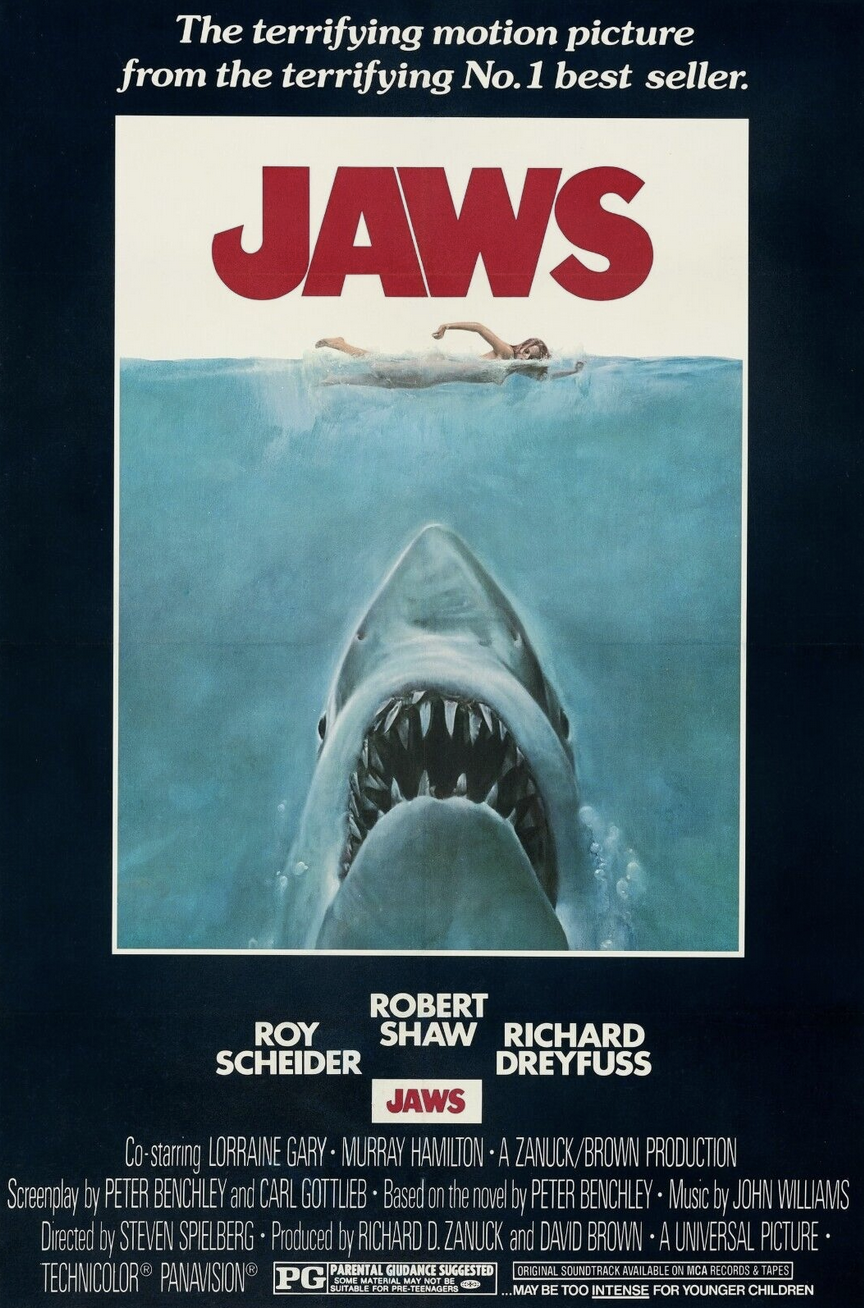
‘Jaws’: 50th Anniversary and Birth of the Summer Blockbuster
Blockbuster firecrackers used to blow kids’ hands off. Then along came ‘Jaws,’ hijacked the name from fireworks, and transplanted it into showbiz forever.
It’s the 50th anniversary of “Jaws,” Steven Spielberg’s ground-zero, great white shark blockbuster. In 1975, America was only familiar with the term “blockbuster” as it pertained to carloads of New England teenage big brothers road-tripping below the Mason-Dixon line during the last weeks of June. They'd arrive back home in time for the 4th of July, hauling loads of illegal fireworks.
Illicit firecrackers were basically a fun, mild form of drug-dealing for suburban boys back in the day—kid brothers would say, “Get me a brick of Black Cats, and twenty M-80’s!” They'd sell them to their buddies. An M-80 was a dangerous, eighth-of-a-stick of dynamite (my gradeschool friend Joe blew his left eye out with one) and a blockbuster was a potentially lethal quarter-stick—roughly a third of the size of a soda can.
On swampy, moonless, firefly nights, there'd come an ground-shaking, window-rattling thunderclap—“BAMMM!!!” and boys would look at each other, nod knowingly, and say, “definitely a blockbuster.” Everyone knew of some kid who had blown his fingers clean off detonating one of those bad boys with a too-short fuse. Blockbusters blew whole hands off too.
Then along came “Jaws” and hijacked the name “blockbuster” from the world of fireworks, and transplanted it into cinematic showbiz forever.
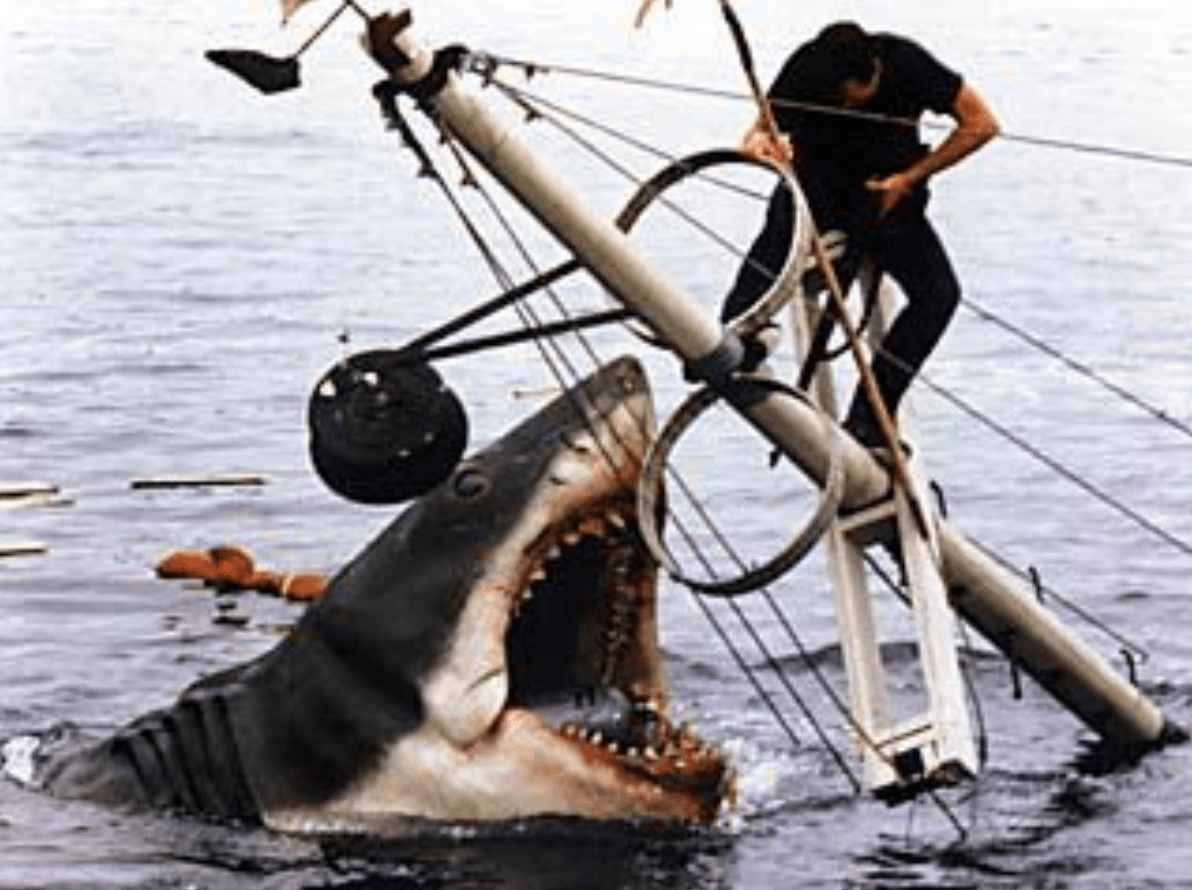
Police chief Brody (Roy Scheider) goes up against the beast, in "Jaws." Universal Pictures
Like blown-off hands and fingers, the movie version blew fans away with fear and excitement, which then blew the roof off the box office. “Jaws” was the first movie to reach the coveted $100 million mark in theatrical rentals in the United States and Canada (the practice of renting out a theater space for a specific period, often for performances, events, or film screenings), which is about 45 percent of the box office gross. It was the highest-grossing U.S. film of all-time.
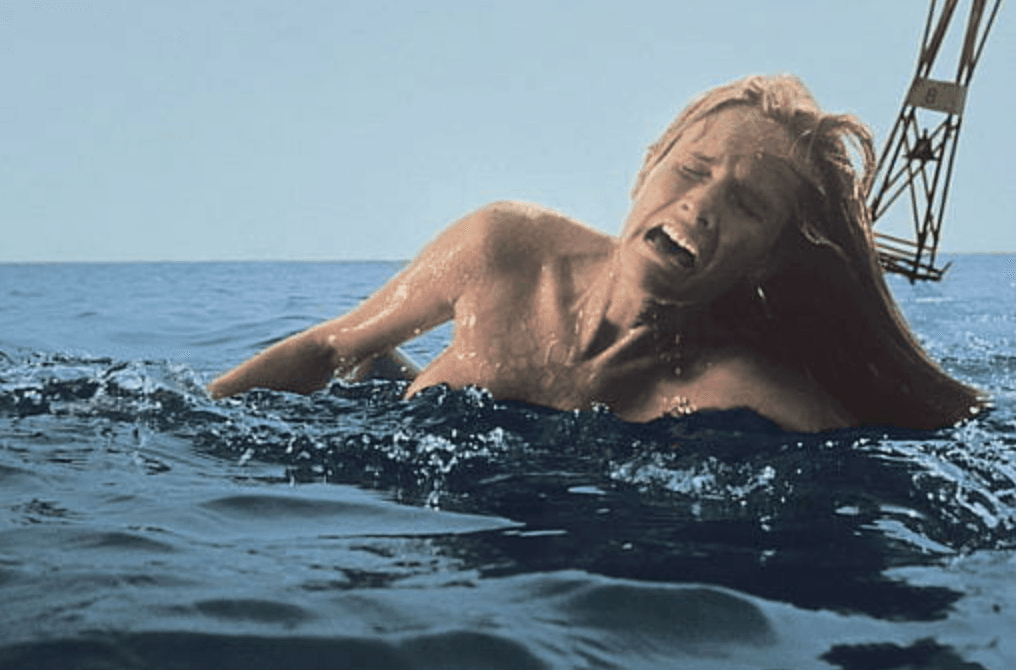
Chrissie Watkins (Susan Backlinie) in a lethal encounter with a great white shark, in "Jaws." Universal Pictures
“Jaws” is the simple tale of a massive killer great white terrorizing a small beach-resort island community (it was shot in Martha’s Vineyard). Since the advent of the internet, the general public’s knowledge of zoology has skyrocketed, but in 1975, few people had ever had themselves a good gander at the full-on, nightmare-causing horror show that is the gaping maw of a 20-foot great white shark. We’re all a bit desensitized now, but back then, that triangular-toothed image—in one fell swoop—ruined the beach-going pleasure of Americans (including the author) for the rest of their natural-born days.
The New England town of Amity Island is dependent on a summer tourist trade. So when a young woman becomes a great white’s midnight snack, new police chief Martin Brody (Roy Scheider) moves to close the beaches. However, mayor Larry Vaughn (Murray Hamilton) overrules him, fearing that the loss of tourist revenue will cripple the town.
After a few more attacks, however, including one on July 4th, the mayor eventually agrees to shut down the beaches. He offers grizzled ship captain Quint (Robert Shaw) a large sum of money to help chief Brody (who’s terrified of water) hunt and kill the marauding beast.
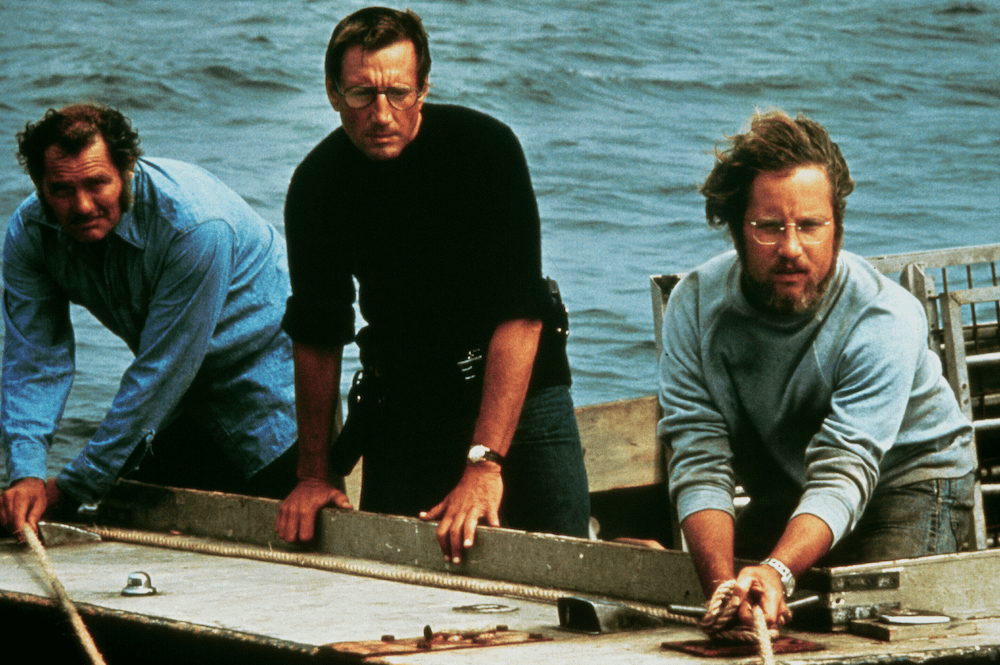
Marine biologist and ichthyologist Matt Hooper (Richard Dreyfuss, fresh off the huge success of “American Grafitti“) offers to help Brody, believing his sharkspertise can give them the edge they clearly need. The three men enter into an epic battle with a natural monster that’s scarier than anything monster-movie directors have concocted, to scare audiences with, ever since. The alien was terrifying too, of course, but I’m talking about an actual animal from planet Earth.
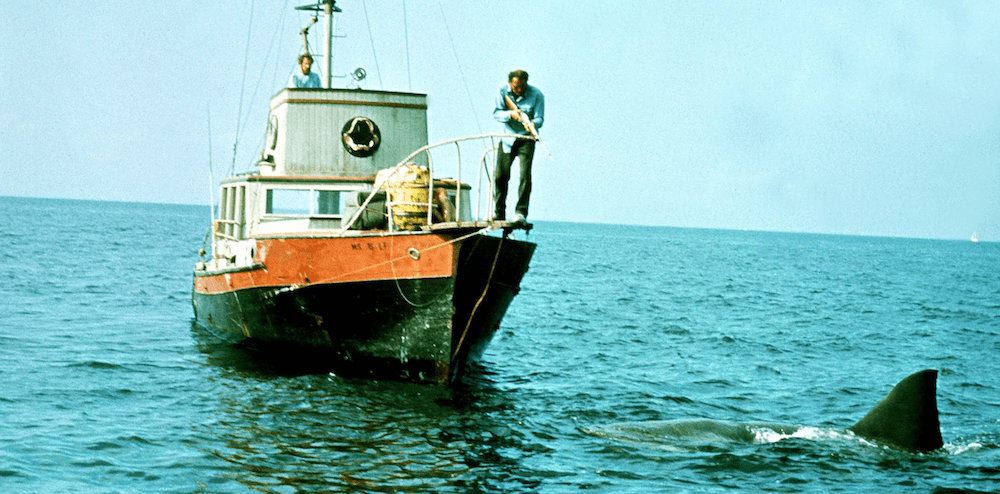
(L–R) Quint (Robert Shaw), Brody (Roy Scheider), and Hooper (Richard Dreyfuss) go shark fishing, in "Jaws." Universal Pictures
Quint and Hooper have a competitive, tension-filled rivalry. Though Hooper studied sharks in college, Quint sees him as an inexperienced college kid who knows nothing about the actual, gargantuan prehistoric fish. This dynamic keeps the movie’s tension high.
Why ‘Jaws’ Still Works
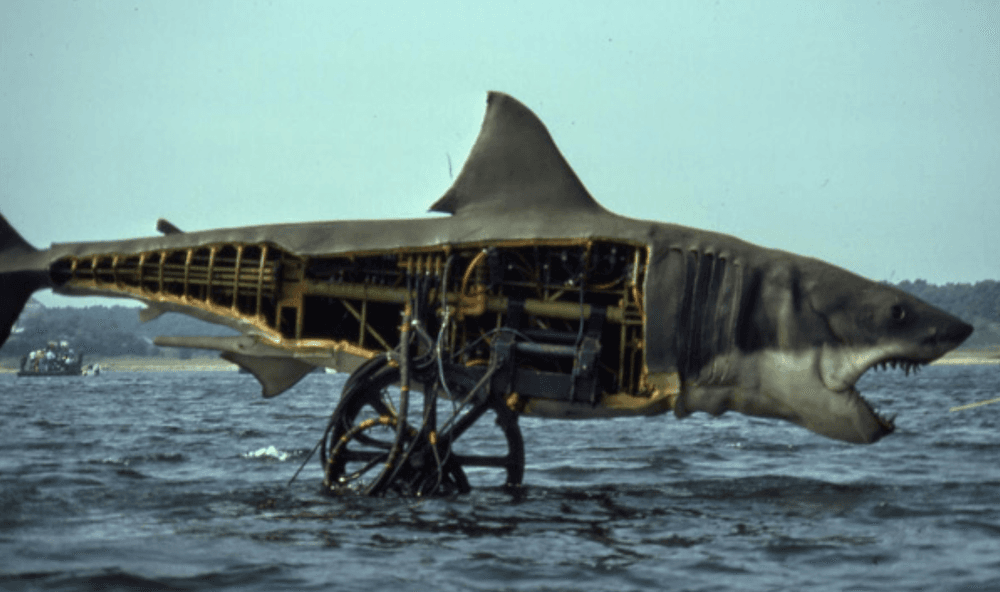
Bruce, the animatronic great white shark—very cutting edge in his day. Edith Blake/Getty Images
Obviously, the film’s animatronic rubber shark, dubbed Bruce, while cutting-edge at the time, is now rather laughable. Then again—some of these older special effects are superior to quite a bit of the current bad CGI plaguing many modern monster movies. “Jaws,” along with 1973’s “The Exorcist”—with its similar low-tech yet blood-curdling special effects—remain two of the scariest movies of all time.
“Jaws” is still immensely entertaining and thrilling. It works in part due to its tight narrative structure, which follows Henri-Georges Clouzot’s 1953 film, “The Wages of Fear,” which Steven Spielberg followed and then recycled for his other historic blockbuster, 1993’s “Jurassic Park.”
Swimmers flee the ocean in droves when a boy is killed, in "Jaws." Universal Pictures
Both “Jaws” and “Jurassic Park” take their time to introduce the characters and set up the problem in the first half. Showing the monsters too early ruins the suspense. In “Jaws,” we don’t get a good look at Bruce for an extended period. The same goes for the T-rex in “Jurassic Park.” It’s the now-iconic, two-note, foreboding John Williams score that generates the horror of that 6-foot, cold-blooded murder-fish; we know it’s lurking nearby, ready to chomp off a limb at a moment’s notice. Yes, you read that right. Six feet. Six feet in DIAMETER, that is.
Spielberg
“Jaws” launched Steven Spielberg’s career, and while it established various Spielberg-ian craft trademarks, it also revealed a young director learning and testing his craft. He flies in the face of Hitchcock’s famous dictum: You can’t kill children onscreen. Spielberg literally goes straight for the jugular, showing a shark-devoured kid via an eruption of crimson seawater, followed by two massive pectoral fins flopping over in a languorous barrel roll.
I’ve often thought it was that particular scene that led directly to me missing half a century of ocean swims, but it was really the severed leg drifting lazily to the sea channel floor that put the nail in the coffin of my seagoing enjoyment. I should feel resentment. Instead, I feel ... grateful? I’m very conflicted.
I‘d actually forgotten all about “Jaws” syndrome and delightedly swam out in the ocean a fair distance off an island in Panama about 15 years ago. When I suddenly realized I’d passed the drop-off point, the bottom had fallen away, and there was nothing but blue-black ocean underneath me, my mind suddenly heard, “Dun-dun, dun-dun, dun-dun, DUN-DUN!!” and I set a flailing, unofficial new freestyle world record back to the beach. Michael Phelps had nothing on me. I also remembered the tagline from “Jaws 2”: “Just when you thought it was safe to go back in the water.“
Spielberg better hope that karma isn’t actually a thing. “Jaws” demonized this wild animal for decades. Now known as “The Jaws Effect,” “Jaws” popularized the image of sharks as relentless killing machines, which contributed to an increase in recreational and commercial shark fishing. This contributed to a significant decline in shark populations globally. Some studies estimate a 71 percent decline in shark and ray populations since 1975.
Not everyone was affected, of course. An active-duty Navy SEAL once told me he’s able to swim 60 feet down in the pitch-black ocean in the great white breeding grounds off San Clemente Island, and it doesn’t phase him one bit. Navy SEAL. Enough said. Thank you for your service, sir.
Great whites, in fact, actually aren’t interested in humans. They fancy seals, not SEALs. Great whites are highly intelligent creatures and athletic apex predators. They need challenges—they need to do “Air Jaws” every once in a while. They weigh up to 5,000 pounds but can still breach 15 feet in the air to catch escaping seals. If put in captivity, these sharks get depressed and die.
Do they make good pets? Well, a fisherman once saved the life of a large female great white caught in a fishing net. Now, whenever he’s in his boat, she immediately knows (great whites have highly sensitive, specialized organs on their snouts called the ampullae of Lorenzini that can detect weak electrical fields in the water) and swims over to thank him. She rears her big scary head out of the water, with her rows of 3-inch Ginsu knife teeth and dead black eyes, and he gives her snout-rubs. “Goo' girl!” Just a big ol' marine pupper. All God’s creatures.
Quint (Robert Shaw) fires on the beast, in "Jaws." Universal Pictures
That said, from iconic scenes like the first drunken midnight swim to Robert Shaw’s brilliantly delivered horror-dripping monologue about the notorious (and historically true) USS Indianapolis shark attacks, and the first full-on appearance of the shark, followed by the famous quote, “You’re gonna need a bigger boat,” “Jaws” is the ultimate monster movie classic and American cinematic history writ large.
‘Jaws’
Director: Steven Spielberg
Starring: Roy Scheider, Robert Shaw, Richard Dreyfuss
MPAA rating: PG
Running Time: 2 hours, 4 minutes
Release Date: June 20, 2025
Rating: 5 stars out of 5
Would you like to see other kinds of arts and culture articles? Please email us your story ideas or feedback at [email protected]
Mark Jackson is the senior film critic for The Epoch Times and a Rotten Tomatoes-approved critic. Mark earned a bachelor's degree in philosophy from Williams College, followed by classical theater conservatory training, and has 20 years' experience as a New York professional actor. He narrated The Epoch Times audiobook "How the Specter of Communism Is Ruling Our World," available on iTunes, Audible, and YouTube. Mark is featured in the book "How to Be a Film Critic in Five Easy Lessons" by Christopher K. Brooks. In addition to films, he enjoys Harley-Davidsons, rock-climbing, qigong, martial arts, and human rights activism.