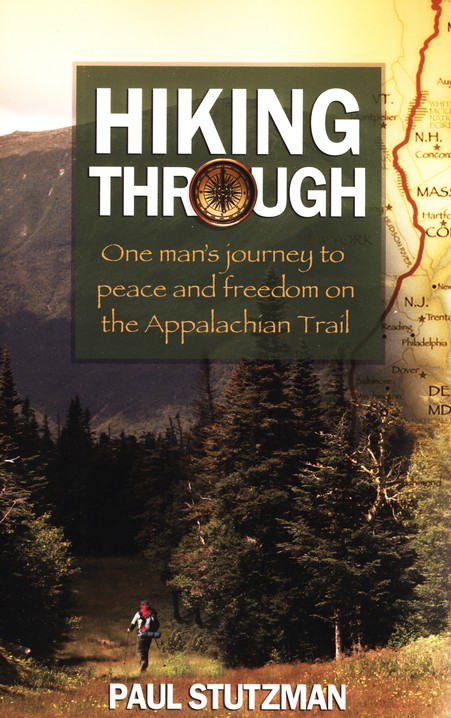
Hiking through the Appalachian Trail (A.T.) northbound from Georgia to Maine is no easy task. The five-to-six-month journey up steep ascents, through vast valleys, lively rivers, and deep bogs requires preparation, stamina, and mind-numbing perseverance.
For a myriad of reasons, each committed northbound hiker enters the trail at Springer Mountain and stays the course until they reach Mt. Katahdin.
“Hiking Through” author Paul Stutzman stepped onto the A.T. in March 2008, after his wife died from breast cancer. He resigned his position as a restaurant manager with a plan: “I would use the walk to deliver a message to men: ‘Don’t take your spouse and family for granted. Enjoy today fully. Don’t assume you have tomorrow to tell your loved ones what they mean to you.”
In Chapter 2, titled “The Plan,” he further shared, “I would deliver the message whenever I could. But I had no way of knowing that on the trail God would deliver an even greater message to me.”
Stutzman referred to the A.T. journey as “The Narrow Path” or “The Narrow Way,” referencing Matthew 7:14 that says, “Small is the gate and narrow the road that leads to life, and only a few find it.” In Chapter 3, he explained: “If you are ever one of these solitary Appalachian Trail thru-hikers and you somehow survive 300 daunting mountains, precarious river crossings, difficult rock climbs, discouraging illnesses and loneliness, and punishing weather, and you stand at last at the summit of mighty Mt. Katahdin, then you will indeed know what it is to be one of those chosen few.”
Stutzman didn’t just describe the practicalities of the trail, he shared with readers his trail name: Apostle. This designation was “not only because my name [is] Paul,” he wrote, “but because the definition of apostle is ‘one sent forth on a special mission.’” He introduced many other hikers along the way by their trail names: Lion King, Marathon Man, and Sailor.

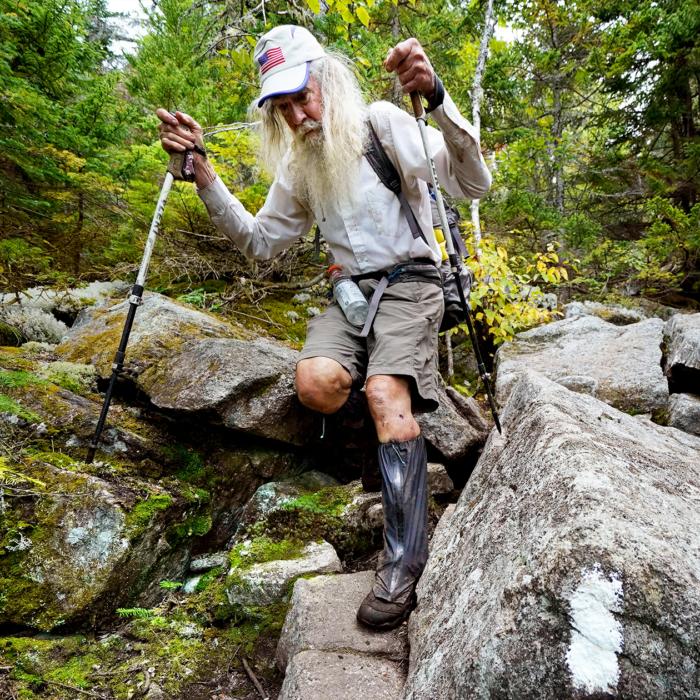
The book also provides humor through Stutzman’s everyday insights. For example, he named his tent “Big Agnes,” and he laments or praises its construction, depending on the day’s circumstances.
Stutzman wrote about milestones on the A.T., such as when he finished the first 100 miles. He wrote about all the moments on the trail that reminded him of his wife, such as seeing butterflies. He wrote about the lure of high-calorie foods, when he exited the A.T. at “trail towns” in order to resupply. He also tossed in historical tidbits that are significant along the trail.
Yet, the farther he traversed, the more he focused on cherishing the life God has provided him, despite the loss of his spouse. He wrote: “I started a habit that stayed with me all the way to Mt. Katahdin. When I slipped or stumbled, but recovered without falling or twisting my ankle or breaking a limb, I heard myself say aloud, ‘Thank you, God.’”
The more he overcame adversity, the clearer his surroundings became. By the time he neared his destination, his appreciation of God’s creation was central. In one of the later chapters, he offered: “Nature worshipped that morning. ... I remembered Psalm 96 talking about the trees singing for joy and Isaiah 55 speaking of the mountains and hills bursting into song and clapping their hands.”
“I encountered God through an emotional conversation that left me weeping face down on the ground and changed my life’s journey.”
Spoiler alert: Stutzman made it to Mt. Katahdin, after having completed Thoreau Spring (one mile from the A.T. finish line), “named for Henry David Thoreau, who explored Mt. Katahdin in 1846 and wrote a book called, ‘The Maine Woods.’”
His first stop after exiting the A.T. was to his wife’s gravesite, where he expressed his accomplishment.
The Bible quote comes from the New International Version.