This copy is for your personal, non-commercial use only. Distribution and use of this material are governed by our Subscriber Agreement and by copyright law. For non-personal use or to order multiple copies, please contact The Epoch Times Reprints.
Church of the Holy Sepulchre: The Holiest Christian Site
In this installment of ‘Larger Than Life: Architecture Through the Ages,’ we visit a 4th-century Jerusalem church that has survived centuries of conflict.
The Christian Quarter, built around the Church of the Holy Sepulchre, is one of the four quarters in the walled Old City of Jerusalem. LALS STOCK/Shutterstock
Nestled in the narrow streets of the Old City of Jerusalem is the monumentally important Church of the Holy Sepulchre, the most sacred Christian complex. The church is believed to be on the specific site of Golgotha, also known as Calvary, where Jesus Christ’s crucifixion and resurrection occurred.
The original ecclesiastical construction, built by Emperor Constantine, was consecrated in 335. In the nearly 1,700 years since, much of its architecture has sustained damage from conquest, pillaging, earthquakes, and fire, necessitating repeated reconstruction. Today, architecture that showcases Roman-Byzantine, medieval Romanesque, 19th-century, and modern-day influences can be seen.
The interior consists of an array of chapels, courtyards, domes, altars, and a crypt that covers about 1 1/4 acres. Reaching 112 feet tall, the rotunda is the church’s highest point.
Uniquely, six Christian denominations share the space: Greek Orthodox, Latin (Roman Catholic Franciscans), Armenian Apostolic, Syrian Orthodox, Coptic Orthodox, and Ethiopian Orthodox. The first three groups are the most powerful and thus have the most allocated space. There have been long-standing conflicts between all of the sects over ownership rights, and some parts of the church are still contested.
Their tenuous coexistence is made possible by the Status Quo. The Status Quo is a set of historic rules and laws set out by the Ottoman Empire governing relations between the communities. The three principal orders are bound to unanimous agreements on a host of issues affecting shared spaces, from scheduling the opening of the church’s door to undertaking much-needed repairs.
Today, the Church of the Holy Sepulchre welcomes millions of pilgrims each year. Ongoing archaeological excavations uncover new and exciting insights about the site’s history, while continuing restoration endeavors to preserve the complex for future millennia.
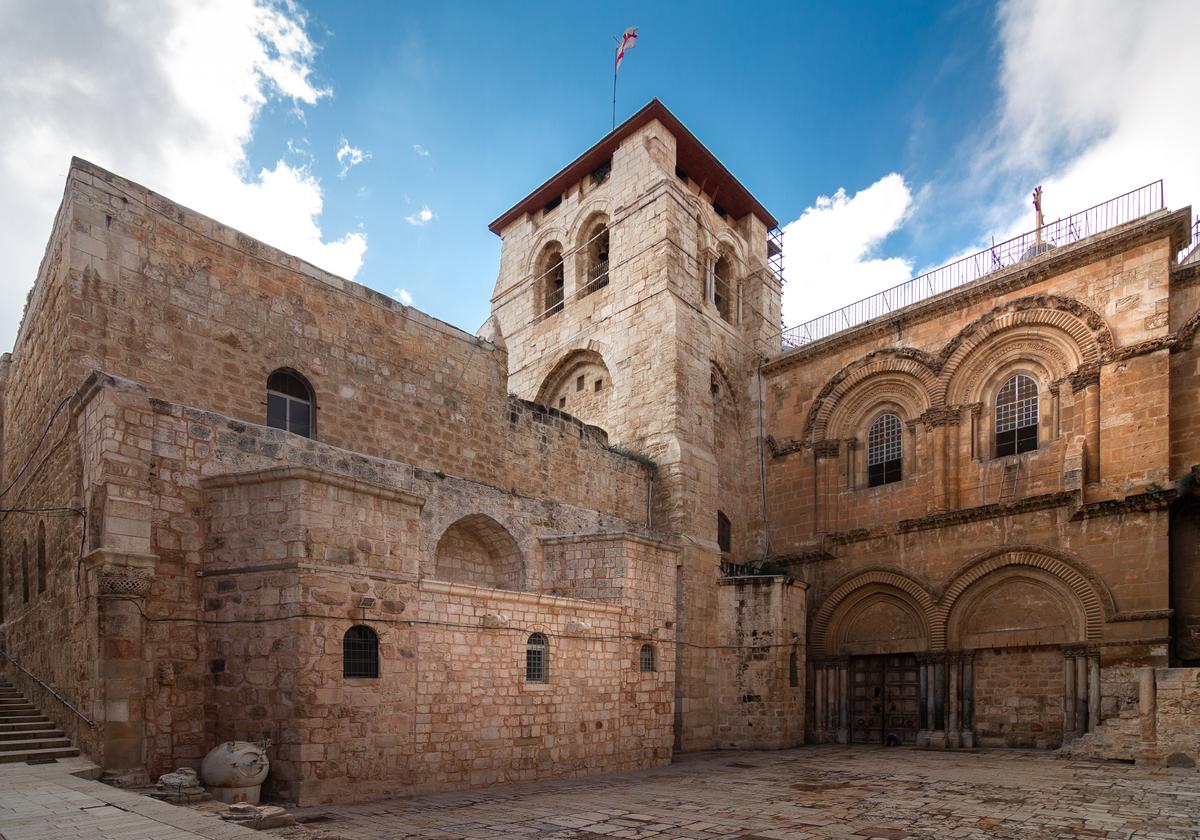
The parvis, or enclosed courtyard, leads to the church’s Crusader-era entrance. An exterior example of one of the Status Quo's rules is the small “Immovable Ladder” that has been on a ledge under a window (R) since at least the 18th century. Jurisdiction is unclear, so it cannot be touched. Descendants from two Muslim families have been keepers of the door and its key since the 12th century to prevent Christian infighting over access. Roofsoldier/Shutterstock
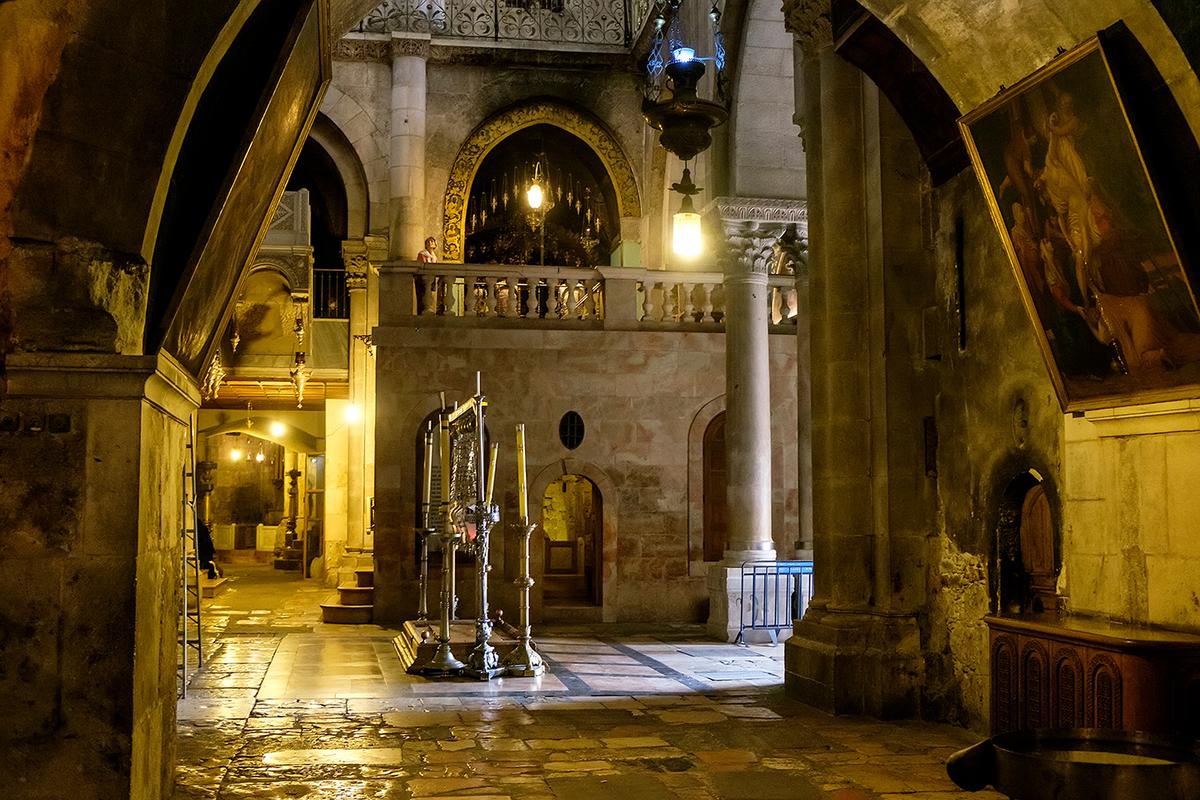
The Stone of the Anointing is visible directly upon entering the church. Highly venerated by the Orthodox and adorned with standing candlesticks and a row of eight lamps, this reddish slab commemorates the anointing of the body of Jesus by Nicodemus and Joseph of Arimathea. The first recorded mention of it in the complex was by a pilgrim in 1288. paparazzza/Shutterstock
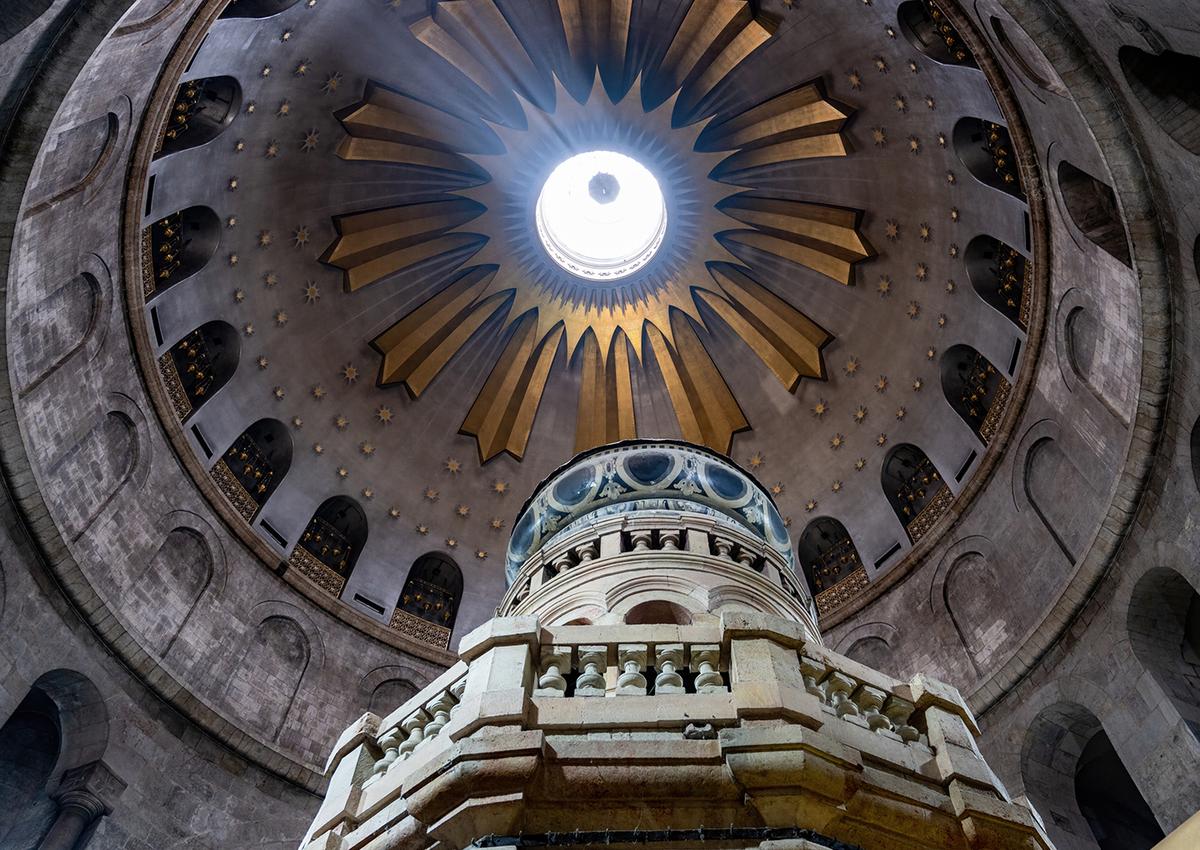
The rotunda (known also as anastasis, Greek for “resurrection”) reflects the original Constantinian basilica design with its alternating pillars, column groups, and sizable windows. The larger of the church’s two domes, it is among the best-preserved areas. The dome is decorated with a starburst of 12 tongues of light. These rays represent the apostles. The small structure within the rotunda’s center is the Edicule, where it is believed that Jesus lay buried for three days before his resurrection. Israfoto/Shutterstock
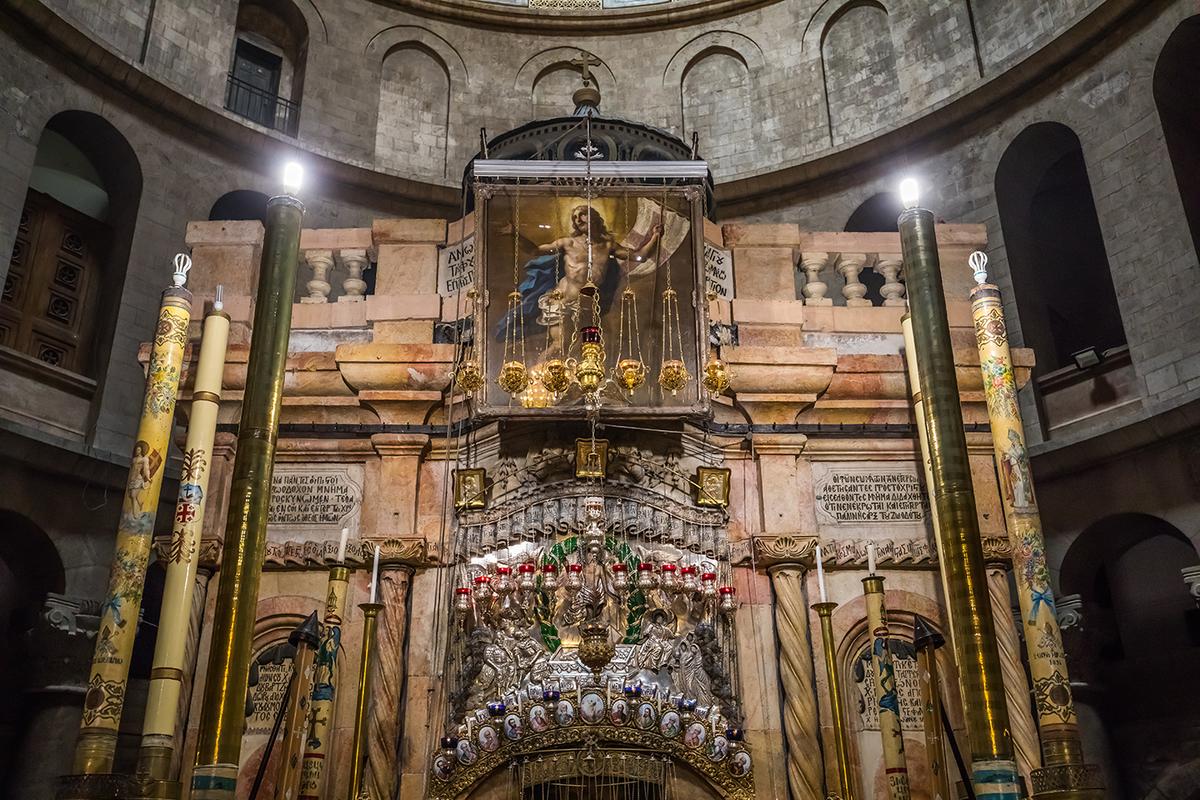
The Edicule (“little house”) encloses the Chapel of the Angel and Christ’s burial chamber. Destroyed and rebuilt four times, the current edifice with an onion-shaped cupola (above the painting of Christ) was constructed in the Ottoman baroque style by the Greek Orthodox community in 1810. It is shared by the orders, and in 2016, they finally agreed on an urgent restoration plan. maziarz/Shutterstock
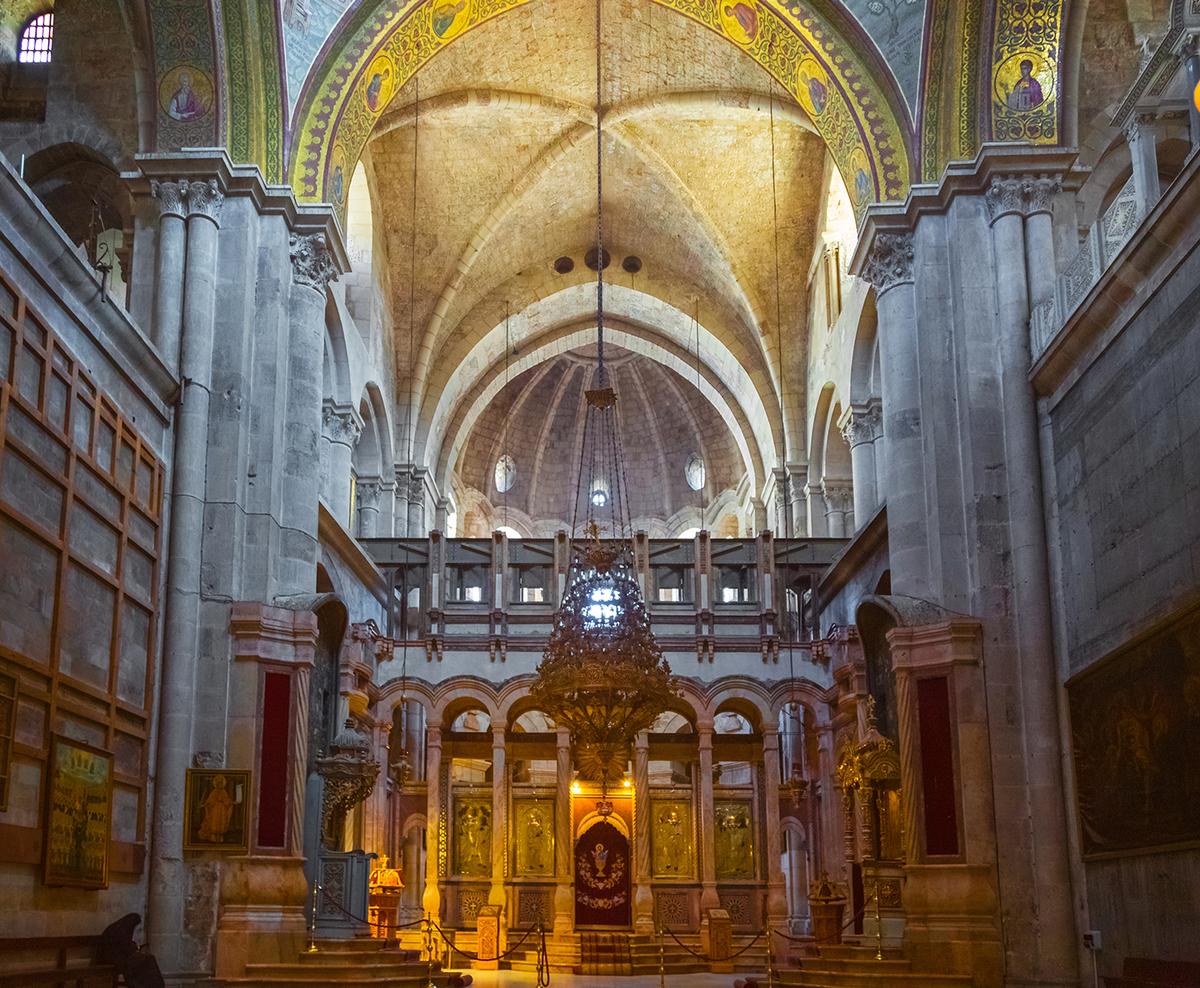
The Greek Orthodox Church controls the Katholikon, the space in front of the Edicule. At the Katholikon's rear is the iconostasis, a partition of icons dividing the altar from the nave featuring red marble arches and columns. Behind the iconostasis is the extant ribbed-vaulted, Crusader-era apse. In the 1960s, excavations beneath the Katholikon’s floor revealed the apse from Constantine’s original building near this spot. Natalia Tretiakova/Shutterstock
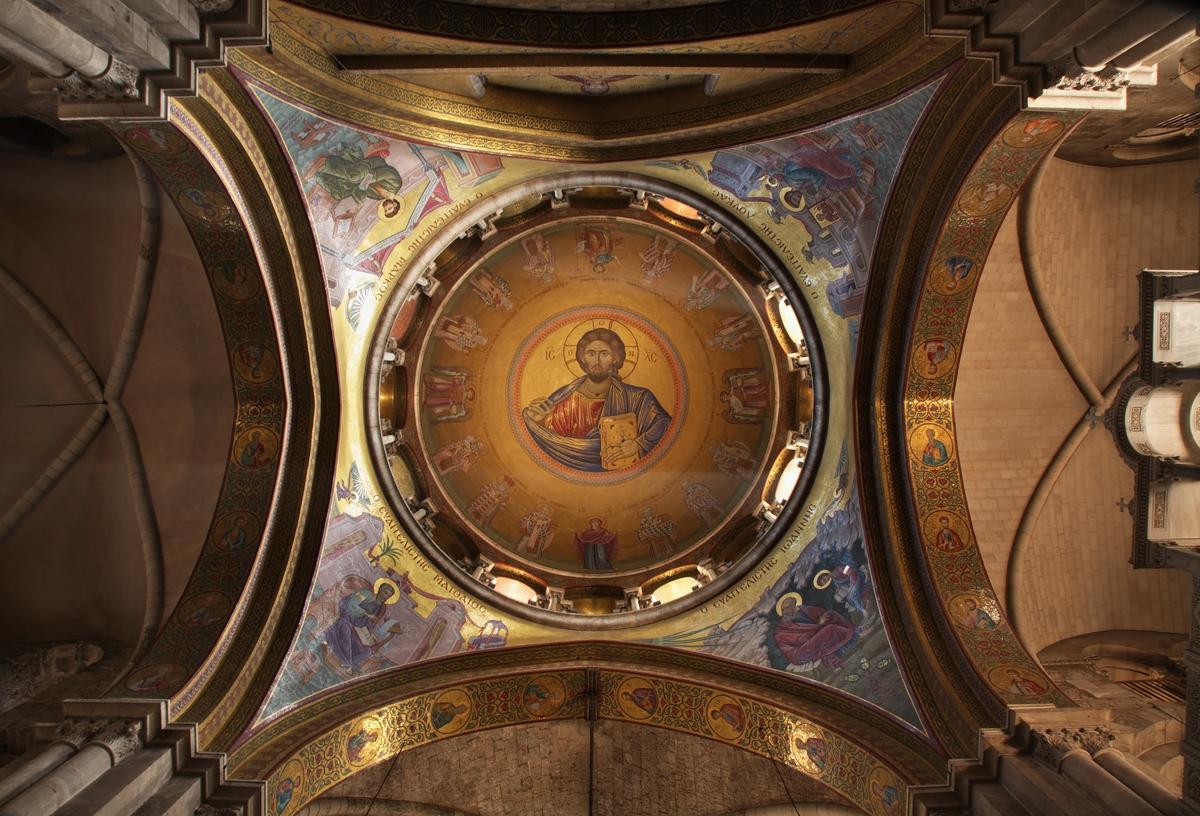
The dome of the Katholikon is decorated with a modern Byzantine-style mosaic of Christ Pantocrator, translated as “All-Powerful” or “the Ruler of All.” This iconography is prevalent in the art of Eastern Christianity. Here, Christ is shown surrounded by Jerusalem’s bishops and patriarchs. The art is supported by arches joined with pendentives (triangular segments that support a dome) to Crusader-era columns. Shevchenko Andrey/Shutterstock
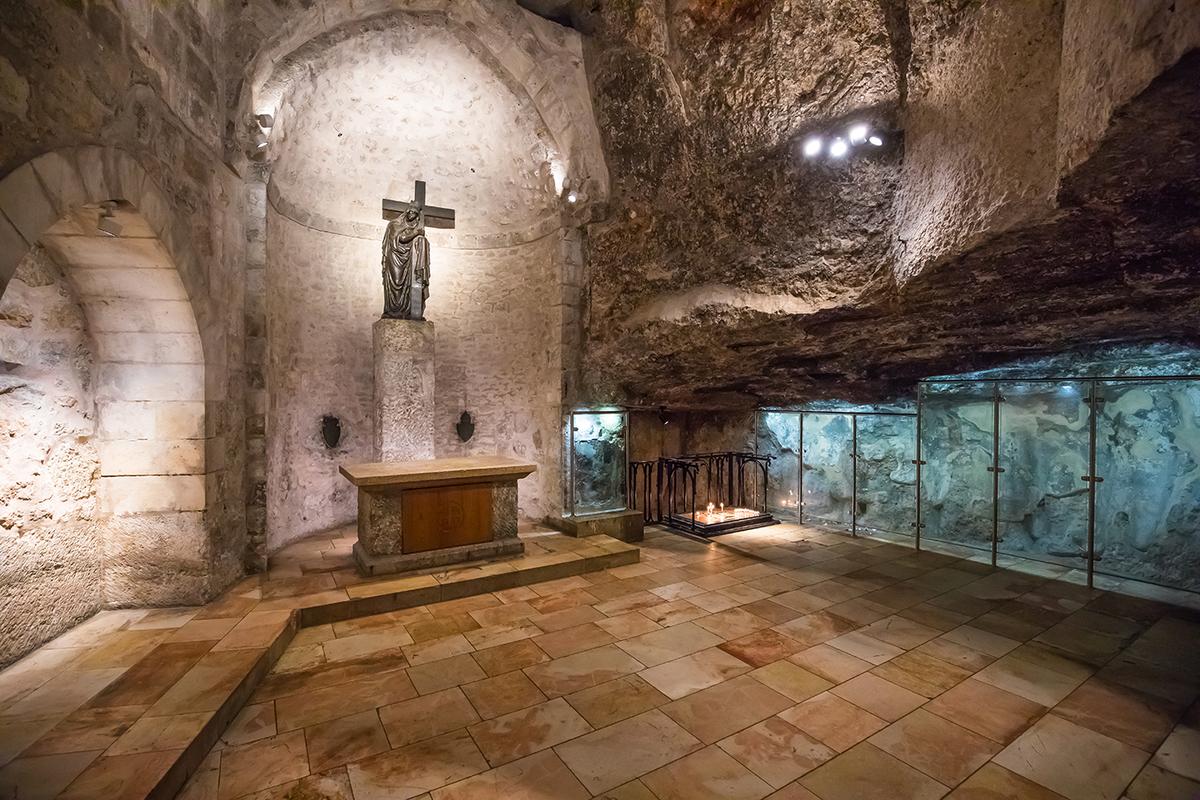
One descends a steep staircase of 22 steps from the Armenian Chapel of St. Helena to reach the Chapel of the Finding of the Cross. The lowest point of the entire church, the chapel is within an ancient limestone quarry that later became a cistern, or waterproof receptacle for water storage. According to tradition, this was where Empress Helena, mother of Constantine, discovered the True Cross. The space features faint traces of 12th-century frescos. maziarz/Shuterstock
What arts and culture topics would you like us to cover? Please email ideas or feedback to [email protected].
Michelle Plastrik is an art adviser living in New York City. She writes on a range of topics, including art history, the art market, museums, art fairs, and special exhibitions.