The oldest city in the United States, St. Augustine, Florida, was founded in 1565 and grew up around the country’s oldest masonry fortification: Castillo de San Marcos. While other wooden fortifications preceded Castillo de San Marcos, the surviving 17th-century fortification is what motivated the true growth of the Atlantic-coast city.
After a 1668 raid by the English pirate Robert Searle destroyed much of St. Augustine, the governor of Spanish Florida, Francisco de la Guerra y de la Vega, ordered a new fort be built—not of wood but of coquina, which is a type of rock made of millions of compressed seashells. This uniquely Floridian material proved highly durable, absorbing the bombardment of cannon balls. Adding to the fort’s sturdiness was the mortar, which was made of oyster shells heated in kilns. The entire fort was coated in a lime stucco, made of sand, water, and lime.
Once the area became better protected, businesses, a school, and houses sprung up. According to City of St. Augustine, “Throughout the modern city and within its Historic Colonial District, there remain 36 buildings of colonial origin and another 40 that are reconstructed models of colonial buildings.”
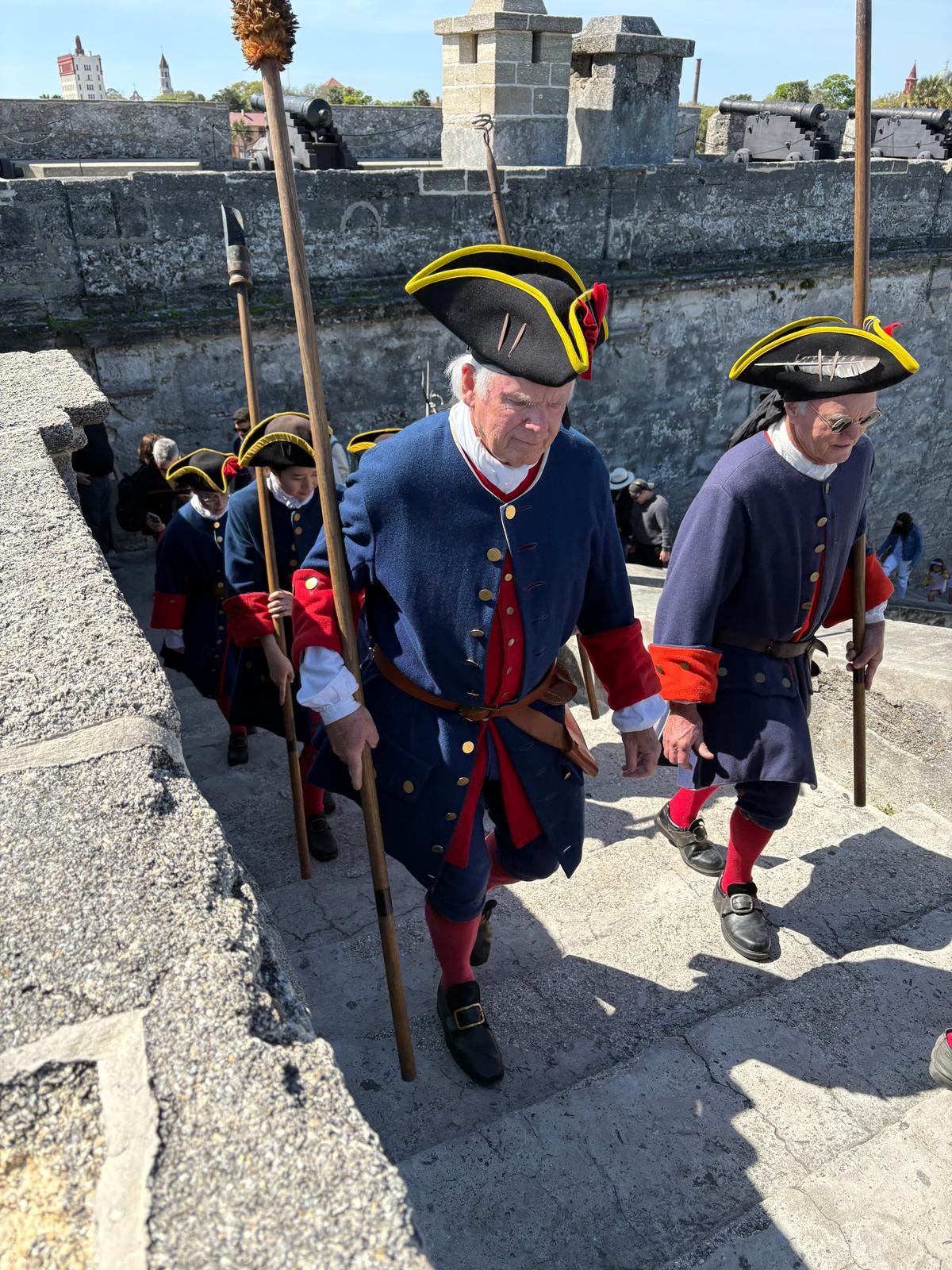
Reenactments are common in St. Augustine's historical district; visitors can learn about America's oldest town from history-loving volunteers. Deena Bouknight
Changing Hands—and Names
What started out as a Spanish fort fell under British control in the 18th century. The name was changed to Fort St. Mark, honoring one of the writers of the Gospels. Yet, the Spaniards took back their architectural masterpiece in 1783, and its name reverted to the original.Spain remained in control of the fort until the United States purchased Florida in 1821; the fort was renamed Fort Marion to honor Francis Marion, a Revolutionary War hero from South Carolina. During the Civil War, the fort housed Confederate troops. In 1898, the year of the Spanish-American War, it served as a military prison.
Finally, the fort was declared a national monument in the 1920s. In 1933, after over 250 years as a continuous military structure, it was deactivated. Congress restored the fort’s original Spanish name in 1942, and ever since Castillo de San Marcos has been under the protection, preservation, and management of the National Park Service.
Made to Last
Next to one of St. Augustine’s busy streets and shopping and dining areas are the Castillo’s main coquina pillar gates. Embedded inside one of the pillars is a decorative bronze plaque that reads: “This gate, opened in 1739, provided the only access through the defense line on the north side of Spanish St. Augustine.”

The Castillo de San Marcos’s design is a star shape surrounded by a deep dry moat. If necessary, it can be flooded with sea water. The fort’s only entrance is through the drawbridge on the main-walled (sallyport) side, where there is a replica of the original coats of arms. Massive wooden doors made of cypress and fixed with hand-forged steel hinges, handles, and locks are at the entrance.
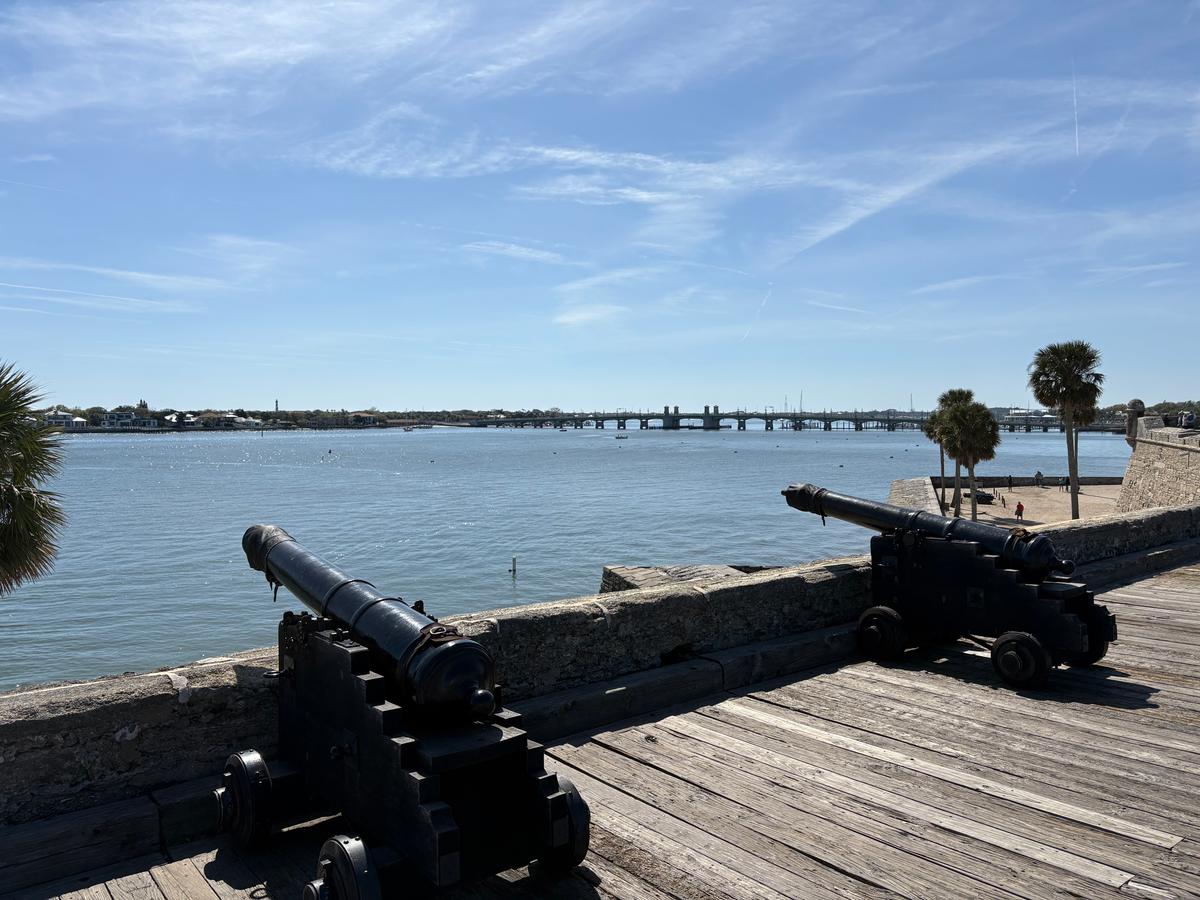
Surrounded by ocean, this fort is highly defendable and a wise strategic location. Deena Bouknight
Watchtowers, a typical European Medieval-era castle architectural design, are on the corners of the “star,” and embrasure openings enabled soldiers to shoot guns from the fort. Providing further protection on the grounds, and accessible to modern visitors, are the palisades, or protective embankments, made of tightly stacked and leaning palm trees.
One of the early coats of arms is located inside the fort, as are displays of the casements, where ammunition was stored, and berthing for soldiers. Volunteers in 17th- and 18th-century period garb offer education regarding what may have transpired at the fort.
One day in March 2025, a volunteer offered details about how the Spanish silver dollar was the most commonly traded coin; it was often cut into fractions (or “pieces”) of eight to denote different values. The educator presented some examples of early Spanish coins showing the dollar sign that became synonymous with American currency.
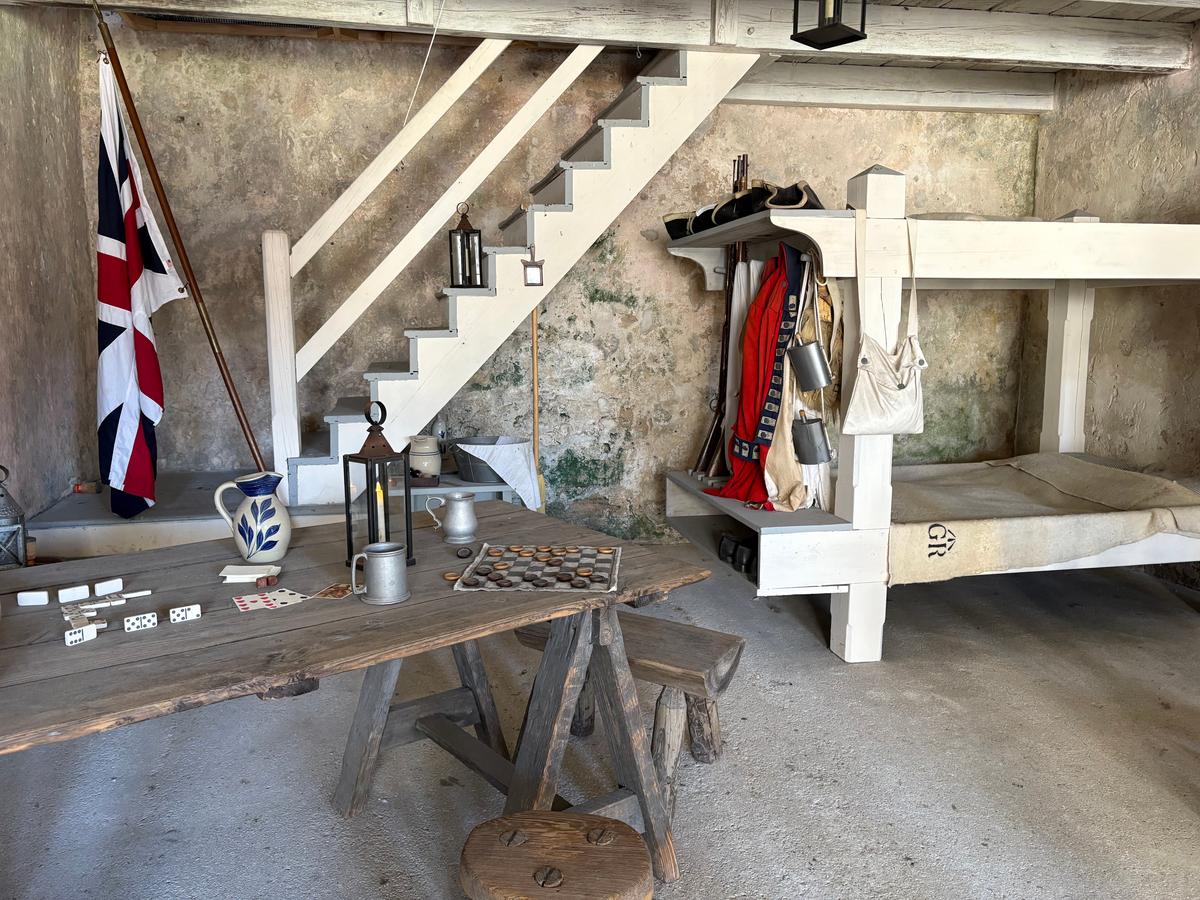
Restored parts of the Castillo de San Marcos appear as they were in the 17th and 18th centuries. Deena Bouknight
On weekends, the fanfare of cannon firings and weaponry demonstrations take place. Volunteers then dress as 18th-century Colonial British soldiers.
After seeing the proximity of St. Augustine and Castillo de San Marcos, and then experiencing their synergetic history, visitors will well understand that the city might not have flourished without the existence of its well-built fort.
What arts and culture topics would you like us to cover? Please email ideas or feedback to [email protected]