



Our noses perform important functions every day of our lives, but we often only notice when disease changes how they work.
Our sense of smell works when chemical molecules are sniffed into the nose and make contact with the sense organ called the “olfactory bulb” in the roof of the nasal cavity. The other main function of [the] nose is to warm and moisten air going to the lungs (air conditioning) and to remove unwanted particles and viruses suspended in the air (filtering).
Anatomy of the Nose
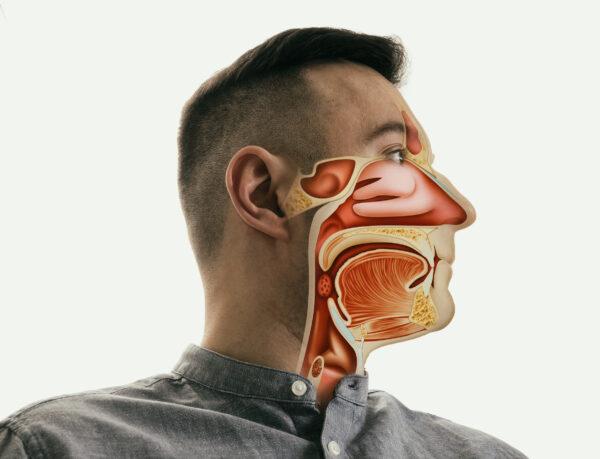
The nasal cavity is much larger inside than it seems from the outside.Dual cavities extend up and also back from the nostrils, and have multiple bony folds (called turbinates) that create a larger surface area (150 square centimeters) for the nasal cavity to be an effective filter and air conditioner.
The nose has a very rich blood supply just under the skin lining (mucosa) which acts as a heat exchange. This can be dialed up or down quickly by nerves controlling dilation or constriction of blood vessels.
There are a number of cavities with connections via narrow tubes to the nasal cavity. That’s four sets of sinuses (hollows) in the facial bones and the middle ear cavity.
When the nose is congested, the tubes connecting ears and sinuses can also become blocked, causing pain from pressure build-up.
The Sticky Stuff
The major passages of the upper respiratory tract are lined with a mucous membrane that also contain mucus-producing goblet cells.Mucus assists in fighting infection when white blood cells and antibodies are excreted into it and increases in volume to flush away infection, irritants, or allergens. Watery mucus—such as from allergy or in the first days of a virus—tends to exit via the nostrils (a “runny nose”).
Thicker mucus tends to exit down the rear of the nasal cavity into the throat, moved by the action of cilia.

My Snot of Many Colors
Mucus can be colorful stuff, which can make people worry.It might be orange and brown if it has some blood in it. Yellow and green hues come from white blood cells (leucocytes) that fight bacterial and viral infections. Colors are more prominent the longer the mucus has “stuck around” —so your morning nose blow might be more brightly colored than later in the day.
A common misconception is that green mucus indicates bacterial infection and requires antibiotic treatment. But most upper respiratory tract infections (even with green mucus) resolve whether or not antibiotics are used.
Making It Better
The main purpose of treatment, when you have a cold, flu, or upper respiratory tract infection, is to relieve symptoms. A nose spray can deliver an effective dose to where it is needed with few side effects.
Yes, There’s a Correct Way to Spray
Using nasal spray is not as simple as pointing it up your nose and pumping. Here’s how to get it right:- Stay in an upright position with the head tilted forward slightly.
- Hold the nasal spray in your hand with your thumb at the base of the bottle and the index and middle fingers on top.
- Insert the tip of spray bottle into one nostril, blocking the other nostril gently with the other hand.
- Squeeze the pump with your index and middle finger and breathe in slowly, just enough to keep the medication in place.
- Use the right hand to deliver a spray into the left nostril, directing the spray towards the left ear. Repeat on the other side.

