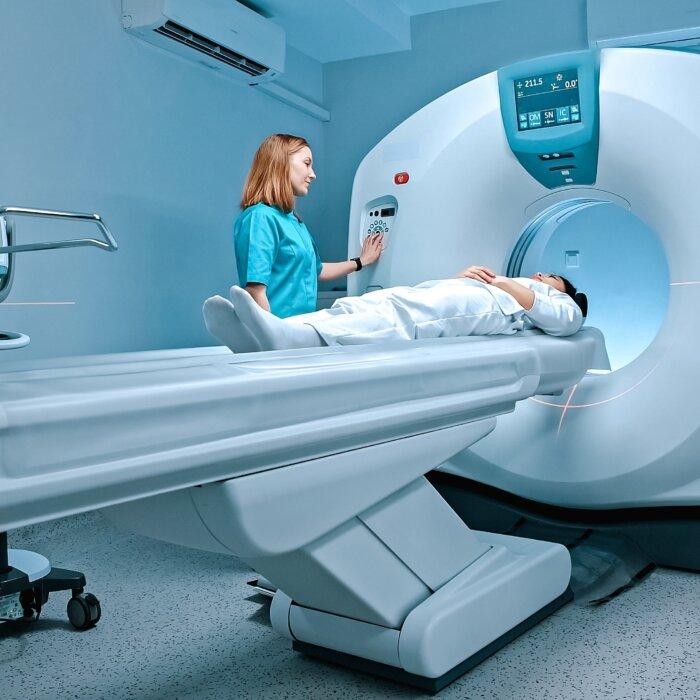
Whether it’s a simple headache that won’t go away or a suspected case of cancer, computed tomography (CT) is a go-to diagnostic tool that allows doctors to see inside the body without the need for surgery.
While most consider CT scans a modern medical miracle, recent research suggests there’s a potential dark side to this technology, as the equipment emits ionizing radiation that may damage DNA and increase the risk of cancer.
People receiving certain scans, or those who carry excess weight, may be most at risk. “Newer CT scanners are very powerful and can scan quickly with high image quality, but they sometimes lack built-in checks to prevent unnecessarily high radiation doses—especially in larger patients or complex scans,” Madan Rehani, a professor of radiology at Harvard Medical School and one of the researchers behind the findings, told The Epoch Times.
Rehani and his colleagues found that radiation emitted from CT scans is increasing, even as the scanners’ technology improves.
Studies Reveal Concerning CT Radiation Trends
The results of the scientists’ first paper, published in the British Journal of Radiology, showed that the number of high-dose CT scan exams with radiation doses equal to or greater than 50 millisieverts increased by 244 percent since 2017.When the scientists looked at nearly 5,000 CT exams that included data on the patient’s body mass index (BMI), they found that about 80 percent of high-dose scans were administered to people with higher BMIs or obesity.

However, both studies relied on data from one medical facility or emergency department, which may not fully represent CT use in other facilities.
Rehani noted that the benefits of a clinically justified CT scan outweigh the radiation risks, and most CT exams in the studies—more than 99 percent—had a lower radiation dose of fewer than 10 millisieverts. So for most people, the risk of developing cancer from a CT scan is low.
High-dose scans, on the other hand, such as those identified in Rehani and colleagues’ research, are more of a concern.
Health Effects of CT Radiation Exposure
Humans are exposed to small amounts of ionizing radiation from natural sources, including radon and uranium decomposition in the environment. Data suggest that, depending on where they live, a person is exposed to about 3 millisieverts per year on average, which is considered a low dose and unlikely to cause health problems.However, CT scans emit much higher radiation levels. For example, a coronary CT angiogram exposes a person to 16 millisieverts, which is equal to 5.3 years of natural radiation exposure. Many people are now exposed to more than three times that amount, especially if they receive multiple scans.
Still, the risk of developing cancer as a result of exposure to CT radiation depends on several factors, including the part of the body scanned, the person’s age at exposure, and the person’s body weight.
Rehani, who is also the director of global outreach for radiation protection at Massachusetts General Hospital, said that CT scans of denser tissues, such as the abdomen or pelvis, and areas on the body that require more details for proper diagnosis, involve more radiation.
“Further, it is not only a question of more radiation, but some tissues have more risk for the same radiation dose,” he said. “For example, [the] breast is a radiosensitive organ. Bone marrow, colon, lung, [and] stomach are also radiosensitive organs. Extremities like arms and legs have lower radiodensity with much lower radiation risk probability.”
Obesity Epidemic Spurs Higher-Dose Scans
Between 1976 and 1980, the obesity rate in the United States was about 15 percent. In contrast, recent Centers for Disease Control and Prevention data show that today, 40 percent of Americans are considered obese.Dr. Jorge Green, a board-certified bariatric surgeon at Renew Bariatrics, said he believes the obesity epidemic is driving the uptick in high-dose CT scans.
“In larger patients, more radiation is required to penetrate tissue and generate a clear image,” Green told The Epoch Times. “The obesity epidemic has created a steady rise in the average body size we scan, and protocols haven’t caught up with the need for dose optimization. It’s a perfect example of how one public health crisis (obesity) quietly fuels another (cumulative radiation exposure).”
CT Protocols May Need to Change
A risk model published in April in JAMA Internal Medicine suggests that “if current radiation dosing and utilization practices continue, CT-associated cancers could eventually account for 5 percent of all new cancer diagnoses annually.” The researchers note that the number of CT scans performed is 35 percent higher today than in 2007.Alerts on CT scans that indicate the scan will involve a high dose of radiation could help lessen the risks for patients, Rehani said.
He added that health care providers can help by using the correct CT protocol for the right reason and by remaining aware that patients with obesity are more likely to receive high doses.
In addition, doctors should question whether multiple images are necessary; set up systems to regularly review CT doses and monitor the number of high-dose exams; and take action to lower the rate of high-dose exams without compromising quality.
“We need automatic, size-based dose modulation as the default instead of as an optional setting buried in the CT console menu,” Green said. “Too many departments still use ‘one-size-fits-all’ protocols, which means obese patients get doses far above what’s necessary for diagnostic quality.”
He said that software with advanced algorithms can process data from CT scanners to create higher-quality images, cutting radiation doses by 30 percent to 50 percent without compromising clarity.
What Patients Can Do to Reduce the Risks
CT scans may be medically necessary when a health care provider needs detailed images of the inside of the body to diagnose or guide treatment, such as detecting cancer, checking for internal injuries, planning surgery, or evaluating blood vessels, lungs, or organs that can’t be seen clearly with other tests.However, when it’s not medically necessary, doctors can consider safer alternatives such as an ultrasound or MRI, which can be used to scan for gallstones, soft tissue injuries, and many abdominal conditions, and don’t use X-rays.
“Ultrasound is often used for pregnancy or abdominal issues, and MRI is useful for brain, spine, and joint problems. The choice depends on what needs to be seen and how urgent or detailed the imaging is,” Rehani said.
Despite the potential risks, people who need a CT should not refuse one out of fear. Instead, Rehani suggested they advocate for themselves by asking their provider if the scan is essential, requesting a lower-dose CT option, and confirming whether the exam will involve a multiphase scan.
Green noted that patients, especially those with obesity, should not be shy about asking their medical team two questions: “Will you consider an alternative imaging method?” and “will you be using a dose-optimized protocol for my body size?”
If a CT is unavoidable, a person can request facilities that use low-dose or ultra-low-dose machines with advanced software. Many academic centers have this technology but don’t advertise it, Green added.
Since situations arise when health care providers may not have access to medical records, Rehani and Green suggest keeping a personal record of prior CT exams. Having records on hand when visiting the doctor can help avoid repeated scans and cumulative exposure to potentially harmful CT radiation.