Everyone wishes for lustrous and healthy hair. However, many people have experienced the sudden onset or exacerbation of graying hair symptoms during periods of high psychological stress, disrupted daily routines, physical weakness, or illness. This is a warning sign that the body might have underlying issues. In this article, we will delve into the reasons behind premature graying and methods for its treatment and prevention.
Understanding Hair Physiology and Anatomy
Each strand of hair grows from a hair follicle, and the dermal papilla and hair matrix form the hair bulb at the follicle’s base. The dermal papilla regulates the number of matrix cells, determining the length of the hair; it also contains capillaries to supply nutrients to the hair. The hair matrix contains melanocytes responsible for hair pigmentation. In the middle part of the follicle, sebaceous glands secrete oils to nourish both the hair and scalp.When the blood supply from the capillaries at the base of the hair follicle is inadequate or when the sebaceous glands secrete excessively, it can lead to blocked pores and inflammation. This, in turn, causes the hair bulb to shrink, resulting in hair loss. On the other hand, insufficient melanocytes in the hair matrix can lead to the development of gray hair.
8 Major Causes of Hair Loss
The leading causes of hair loss are often associated with factors such as genetics, stress, illness, hormones, nutrition, and dietary habits.- Genetics: Primarily affecting males, male pattern baldness, or androgenetic alopecia, is a hereditary condition caused by male hormones and is the most common form of baldness. This type of hair loss typically starts around 20 to 30, shows a familial tendency, and progresses most rapidly around 30.
- Excessive stress and immune imbalance: Hair loss resulting from these factors often manifests as alopecia areata, also known as the “ghost shaved head” in traditional Chinese medicine (TCM). It also includes conditions such as seborrheic hair loss. Patients may observe a sudden patch of hair loss. This is characterized by non-inflammatory, nonscarring alopecia in round or oval shapes on the scalp, with clear boundaries and smooth skin in the affected area.
- Medication: Many medications can cause hair loss as a side effect. These include drugs used to treat conditions such as hypertension, diabetes, heart disease, and high cholesterol. Additionally, contraceptives, hormonal replacement therapy for both females and males, steroids, medications for adolescent acne, anti-thyroid drugs, anti-seizure medications, and chemotherapy drugs are also known to have this side effect.
- Hormonal changes: Women may experience significant hair loss during periods of hormonal fluctuations, such as postpartum and menopause. Generally, the situation improves once hormonal levels stabilize.
- Hypothyroidism: The thyroid releases various hormones to regulate the body’s metabolism, and an underactive thyroid may lead to hair loss.
- Iron deficiency anemia: Anemia can cause insufficient microvascular blood supply to the hair, leading to diffuse hair loss.
- Deficiency in essential nutrients: Apart from iron deficiency, inadequate intake of essential nutrients such as protein or vitamins C and B group and the mineral zinc can also lead to hair loss.
- Unhealthy dietary habits: Excessive consumption of fried, spicy, or charred foods can contribute to hair loss. The primary reason is that such foods tend to induce chronic inflammation in the body, leading to abnormal secretion of sebaceous glands. This, in turn, results in excessive scalp oiliness, clogging pores and causing hair loss.
A study published in Nature in 2021 found that when fed a high-fat diet, mice developed sparse fur due to inflammation of hair follicle stem cells.
Treatment for Alopecia Areata
In the ancient medical text “Golden Mirror of Medicine,” alopecia areata is described as follows: “This condition presents with dry and scorched hair, patchy hair loss, bright red and shiny skin, accompanied by itching resembling insect movement, commonly known as ghost shaved head. It is caused by the dilation of hair follicles, allowing pathogenic wind to invade the body. This leads to an excess of wind and blood dryness, preventing the nourishment of hair. It is recommended to take Shen Ying Yang Zhen Dan to address the root cause while using Hai Ai Tang externally to alleviate the symptoms.”1. Shen Ying Yang Zhen Dan
Ingredients: Angelica sinensis, white peony root, Chuanxiong rhizoma, prepared Rehmannia root (steamed with wine, then mashed into a paste), Notopterygium incisum, and Gastrodiae Rhizoma. In ancient medical texts, there is also mention of adding papaya and dodder seed, each in equal parts, grounding them into powder, and forming honey pills about the size of a pea.Formula analysis: This formula is derived from the “Treatise on the Three Categories of Pathogenic Factors and Prescriptions (San Yin Ji Yi Bing Zheng Fang Lun).” Angelica sinensis, Chuanxiong rhizome, white peony root, and prepared Rehmannia root work to nourish the blood and activate blood circulation. Prepared Rehmannia root, papaya, and dodder seed nourish the liver and kidneys. Gastrodiae Rhizoma and Notopterygium incisum, being acrid and warm, dispel wind, remove collateral obstruction, and guide the medicinal properties upward to the crown of the head.
Method: Take 0.35 ounce (10 grams) each time, twice a day. Administer after meals with warm wine or a salty soup.
2. 7-Star Needling Technique
The seven-star needle, also known as the plum-blossom needle, is used to tap on the affected area of the scalp. This technique can activate local qi and blood circulation, stimulate metabolism, and accelerate hair growth. It is particularly effective for issues such as receding hairlines and alopecia areata.Method: Sterilize the seven-star needle with alcohol, then gently tap the area of hair loss on the scalp until it becomes slightly flushed and warm. Follow by applying some safflower oil. It is crucial to avoid excessive force during tapping to prevent skin injury. If bleeding occurs, apply sesame oil or topical skin medication.
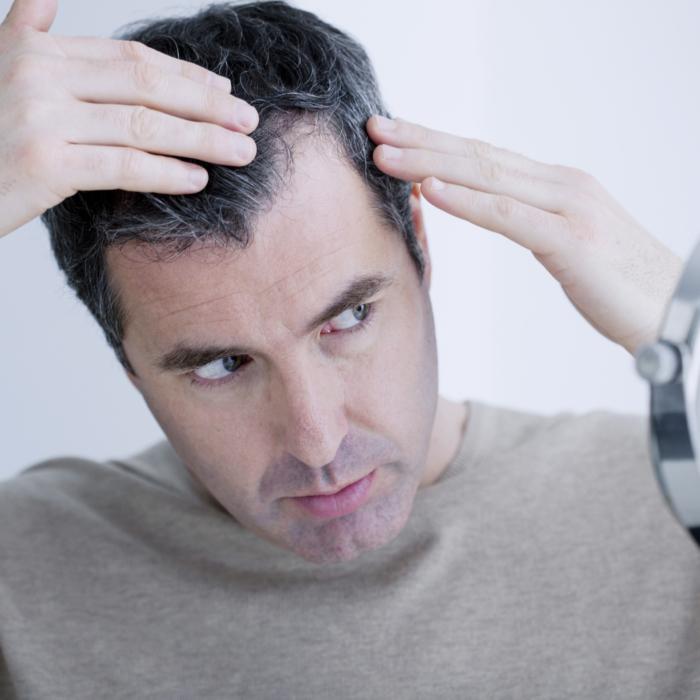

A study revealed that patients with seborrheic alopecia, after applying a TCM solution to the affected area and gently tapping with the seven-star needle, in combination with oral Chinese medicine, exhibited significant improvement in hair loss and promotion of hair growth, with an effectiveness rate reaching 95 percent.
Treatment for Diffused Hair Loss
The main causes of diffused hair loss include insufficient qi and blood, liver and kidney essence, blood deficiency, and local blood stasis. The treatment approach involves nourishing qi and blood, tonifying liver and kidney essence and blood, promoting blood circulation, and removing stasis. Formulas such as Shiquan Dabu Tang, Renshen Yangrong Tang, Qibao Meiran Dan, and Tongqiao Huoxue Tang can be employed for therapy.Diet Therapy for Hair Loss
To ensure the activation and strength of our hair, it is essential to provide it with an adequate supply of nutrients, particularly the following five essential nutrients:- Iron: Animal sources include pig’s blood, duck blood, meat, and seafood. Plant sources include red amaranth, Okinawan spinach, seaweed, legumes (such as soybeans, red beans, and green beans), red dates, black dates, raisins, and nuts and seeds (such as sesame seeds and cashews). The absorption and utilization of iron from animal sources are generally superior to those from plant sources in the human body.
- Protein: dairy products, eggs, seafood, meat, legumes, and whole grains.
- Vitamin B: foods rich in vitamins B6, B9, and B12. Animal-based foods include tuna, salmon, pork liver, beef liver, beef, chicken breast, clams, and milk. Plant-based foods include white rice, potatoes, spinach, asparagus, cauliflower, avocado, and banana.
- Vitamin C: kiwi, citrus fruits, guava, papaya, strawberries, and tomatoes.
- Zinc: oysters, mussels, clams, lobster, crab, pork, beef, lamb, egg yolk, milk, cheese, nuts (cashews, almonds, and pumpkin seeds).
Simple and Effective Hair Care Techniques
1. Massaging the Scalp With Infused Alcohol
The primary method for treating hair loss is to enhance the circulation of qi and blood in the scalp, thereby stimulating the regeneration of hair follicles. One technique involves soaking approximately 1 ounce (30 grams) of ginger peel and 2 ounces (60 grams) of Rhizoma Drynariae in alcohol for 10 days. The infused alcohol is then applied to the affected area three times a day.2. Combing the Hair With 10 Fingers
The simplest and most convenient method for treating and preventing hair loss is “frequent hair combing.” In ancient times, hair combing was highly emphasized in health preservation. Su Dongpo, a renowned poet from the Song Dynasty who experienced significant hair loss, received advice from a skilled physician to diligently comb his hair morning and night. Following the physician’s guidance to comb his hair over a hundred times before sleep and allowing his hair to scatter while lying down, Su Dongpo was able to cure his hair loss in a short period.TCM considers the head the “convergence of all yang energies” and the “house of the original spirit,” where all the body’s meridians (energy pathways) eventually gather. According to TCM’s holographic theory, the head reflects the entire body. By stimulating specific scalp areas through acupuncture, corresponding internal organs can be treated. Therefore, scalp massage promotes blood circulation in the scalp and can address various ailments throughout the body.
Method: Use all 10 fingers to comb the hair, starting from the hairline and moving toward the roots. Begin with both hands moving from the center toward the back, then separate both hands and comb toward the sides. Repeat this process 100 times every morning, afternoon, and evening. Consistency is the key to yielding positive results with this practice.
Views expressed in this article are the opinions of the author and do not necessarily reflect the views of The Epoch Times. Epoch Health welcomes professional discussion and friendly debate. To submit an opinion piece, please follow these guidelines and submit through our form here.