Essence of Meridians
Modern scientific research attempts to explore meridians from the perspective of nerves, endocrine, and electricity but cannot fully explain all the related phenomena.The main reason is that there are microscopic spaces in the meridians that cannot be explored by existing science, and the macroscopic phenomena of existing material spaces such as nerves, endocrine, and electricity cannot show the true essence of the meridians.
In “Eight Extraordinary Vessels” Li Shizhen of the Ming dynasty wrote: “Neijing tunnels, only those who Introspect can observe it.”
Here’s the general idea of what that means: The Neijing is the internal organs, and the tunnels are the meridians. If one wants to know the essence of the viscera and meridians, he can only realize it through practice and introspection.
Therefore, the meridian system is more like a complex energy network system in another dimension that cannot be seen by the naked eye.
Spiritual Pivot. Meridian Chapter: The meridian, which can determine human life and death, deals with all kinds of diseases, and to adjust the deficiency and the excess, it must be unblocked.
The Composition of the Meridian System
Meridians are divided into size, vertical channels, and horizontal branches. The 12 principal meridians, 12 channel divergences, and the eight extra meridians are the relatively large and vertical channels of the meridians. “Luo meridians” branch off horizontally from the principal meridians. “Sinew channels” and then “cutaneous region” exist in the superficial muscles and skin.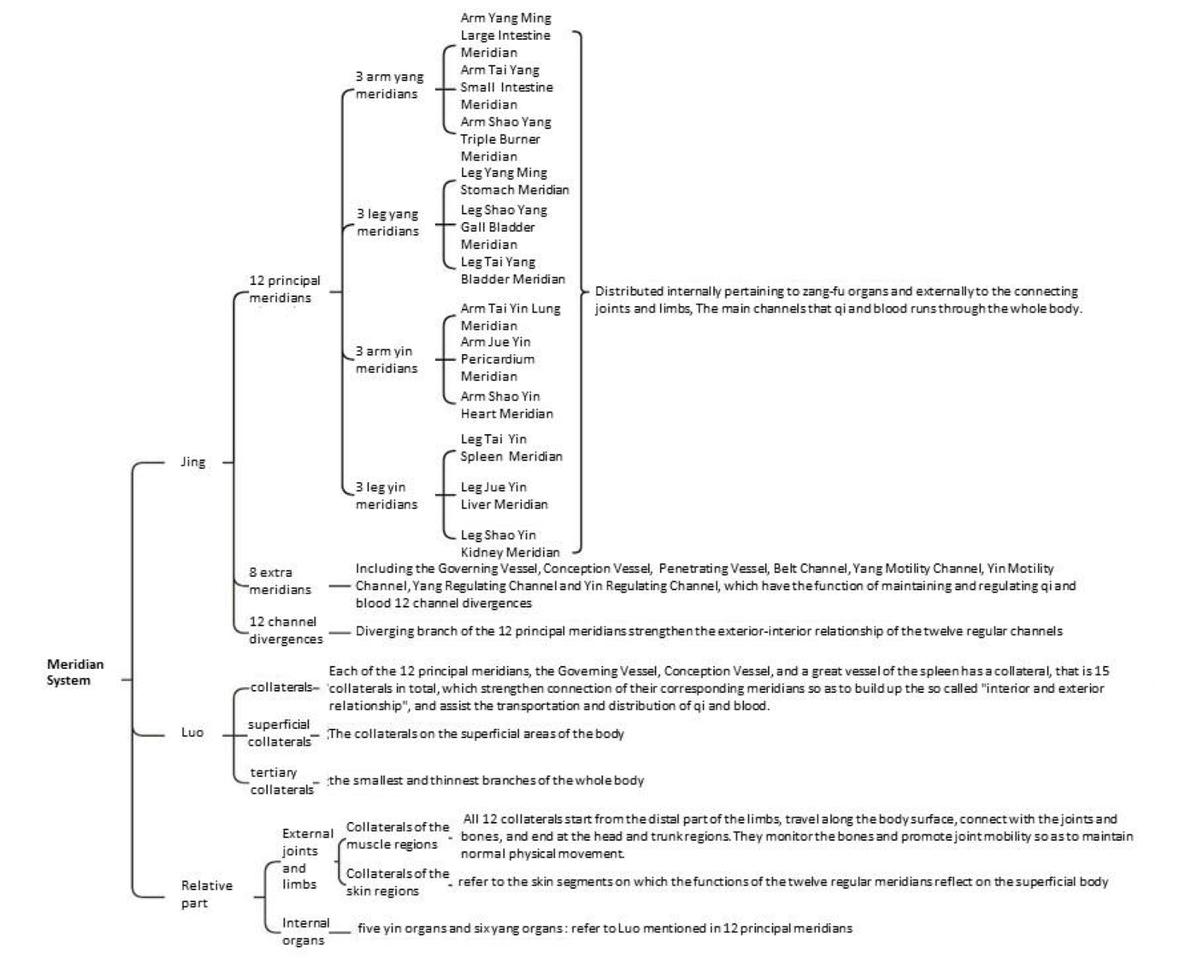
Physiological Functions and Applications of Meridians
The interrelationship between the inside and outside, up and down, front and back, left and right of the human body, and the coordination and union of various functions of the organs, limbs, five sense organs, and nine body orifices are mainly achieved by the communication and connection of the meridians.The meridians, as the main channels for running qi and blood, have the function of transporting qi and blood. The collaterals, as the branches of the meridians, have the function of spreading and infiltrating the qi and blood of the meridians to the organs, limbs, five sense organs, and nine body orifices, and the meridians themselves. Each of the above, when fully nourished by qi and blood, can exert their respective functions, so that the physiological functions can be exerted normally, the body is strong, and it can resist the invasion of external evils.
There are certain parts of the body where the meridians and collaterals start and end, and they belong to the corresponding zang-fu organs (internal organs). Diseases of the internal organs can be reflected in the corresponding body parts through the meridians.
Various clinical manifestations can be analyzed according to the path of the meridians and the physiological and pathological characteristics of the meridians and viscera to which they belong. It can be inferred that disease occurs at the meridians or internal organs, and the severity and development of the disease can be judged according to the nature and order of symptoms.
The theory of meridians is widely used to guide the treatment of various clinical diseases and is the theoretical basis of acupuncture, massage, and drug therapy.