The Impact of Mobile Phones on Physical Well-Being
1. Eye health
In the present day, it is widely understood that the blue light emitted by mobile phones can harm our eyes. Therefore, some people choose to adjust their phone’s brightness to a lower level. Nevertheless, the potential harm to our eyes from prolonged involvement in online games or video streaming on mobile devices is not to be taken lightly. In clinical settings, there have been numerous instances where individuals who spend extended periods watching videos on their phones experience a rapid deterioration in their eyesight, underscoring the importance of taking proactive measures to protect our eyes.The impact of prolonged mobile phone usage on our eyes can be likened to the following metaphor: Imagine looking directly into a flashlight—our eyes would find it uncomfortable and instinctively shift away to avoid the intense glare. The intensity of light emitted from a mobile phone screen is roughly one-sixth that of a flashlight. This level of brightness might initially appear tolerable, however, staring at a phone screen for 1 to 2 hours or even only 30 minutes, can result in significant strain on the optic nerve located at the back of the eye.
While many people tend to associate excessive smartphone usage with younger individuals, the reality is that there is a significant number of individuals aged 60 and above who also spend prolonged periods on their phones. This is especially true as the elderly population tends to have more leisure time, with many of them being retired. Without strong self-discipline, many older adults may find themselves spending over three hours a day on their phones. Consequently, the deterioration of eyesight among the elderly has become both more rapid and severe than in the past.
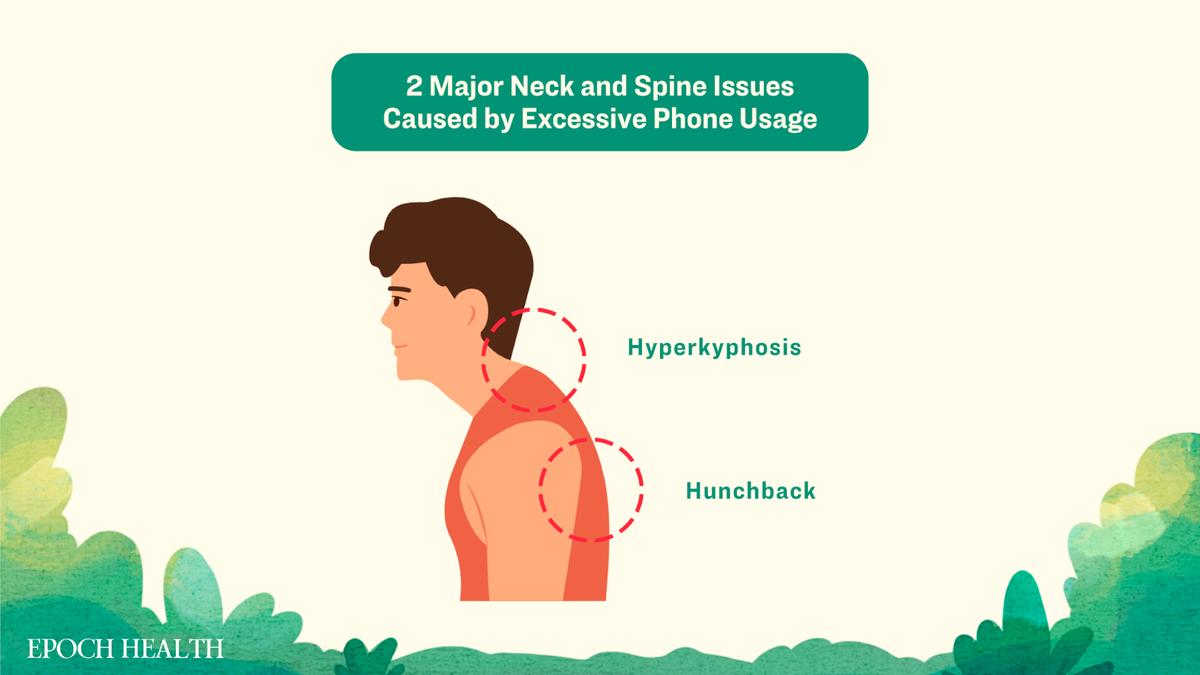
Which eye conditions can result from extended smartphone usage? The answer is virtually all ophthalmic issues, such as nearsightedness, presbyopia, dry eye syndrome, cataracts, macular degeneration, and optic nerve damage. Therefore, limiting smartphone usage is often a fundamental aspect of addressing eye disorders in clinical practice.
2. Neck and spine health
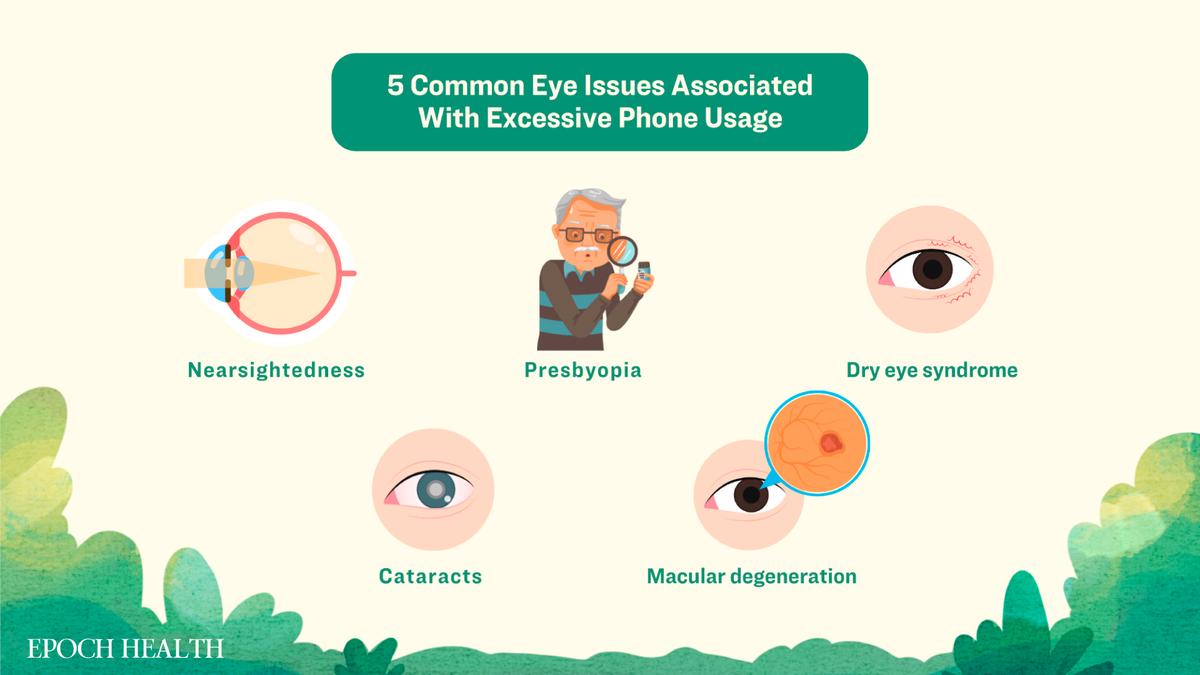
Many people have a habit of looking downward while using their phones, which can result in a protrusion at the junction of the cervical and thoracic vertebrae (commonly referred to as hyperkyphosis or dowager’s hump) and eventually lead to a hunchback posture over time.

Hyperkyphosis can lead to a range of symptoms, including hand numbness, shoulder and back soreness, neck pain, headaches, a sense of heaviness in the head, dizziness, tinnitus, eye discomfort, rapid vision deterioration, sleep disorders, palpitations, chest tightness, bloating, and digestive issues. Maintaining proper posture and body alignment is crucial for overall health, and it should not be underestimated.
8 Exercises for Smartphone Users
If you are experiencing eye and neck discomfort caused by smartphone usage, you can perform the following exercises for self-rehabilitation:1. Palming technique: Rapid relief for eye fatigue, soreness, and pain
Developed over a century ago by American ophthalmologist Dr. Bates, this technique proves highly effective in relieving eye fatigue, soreness, and discomfort. Typically, engaging in continuous palming for 3 to 5 minutes can eliminate the sensation of eye fatigue. After the session, you may experience a noticeable improvement in the visual clarity of both eyes. If time allows, it is recommended to perform palming for 15 to 20 minutes for optimal results.
Instructions:
1. Sit in front of a table.
2. Rub your palms together for 10 seconds to generate warmth (they do not need to be very hot).
3. Close both eyes. Cup your palms, align them with your pupils, with the fingertips of both hands overlapping, and position your palms on the sides of your nose. Make sure that your eyes are shielded from any light, creating a sense of darkness.
4. Place both elbows on the table and slightly lean your upper body forward (this posture helps to relax your body).
5. Visualize your eyes in a completely dark environment.
6. Relax completely from top to bottom, starting from your palms, wrists, elbows, shoulders, head, neck, back, waist, hips, knees, ankles, and all the way to your feet.
7. You can amplify the relaxation effect by practicing the 2-to-1 breathing technique, which involves inhaling through your nose for 4 seconds and exhaling through your mouth for 8 seconds.
2. Two-step ancient eye care exercise
1. Close both eyes and rotate them clockwise 14 times, then counterclockwise 14 times.
2. Shut your eyes tightly for 3 to 5 seconds, then open them wide in an instant. Repeat this process three times.
3. Gentle massage around the eyes
1. Position the index fingers of both hands in the space between the lower eye socket and the eye. Apply gentle pressure to the eight points from the inner to the outer area. Repeat this process 3 to 5 times.
2. Similarly, position the index fingers of both hands in the space between the upper eye socket and the eye. Apply gentle pressure to the eight points from the inner to the outer area. Repeat this process 3 to 5 times.
Self-Rehabilitation Exercises for the Neck Spine
4. Acupoints massage at the base of the skull
Use your thumbs to massage acupoints like Tianzhu, Fengchi, Anmian, and Yifeng along the groove beneath the skull. You can also apply pressure to the Fengchi acupoint with your thumbs while gently rocking your head from side to side, using momentum to relax the muscles. This can also help realign the displaced first cervical vertebra (atlas).
5. Turtle neck rotation exercise
6. All-direction head rotation exercise
Rotate your head in all directions like the strokes of the Chinese character “米.”
1. Turn your head to the upper left at a 45-degree angle (extend as far as comfortable), then return to the center. Repeat the motion to the upper right at a 45-degree angle, and return to the center. Perform this sequence 5 times.
7. Butterfly stroke exercise
1. Stretch both arms out horizontally, with palms facing downward, and firmly grip with your fingers in a manner resembling eagle claws. Imitating the motion of butterfly swimming, rotate both arms and shoulder blades from the back upwards to the front, and repeat this sequence 10 times.
2. Keep both arms extended horizontally, but this time with your palms facing upward. Repeat the backward-to-forward rotation motion as done in the previous step, performing it 10 times.
8. Head tilt and sway exercise
After completing the previous exercise, your muscles and ligaments around cervical vertebrae 5, 6, and 7 should be more relaxed. Now, tilt your head backward, fix your gaze straight ahead, and gently sway your head from side to side 10 times. This movement can promote mobility in the joint surfaces of cervical vertebrae 5, 6, and 7.
By combining exercises seven and eight, you can effectively alleviate numbness in the hands caused by nerve compression in the cervical vertebrae 5, 6, and 7 regions. Additionally, it can help improve the symptoms of hyperkyphosis. Going forward, remember to avoid habitually leaning your head and cervical spine forward while on your phone.