This copy is for your personal, non-commercial use only. Distribution and use of this material are governed by our Subscriber Agreement and by copyright law. For non-personal use or to order multiple copies, please contact The Epoch Times Reprints.
Sciatica is pain caused by irritation of the sciatic nerve and can extend from the buttocks to the legs and even the soles of the feet, making moving through daily activities painful. A combination of rest in the acute stages, then gentle exercises, can help to manage pain and promote healing.
Causes of Sciatica
The sciatic nerve is a group of sizable nerves in the lower limbs, formed by the fourth and fifth nerve bases of the lumbar vertebrae and the first, second, and third nerve roots of the sacral vertebrae, extending through the lower back and buttocks to the entire lower limb. When the sciatic nerve is stimulated, the pain may extend along the direction of the sciatic nerve.
Common causes of sciatica include herniated discs, aging of the spine, and inflammation of the piriformis muscle.
1. Herniated disc: Maintaining bad posture, such as hunching over or sitting for a long time, can cause the intervertebral space to narrow, leading to herniated disc, which may compress the sciatic nerve.
Western medicine usually uses traction to mechanically stretch the spine to relieve nerve compression. However, this type of rehabilitation method may require frequent return visits to ensure the treatment effect.
2. Aging spine: Spinal degeneration may cause bone spurs, which may compress the nerves and induce sciatica.
3. Piriformis inflammation: Bad postures from sitting for a long time and crossing your legs may cause inflammation and swelling of the piriformis muscle deep in the buttocks. Swelling and inflammation can compress the sciatic nerve, causing pain, numbness or tingling extending from the buttocks to the legs.
Sciatica Rehabilitation Exercises
In the acute stage of sciatica, rest should be the focus, which is conducive to pain relief and body repair. After the pain is relieved, the following five movements can be used to promote recovery.
The following exercises help open the vertebral space and enhance spinal flexibility:
1. Mermaid Pose
Step 1: Lie on your belly with your hands naturally placed forward on both sides of your body.
Step 2: First use your abdominal strength to lift your upper body, then use your hands to support the ground and push your upper body as far away from the ground as possible. Pay attention to relaxing your shoulders and do not shrug.
This is the opposite movement of bending over. Practicing spinal extension can help relieve the pressure on the intervertebral disc caused by excessive forward bending.
2. Cat-Cow pose
Step 1: Kneel on hands and knees, elevate your heels by coming onto your toes, and straighten your back.
Step 2: Tilt your pelvis backward, and arch your spine slowly upward, while looking down.
Step 3: Tilt your pelvis forward, sink your spine section by section, while slowly looking up.
Note that the entire process should be performed slowly, feel the movement of the spinal joints, and enhance the flexibility of the spine.
3. One-Touch Stretch
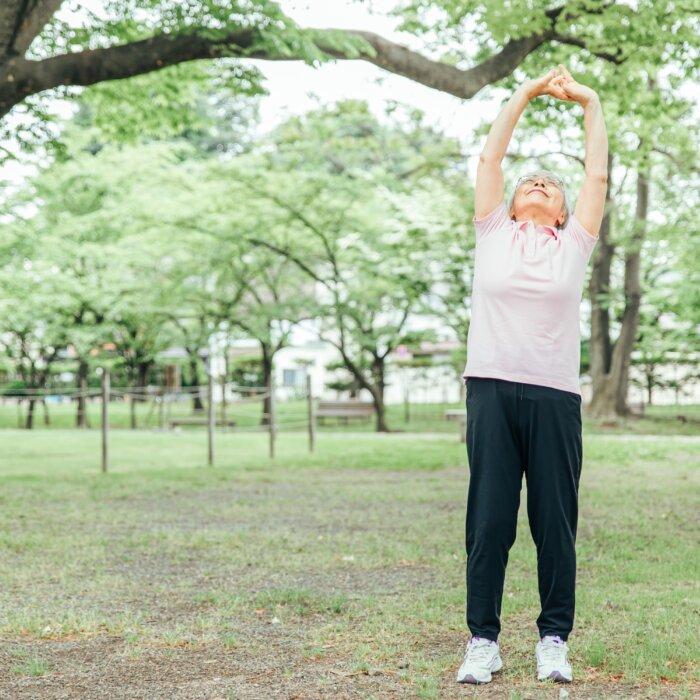
Step 1: Stand with your feet shoulder-width apart and cross your hands in front of your abdomen.
Step 2: When inhaling, raise your hands and turn your palms up, stretch your arms straight over your head, with your palms facing up, and feel your whole body lifting.
Step 3: You can add the tiptoe movement to enhance the feeling of stretching upwards.
Step 4: When exhaling, put your heels on the ground, put your hands down, and return to the initial position.
This movement simulates the traction effect and can help stretch the spine.
When the piriformis muscle is inflamed and causes pain, it is recommended that after the pain index decreases, you can practice the following two movements to help strengthen the toughness and elasticity of the piriformis muscle:
1. Four-Character Leg Hug
Step 1: Lie down, bend your knees, and lift your feet off the ground.
Step 2: Put one foot on the other thigh, hold the knee of the leg being pressed with both hands, and gently pull it towards the chest.
During the exercise, you will feel the buttocks being stretched, which can promote blood circulation and muscle relaxation.
2. Roller Pressing
Step 1: Place the roller horizontally under one hip, place both feet and one elbow on the ground, and slowly roll and press the sore area of the hip.
Step 2: If you want to make the pressure go deeper, you can try to put the non-pressing foot on the opposite thigh to increase the pressure and training intensity.
This exercise helps to relax tight muscles and reduce nerve compression.
While focusing on rest, combined with gradual self-rehabilitation exercises, you can relieve pain and help the spine and muscles restore their health and prevent recurrence.
Amber Yang
Amber Yang is a certified personal trainer. She met all the requirements of the American Council on Exercise to develop and implement personalized exercise programs. She worked as a marketing manager for natural skin care products for years and as a health and beauty reporter and editor for ten years. She is also the host and producer of the YouTube programs "Amber Running Green" and "Amber Health Interview."