
Once considered exotic and only eaten in tropical climates, mangoes have become one of the world’s most popular fruits.
Often carrying the moniker of “king of fruits,” the mangoes’ abundant fiber and moisturizing properties have made it a trusted remedy for soothing digestion and promoting regularity for centuries. Today, scientists are catching up to this ancient wisdom and discovering mango’s digestive benefits. Even more health-promoting effects, such as its brain-enhancing abilities, are being uncovered.

Key Nutrients
- Fiber: One mango has 5.38 grams of fiber. A medium-sized mango can offer about 15 to 20 percent of the recommended daily fiber intake for adults.
- Vitamin C: One mango contains 122 milligrams of vitamin C, which is considerably more than an orange, which has just 82.7 milligrams.
- Folate (vitamin B9): One mango has 144 micrograms of folate.
- Mangiferin: A polyphenol that is abundant in mangoes.
Health Benefits
Benefits Digestion
Mangoes have been a long-trusted remedy for digestive woes, particularly in traditional medicine.
In Ayurveda, mango is considered nourishing, replenishing, and slightly cooling, making it useful for soothing inflamed tissue. Mangoes are used as laxatives to prevent dry-type constipation.
In traditional Chinese medicine, mangoes are cooling, help regenerate fluids, and strengthen digestion. They quell inflammation and are rich in digestive enzymes that help detox the body and fight bacteria in the intestines.
A healthy gut is important because good bacteria help break down the polyphenols so that they can be absorbed and used by the body. Once they’re absorbed, the polyphenols can help lower inflammation in the gut, help protect gut lining—preventing leaky gut—and support digestion.
The pilot study split healthy participants with functional constipation—which is constipation without a clear physical cause—into two groups. One group ate 300 grams of mango daily for four weeks, while the other had the equivalent amount of fiber from a different source. Participants who ate mangoes showed significant improvements in their symptoms. They had more frequent bowel movements, stools were softer and easier to pass, and they exhibited less intestinal inflammation. They also had increased gastrin levels—a hormone that stimulates stomach acid and helps food move through the gut.
Improves Brain Health and Cognition
A 2024 randomized, double-blind controlled study tested a supplement made from mango extract to determine whether it could improve cognitive function—particularly memory and focus—in healthy adults who regularly play computer games.- Mental speed
- Attention
- Working memory
- Verbal learning and memory
- Response inhibition—the ability to pause before reacting
Fifty healthy lean participants and 44 obese participants between 18 and 55 years of age ate 400 grams of mango pulp daily with either a probiotic or a placebo for eight weeks. The researchers took blood to assess inflammation and tested memory, attention, and visual processing.
Support Heart and Metabolic Health
A small study published in March found that mango improved heart and metabolic health.Overweight or obese postmenopausal women took 330 grams of mango daily for two weeks. Results showed that the women had significant improvements in systolic blood pressure, mean arterial pressure, pulse pressure, and fasting cholesterol.
Additional Benefits
Mangoes have benefits that extend beyond digestion and the brain.How to Increase Absorption
- Eat mangoes with healthy fats: Eating mangoes with healthy fats helps our bodies absorb the fat-soluble vitamins in mangoes—vitamins A, E, and K, as well as lutein and zeaxanthin, which are crucial for healthy vision.
- Eat at peak ripeness: Many of mango’s nutrients are at their peak when they reach a perfect state of ripeness. To maximize mango carotenoid content, choose fruit that is bright yellow-orange in color.
- Combine with iron-rich foods: Combining mangoes with iron-rich foods enhances the absorption of nonheme iron, found in plant-based foods.
Optimal Storage
Pro Tips
Peeling and Cutting Prowess
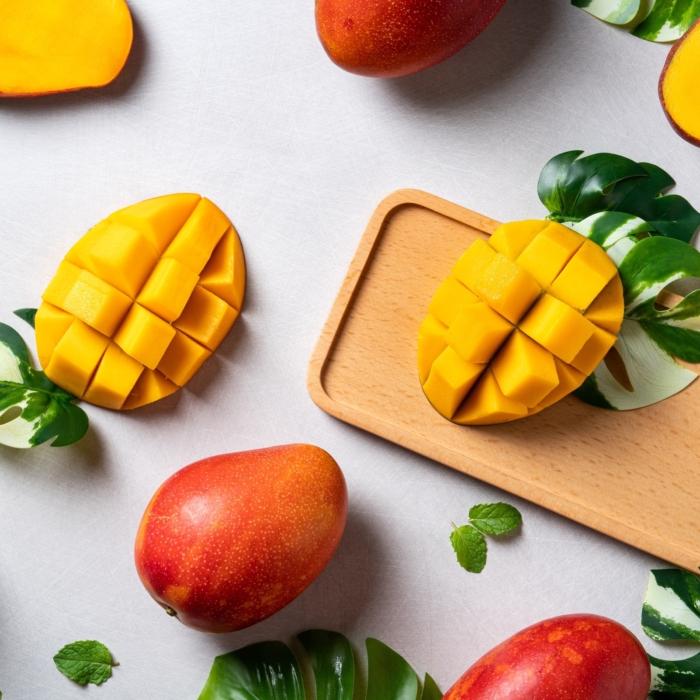
A mango has one long, flat seed in its center, so cutting it is all about working around the seed and getting every delicious bite. There are multiple ways to peel and cut a mango.You don’t have to peel the mango first, however.
- With the skin on, cut the mango down the flat sides first.
- Lightly slice the flesh into a checkered pattern without breaking the skin underneath.
- Gently turn the slice inside out to expose the fruit in symmetrical pieces for easy eating.
Ripening
If you want your mango to ripen more quickly, there are a few things you can do. Placing mangoes with bananas will speed up ripening because of the ethylene gas bananas emit. You can also place mangoes in a sunny window or in a paper bag to accelerate the process.Soaking Mangoes Before Eating
Some sources suggest that soaking mangoes in water before eating them makes them easier to peel, removes contaminants on their skin, and helps make their nutrients more easily absorbed.Precautions
Recipe: Creamy Mango Smoothie
Ingredients
- 1/2 can (approximately 7 ounces) coconut milk
- 10 ounces frozen mangoes
- 1 teaspoon lemon juice
- 1 tablespoon pumpkin seeds
- 1 full scoop or 2 tablespoons vanilla protein powder
Directions
Add frozen mango, coconut milk, lemon juice, and protein powder to a high-speed blender. Blend until smooth, then add pumpkin seeds and pulse through again. Adjust thickness and sweetness to your liking.Fun Facts
- Mangoes belong to the same plant family—Anacardiaceae—as cashews, pistachios, and poison ivy.
- Mango is the national fruit of Pakistan, India, and the Philippines—and the national tree of Bangladesh.
- India is the world’s largest producer of mangoes, although it accounts for less than 1 percent of exports, as most are eaten domestically.
- A mango tree can live 300 years and still bear fruit.
- Botanically, mangoes are drupes, which means they have a central pit, or stone. They share this distinction with other fruits, such as plums, peaches, and cherries.
Tips for Kids