An age-old conundrum continues to confront countless students as they face mounting pressures from school: Should I stay up a little later to study or go to bed, wake up fresh, and tackle this material tomorrow?
Have you ever struggled through a study session before going to sleep, then upon waking, discovered that the material was fresh and deeply embedded in your mind? Conversely, have you ever chosen studying over getting sleep to the detriment of your performance the following day?
Although learning is still possible with a lack of sleep, the brain is programmed to strengthen new memories during (quality) rest. Whether you’re a young student or a retired professional, sleep is the most natural way to fortify your memory.
Key Facts
- Memories undergo a process called “consolidation” during sleep, meaning newly acquired information is integrated into long-term memory banks.
- In particular, deep sleep is critical. This is when memories are reactivated so that deeper connections can be made.
- By minding your sleep routine, you can optimize your long-term memory—and more.
How Sleep Affects Memory
Ever wondered what your brain does while you sleep?A couple of components in the brain are particularly relevant to our discussion. One is the hippocampus, which is responsible for preserving recent memory. If you’re inclined toward computers, you could think of it like your brain’s RAM (random access memory)—it recycles experiences in a buffer to keep them accessible. This kind of memory tends to be vivid, preserving all the sensory details of what physically happened.
Next is the neocortex: This is what you often see when looking at pictures of the brain, the large mass of folded brain tissue on the outer layer of the brain. It covers a core set of smaller regions, including the hippocampus, which is situated in the center of the brain and brain stem. The neocortex is responsible for much of your higher-level sensory processing and storing semantic information such as facts and associations.


The neocortex includes the temporal lobes (two large areas located on the sides of the brain). These store knowledge of facts and associated details, even though you may not remember when you learned these things. So when you are recalling trivia, you can thank your temporal lobes.
‘Slow-Wave’ Brain Frequency Maximizes Memory
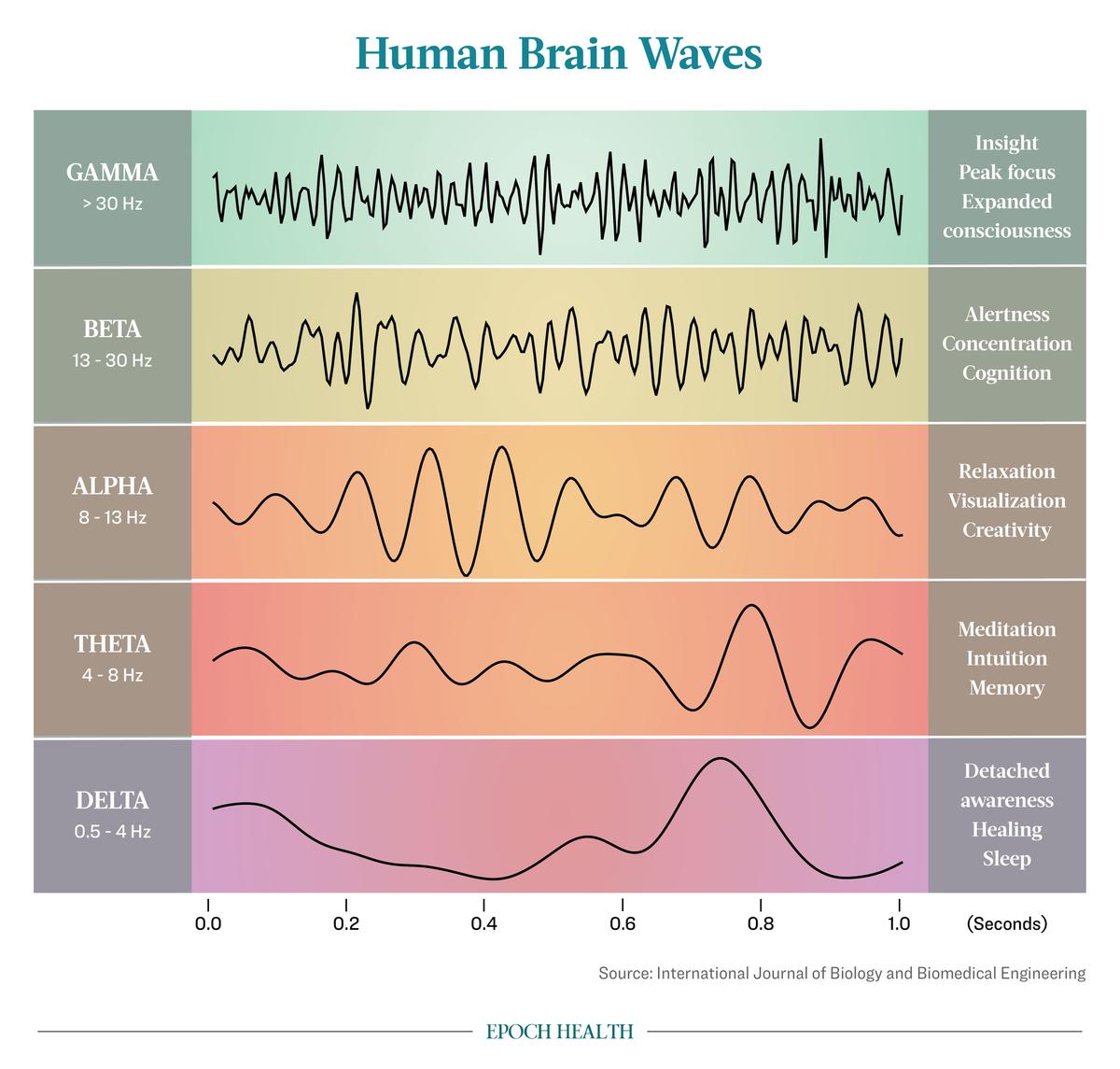
Our brain cells relay electrical impulses in oscillations at different frequencies. When cells’ signals are oscillating at the same frequency, it allows them to sync. During sleep, we go through different stages characterized by different frequencies.Generally, we can think of rapid frequencies as talking between nearby neurons and slower frequencies as entraining large swaths of neurons that may be farther away from one another.
In “deep sleep,” also known as “slow-wave” sleep, the brain enters its slowest delta frequencies (0.5 to 4 hertz). This enables larger swaths of neurons to coordinate and is thought to promote long-term consolidation of information. The brain changes its rhythms throughout a night of sleep.
Metabolic Benefits of Deep Sleep
The immune system also has a kind of “memory.” When foreign pathogens enter the body, immune cells learn to recognize disease through a complex series of biochemical adaptations. This enables the body to produce more antibodies and fight off disease if we are exposed to the same pathogen again later, supporting acquired immunity.How to Improve Sleep Quality
It’s no secret: Americans are a sleep-deprived bunch. According to recent research, nearly one-third of Americans may not be getting adequate sleep. About a quarter may be insomniacs. Although more than half of Americans reported that sleep was a “major priority,” we all know it’s not always easy to achieve.It’s important to note that simply plopping your head on the pillow and sawing wood doesn’t guarantee quality sleep, even if you are getting a solid eight hours. Disruptive factors such as stress, caffeine, alcohol, and exposure to blue light from electronic devices can all interfere with the brain’s ability to achieve deep sleep.
- Establish a regular sleep schedule. Your body gets used to rhythms. By maintaining a consistent routine, even on days off, you can set your body to go to bed at a certain time. Prepare yourself for winding down and prime yourself to wake up ready to seize the day. Automatically adjusting lightbulbs that mimic sunset and sunrise can be particularly useful.
- Develop a healthy bedtime routine. Establishing cues that it’s time to relax will set you up for success even before you get into bed and try to nod off. Using lavender aromatherapy or taking a warm bath can help you wind down from the daily grind and prepare yourself for rest. Avoid stimulating activities and blue light from electronic devices at least 30 minutes before bed; instead, do something relaxing such as reading a book.
- Create a calm sleep environment. Because we are highly sensitive to light, black-out shades or an eye mask can go a long way in helping us fall asleep. Background noise, such as a fan, white noise, or rain sounds, can often buffer pesky auditory intrusions. For others, a nice set of earplugs may make the difference. Finally, consider lowering the temperature a little before slipping into bed and raising it for waking up.
- Watch out for caffeine. If you like to have an afternoon pick-me-up, bear in mind that caffeine has an average half-life of three to five hours, according to the American Academy of Sleep Medicine. The half-life is the time it takes to eliminate half of the caffeine from your body, though the rest can still linger longer. That means that the average person may want to avoid consumption past mid-afternoon. Don’t try to turn your body on and off with coffee or alcohol.
- Avoid alcohol as a sleep aid. While alcohol may relax you at first, it’s also been shown to disrupt deep sleep quality. Additionally, living life like a yo-yo puts stress on your body’s ability to adapt, as not all systems will be reversed with sleep aids after introducing a stimulant.
- Avoid late eating. When we sleep, digestion slows significantly. Avoid heavy meals before bed, which can burden the digestive system and disrupt a good night’s sleep. Eating can signal the body to get energized for activity, which isn’t what you want before bed.
- Nip the napping. Midday naps can be great for improving mental energy, but limiting them to 20 to 30 minutes works with your brain’s sleep stages to keep you from going “too deep” and guards against falling into a drowsier, hungover state. It’s best to nap in the early afternoon to ensure you can fall asleep at night.
- Exercise regularly. Regular exercise relieves pent-up stress and is shown to promote healthy sleep. It’s best to exercise in the morning or early afternoon so your body has a chance to return to a relaxed baseline before bedtime. Moving throughout the day—standing, walking, doing light cardio or calisthenics (e.g., pushups, jumping jacks), or stretching—can also help keep your mind and body balanced and more relaxed when you sleep.
- Tune out mental chatter. Consider using a technique called “serial diverse imagining.” Simply pick a word and imagine as many things as possible that start with the same first letter. For example, choose “sleep” and start with words beginning with “s,” such as snooze. When you run out of ideas, move on to the following letter. Focusing on something neutral can help to redirect thoughts. Listening to a calm, low-stakes lecture or bedtime story can also achieve this effect.
- Clear your mind. Progressive relaxation and yoga breathing techniques can help regulate the mind. Engaging in mindfulness or meditation practice can help redirect thoughts away from worry to focus on the present moment. These have proven health benefits, which is why they’ve been practiced for thousands of years.