Cassie Madsen found occasional massage therapy helpful for general relaxation during the height of her struggles with irritable bowel syndrome and anxiety. Still, she wasn’t expecting her massage therapist to offer an abdominal massage.
She had never heard of such a thing. The duo first talked about Madsen’s gut function, including her frequent constipation.
“She thought it would be helpful,” Madsen told The Epoch Times. “I felt a little better afterward. It wasn’t a magic cure or anything. I feel like sometimes it works for me, and sometimes it doesn’t make a big difference.”
Now a dietitian specializing in gut health and nutrition, Madsen said that while abdominal massage can’t replace the role that food plays in digestion, the power of touch is helpful and accessible enough for symptom management that she often shares information about it with her clients.
How It Works
Enteric nerves line the walls of the gastrointestinal tract, from the esophagus to the rectum. They help to coordinate muscle contractions, known as peristalsis, and can operate with or apart from the central nervous system. This means that the enteric nervous system can be influenced by our emotions.Abdominal massage can be beneficial for manually loosening or stretching the muscles involved in digestion, relieving discomfort and potentially stimulating bowel movements. Abdominal massage can be especially helpful as an alternative to laxatives and stool softeners, which can be harsh and have lasting effects on the gastrointestinal tract, according to Jillian Miller, a physical therapist with Brooks Rehabilitation. Miller specializes in pelvic health and is trained in colonic massage.


Who Should Try Abdominal Massage?
Anyone who struggles with constipation—either infrequently or chronically—and has the manual dexterity to perform massage can try abdominal massage, Miller told The Epoch Times. It may be helpful to hire a trained specialist if you’re intimidated by starting, at least for your first session.How to Do Abdominal Massage
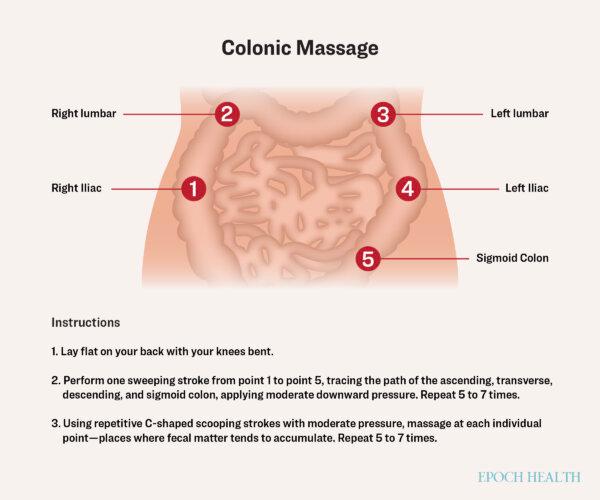
A basic colon massage is straightforward enough that many people can try it without first seeing a therapist.According to Miller, the standard technique involves the patient lying on his back with knees bent to relax the abdominal muscles.
You begin by tracing the path of the ascending, transverse, descending, and sigmoid colon, applying moderate downward pressure. This sweeping stroke is done five to seven times. This is followed by repetitive C-shaped scooping strokes applied to five points where fecal matter tends to accumulate.
“While some variations exist—some techniques start at the sigmoid colon and work backward—I usually follow the natural digestive path, beginning on the right side and progressing toward the rectum,” Miller said, discussing the second part of the massage. “Clinically, I always encourage my patients to try both directions and see what works best for them.”
Numerous videos and diagrams are available online, although some are in mirror-image format. The important thing to remember is that massage typically begins on the right, lower side and follows the natural flow of digestion.
Abdominal massage should not be painful or overly uncomfortable. Although injuries are rare, there are reported cases of organ trauma associated with aggressive or vigorous massages.
A Holistic Tool
Abdominal massage has roots in ancient Chinese culture. It was used by monks in monasteries as a holistic tool for physical, mental, emotional, and spiritual health. Called Chi Nei Tsang, or sometimes TaoTouch, it’s believed to address the root causes of disease.- Correct posture as it repositions organs and restores optimal function
- Alleviate stagnation of lymph and blood to strengthen the immune system
- Address stored, unprocessed emotions in the digestive system
Supporting Abdominal Massage
To facilitate abdominal massage, Miller offered additional tips:- Drink half your body weight in ounces of water each day unless your doctor says otherwise, and try to drink a large portion at room temperature and in the morning. This means that someone weighing 160 pounds would shoot for 80 ounces of water daily.
- Get up and move by exercising, walking, or even standing, preferably early in the day.
- Wait for a strong urge before heading to the toilet.
- Don’t sit on the toilet for longer than 10 minutes, and avoid the urge to bear down or push.
- Position yourself with your knees higher than your hips (unless you’ve had a hip replacement), lean forward, relax, and maintain even breathing.
However, she said that many of her patients who use self-massage and other techniques learned in physical therapy enjoy significant, ongoing well-being. It’s common, Miller said, for new patients who haven’t had a bowel movement for a couple of weeks to have one right after receiving abdominal massage, even before they leave the office.
Other Techniques
While massage is one technique, specially trained physical therapists can also use manual therapy techniques with pelvic floor muscles, such as trigger point release or instrument-assisted soft tissue massage. Trigger point release is sustained pressure applied to points to release tension, improve blood flow, and restore muscle function in the muscles that can become tight or stop working correctly.“Like a lot of things we do, we don’t want people to keep coming back to therapy,” she said. “We want to give them all the tools they need, so they can manage it on their own.”